
August 2026
The Silent Sabotage: Why Unwritten Ground Rules UGRs® Compromise Your Critical Manuals
In every high-hazard organisation—whether in MedTech, Energy, Aerospace, or Heavy Industry—leadership invests heavily in immaculate safety management systems, robust quality frameworks, and exhaustive compliance audits. Yet, despite these multi-million-dollar safety structures, costly operational errors and audit non-conformances still occur on the shop floor, the rig, and the cleanroom.
The root cause rarely lives in your formal policy manuals. It lives in your Unwritten Ground Rules (UGRs)—those pervasive, unvoiced workplace norms of “this is the way we do things around here.”

While UGRs typically get discussed in the context of leadership culture or safety behaviours, their most dangerous manifestation is entirely invisible. They quietly dictate how your engineering teams write, review, and approve technical documentation.
The Gap Between the Quality Manual and the Technical Page
Walk into any engineering department or technical publications office, and you will find formal processes designed for absolute precision. But look closer at the actual text inside the standard operating procedures, maintenance instructions, and device user manuals.
Deeply ingrained legacy UGRs silently shape what ends up on the page. Unspoken habits dictate that “if it sounds complex, academic, and dense, it must be rigorous” or “we’ve always written our technical manuals this way, so do not rock the boat.”
When these cultural norms take over, authors default to ambiguous, open-ended phrasing. Terms like appropriate, sufficient, adequate, or as needed slip past review boards unchallenged. Why? Because within the existing departmental culture, challenging a senior engineer’s convoluted phrasing or breaking a legacy template feels like an unnecessary battle. Silence becomes the path of least resistance.
When Linguistic Ambiguity Becomes an Operational Liability
The moment an ambiguous document leaves the engineering office and lands in the hands of a field technician, a quality inspector, or a clinical application specialist, that cultural silence turns into operational risk.
When a maintenance manual instructs a technician to “tighten the assembly to an appropriate torque” or “verify that the component is sufficiently cleared of debris,” it strips away objective reality. It forces skilled operators into split-second subjective guesswork during high-pressure execution phases.
This is where operational variance spikes. Human error during critical tasks rarely stems from incompetence. Instead, it stems from instructions that leave room for interpretation. Vague writing invites procedural drift, which in turn leads to safety incidents, audit findings, and catastrophic downtime. Poorly written technical instructions are not just a copyediting oversight. They are a direct symptom of a deeper cultural silence where cross-functional teams hesitate to demand absolute clarity.
Linguistic Governance as Cultural Intervention
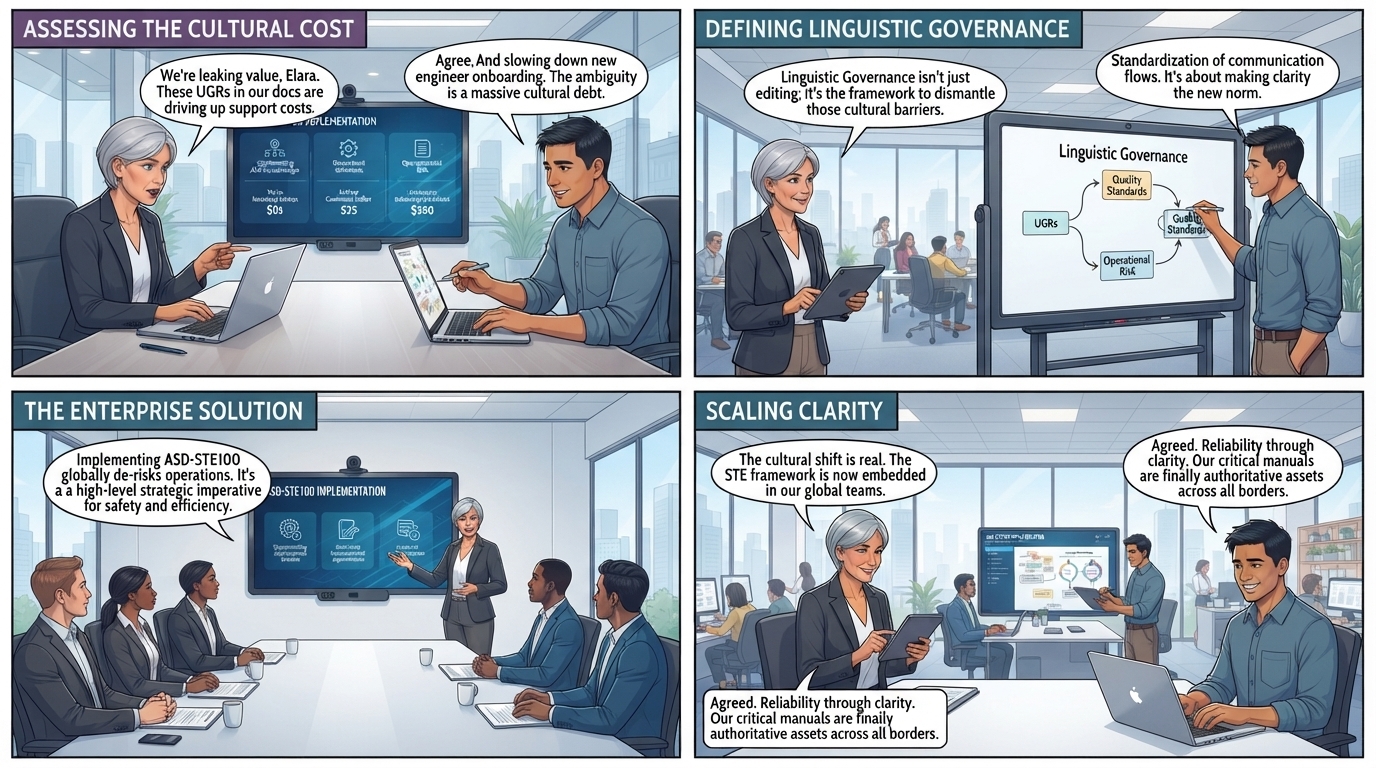
Fixing this requires moving past the superficial view that technical authoring is just a box-checking exercise or a matter of running text through basic grammar software. True risk mitigation demands Linguistic Governance.
Implementing a controlled standard like Simplified Technical English is not merely about enforcing a vocabulary list. It is a systematic cultural and operational intervention that breaks the legacy habit of hiding behind complexity. By restricting a verb to a single meaning, eliminating jargon, and banning ambiguous modifiers, Simplified Technical English forces cross-functional alignment.
When engineering design, technical writing, and field operations operate under a single standard of absolute linguistic clarity, the cultural dynamic shifts. Authors no longer guess what an engineer meant, and technicians no longer gamble on what an instruction implies. It establishes shared ownership over safety-critical data.

Are legacy documentation habits driving up compliance variance in your engineering workflows? Let’s audit your linguistic risk.
🔗 Reserve a 30-min STE Feasibility Session: https://calendly.com/shufranstechdocs/30min
At Shufrans TechDocs, we help aerospace leaders secure total linguistic control over their operations. We move beyond passive software tools by providing expert, human-centric STE training and implementation programmes tailored directly to engineering teams. By standardising technical data at the source, we remove ambiguity to ensure your documentation is accurate for human operators, readable for automated systems, and fully compliant with global safety standards.
UGRs® (Unwritten Ground Rules) was created by Steve Simpson, a registered trademark.


