ASD-STE100 Archives | Shufrans TechDocs Home // ASD-STE100 Archives | Shufrans TechDocs

The Invisible Safety Risk in Aerospace Documentation: Why Clear Grammar Isn’t Enough

The Invisible Safety Risk in Aerospace Documentation: Why Clear Grammar Isn’t Enough

When we think about aviation safety, our minds immediately go to mechanical reliability, strict engineering tolerances, and robust software systems. But there is a silent, less obvious vulnerability hiding inside the technical data layer of the global aviation supply chain, and that is linguistic ambiguity.

Every day, aircraft parts and technical data packages cross international borders. They are reviewed by major national bodies like the FAA and other Civil Aviation Authorities (CAAs), and handled by engineers and technicians worldwide. Yet, the manuals that dictate how these aircraft are maintained are frequently riddled with subjective language that leaves room for dangerous guesswork.

The Danger of “Vague Words” in Instructions for Continued Airworthiness (ICA)

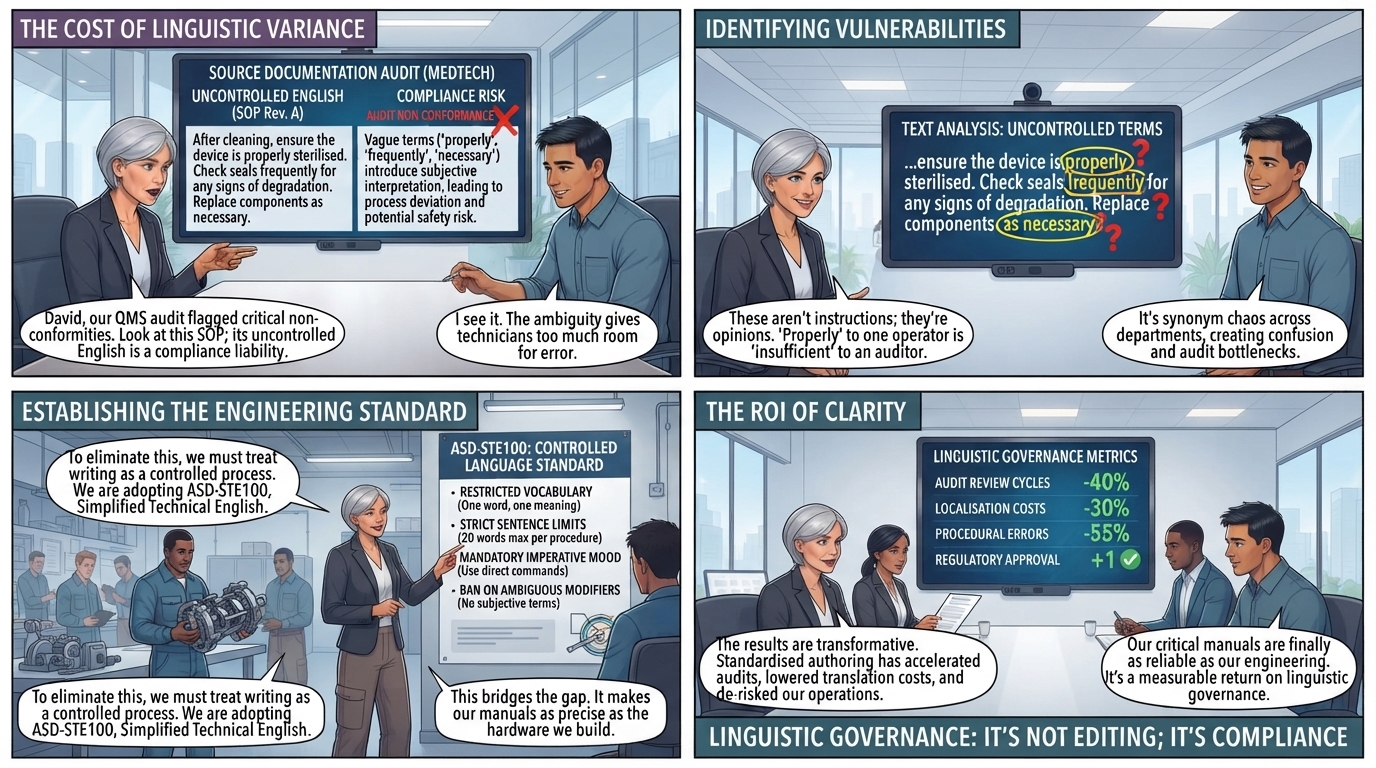
Consider how often words like “appropriate”, “sufficient”, “regularly”, or “carefully” creep into Instructions for Continued Airworthiness (ICA) or service bulletins.

To an author sitting at an OEM headquarters in one country, an instruction to “check the casing regularly for sufficient clearance” might seem perfectly obvious. But to a foreign regulator validating that data, or a local technician on a noisy hangar floor thousands of miles away, those words introduce a massive human guessing game.

What constitutes a “sufficient” check? How often is “regularly”? What passes a safety audit under one jurisdiction can easily be flagged as a compliance failure by another authority during a state-to-state validation process. This linguistic mismatch does more than just create safety blind spots. It causes immediate regulatory friction, bilateral validation backlogs, and costly aircraft return-to-service delays.


Why Software Checkers Aren’t a Silver Bullet

To combat this, many aerospace organisations look for a quick fix by deploying automated grammar checkers. While these tools are excellent at catching typos or banned words, they operate at the very end of the line. They are passive and reactive.

A software checker cannot evaluate whether a maintenance step is logically planned or operationally safe. If an engineer writes a confusing, ambiguous instruction, a checker will simply give you a grammatically correct version of a flawed step. It creates a false sense of compliance.

True risk prevention requires training human authors to think, structure, and write with absolute clarity from the very beginning, before a single word is ever typed into a system.

Preparing the Data Layer for the Next Generation of Tech

This issue is becoming even more critical as aviation authorities evaluate advanced systems, such as automated maintenance tracking and predictive diagnostic tools.

Modern technical documentation is no longer just for human eyes. It serves as the baseline data layer that digital systems read to predict part failures or track maintenance history. If that data layer is filled with inconsistent terminology and vague language, the automated systems get confused. This leads to data errors, hallucinations, and flawed safety conclusions. Standardising language is no longer just a paperwork exercise. It is about future-proofing your data for the next generation of aviation technology.

Eradicating Ambiguity at the Source

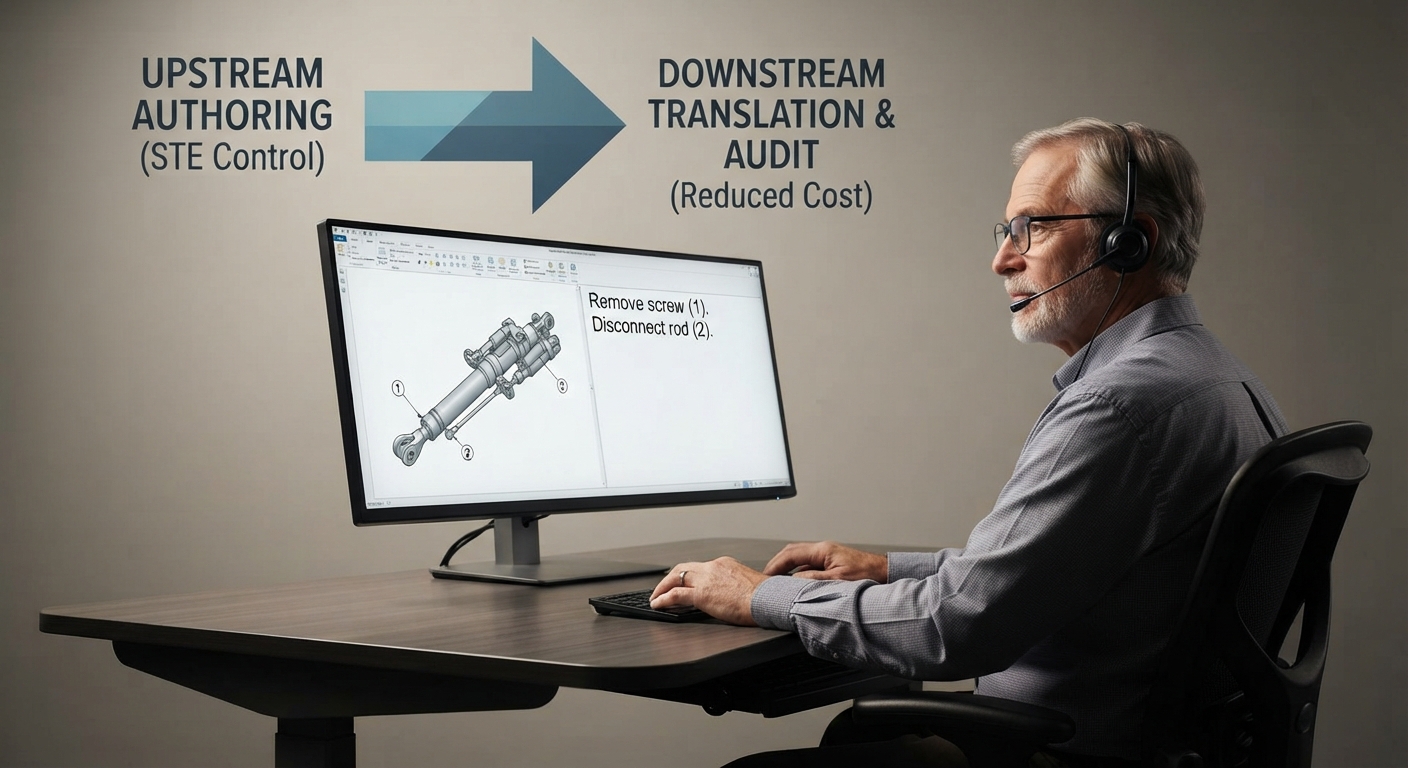
To maintain absolute safety and seamless compliance across borders, the aerospace industry relies on international linguistic standards like ASD-STE100 (Simplified Technical English). STE replaces guesswork with precise metrics, limits words to one specific meaning, and ensures instructions are completely unmistakable.

At Shufrans TechDocs, we help aerospace leaders secure total linguistic control over their operations. We move beyond passive software tools by providing expert, human-centric STE training and implementation programmes tailored directly to engineering teams. By standardising technical data at the source, we remove ambiguity to ensure your documentation is accurate for human operators, readable for automated systems, and fully compliant with global safety standards.

To learn how to eliminate ambiguity from your technical documentation and protect your operational timelines, connect with the team at Shufrans TechDocs.


9 Years Later, a Slice of Cream Cake, and Why ‘Good Enough’ English is a Universal Cognitive Tax

9 Years Later, a Slice of Cream Cake, and Why ‘Good Enough’ English is a Universal Cognitive Tax

Shufrans TechDocs is currently marking a significant milestone as our principal trainer has reached 20 years of delivering technical documentation expertise and training to high-compliance industries. Such milestones prompt reflection on the evolution of linguistic standards. A retrospective look at our archives brought us to a few photographs from February 2017, taken during our ASD-STE100 Simplified Technical English training in Tiel, Holland.

During that session, our team and the participants celebrated the release of STE Issue 7 with a traditional cream cake. Beyond the rigorous application of controlled language rules, our trainer also hosted a traditional tea ceremony to provide a structured intermission from the technical material. These images highlight a persistent challenge, particularly the ongoing friction that technical authors and editors encounter daily when advocating for corporate linguistic governance.

A recent post-implementation review of our 2017 masterclass cohort confirms that a pervasive structural bottleneck remains unaddressed in web governance and software deployment documentation.

Modern software teams frequently use automated systems to extract user documentation directly from source code or system configurations. This process is efficient on paper. However, automated outputs that bypass rule-based linguistic standards consistently default to unstructured, traditional, and ambiguous prose.

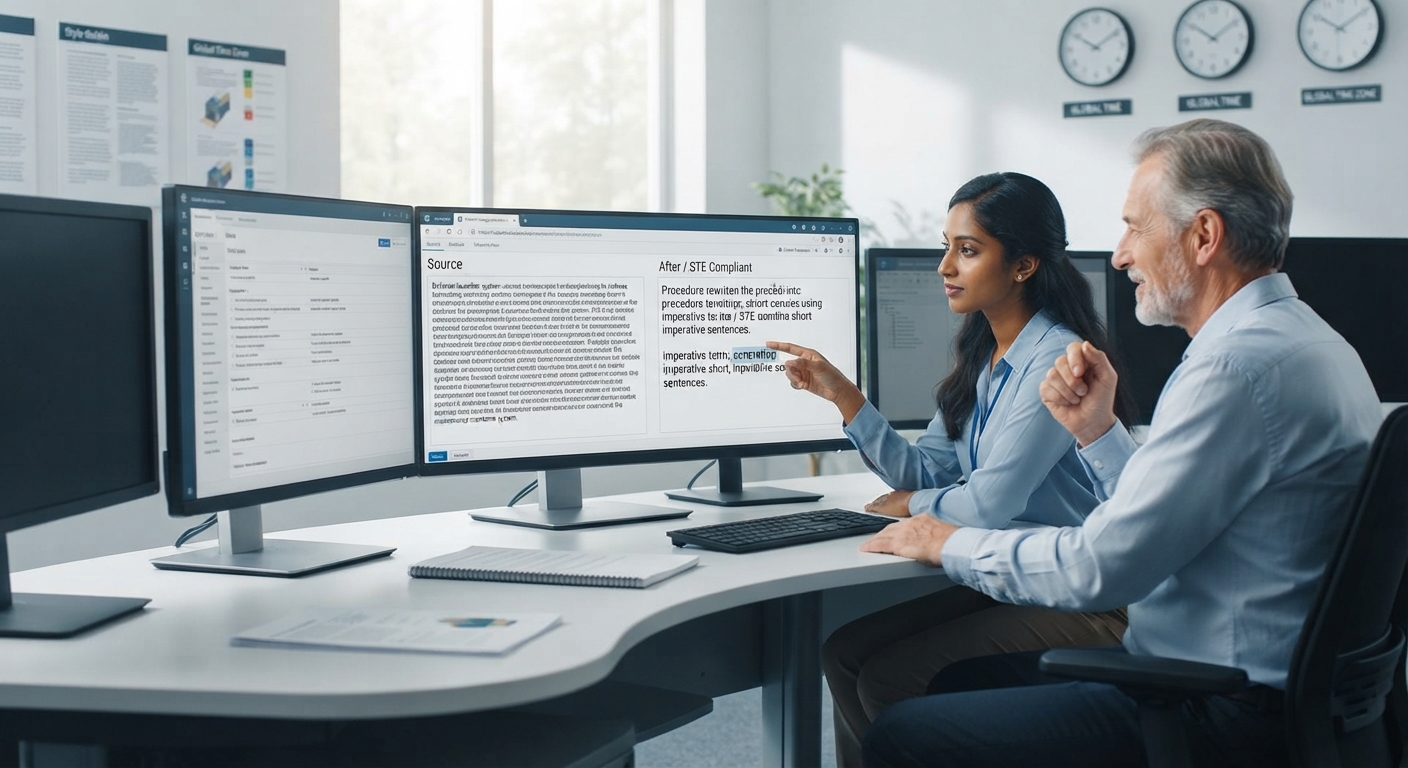
When editors attempt to standardise this text to comply with ASD-STE100 guidelines during peer review, engineering teams often resist. Their argument is predictable: the wording is acceptable because the basic grammar is correct.

For technical communicators and developers managing this friction across globally distributed networks, the following arguments establish the objective business case for controlled language.


A recent post-implementation review of our 2017 masterclass cohort confirms that a pervasive structural bottleneck remains unaddressed in web governance and software deployment documentation.

Modern software teams frequently use automated systems to extract user documentation directly from source code or system configurations. This process is efficient on paper. However, automated outputs that bypass rule-based linguistic standards consistently default to unstructured, traditional, and ambiguous prose.

When editors attempt to standardise this text to comply with ASD-STE100 guidelines during peer review, engineering teams often resist. Their argument is predictable: the wording is acceptable because the basic grammar is correct.

For technical communicators and developers managing this friction across globally distributed networks, the following arguments establish the objective business case for controlled language.

The Reality of the Accessibility Card

Organisations routinely categorise web governance and documentation accessibility as an isolated compliance box, viewing it as a secondary accommodation for users with specific cognitive or physical challenges.

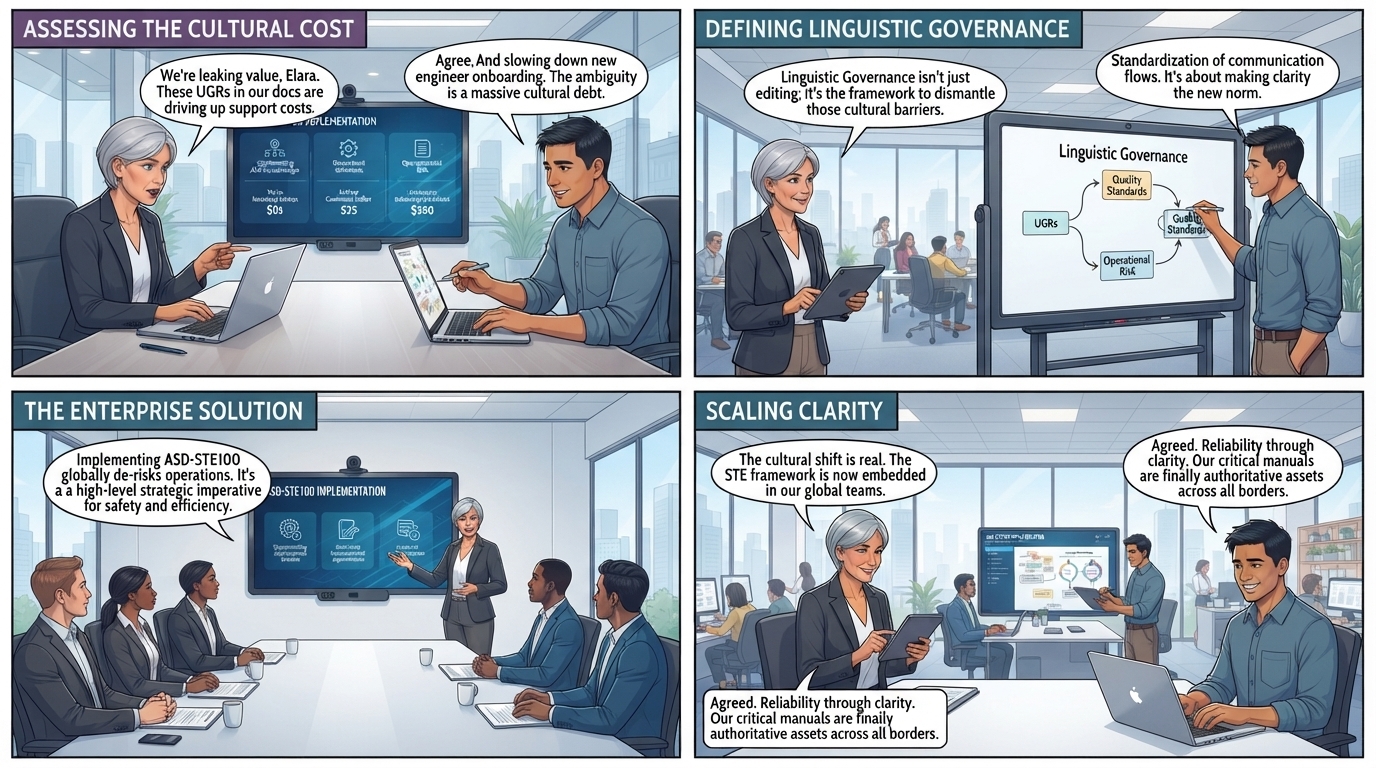
Shufrans TechDocs treats accessibility as a core functional requirement. Ambiguous text imposes a universal cognitive tax on all readers. Whether the user is a native speaker, an international client using English as a second language, or a systems engineer troubleshooting a critical failure under operational pressure, unstructured language forces the human brain to expend extra processing capacity simply to decode intent.

When technical content includes subjective attributes like “appropriate” or “sufficient” or relies on complex, passive structures, it compromises user efficiency. Forcing an operator to interpret meaning constitutes a structural product failure, irrespective of user ability. True accessibility ensures immediate, deterministic comprehension for every user across the global operational ecosystem.

Automation Requires Deterministic Constraints

When development teams automate documentation retrieval from source code, the operational logic driving that text generation must incorporate STE rules as core parameters.

Automated language generators excel at producing fluent prose. However, without deterministic boundaries, these engines systematically introduce rhetorical padding, passive structures, and polysemous verbs. Filtering automated output through a controlled language framework like ASD-STE100 ensures that software documentation remains predictable, standardised, and immediately actionable.

For technical communicators and editors enforcing these standards, linguistic governance is not a pedantic exercise in word choice. It is a necessary mechanism to safeguard data integrity and minimise cognitive strain across the digital enterprise.


The Cost of Creative Writing in Aviation Maintenance: Why Curriculum Integration Beats Passive Distance Learning

The Cost of Creative Writing in Aviation Maintenance: Why Curriculum Integration Beats Passive Distance Learning

In aviation engineering, linguistic clarity is a matter of operational safety and structural efficiency. Yet, a significant gap remains in how the aerospace ecosystem trains both incoming graduates and experienced engineers.

While technical training rightly focuses on avionics, airframe structures, and mechanical precision, the language used to document and maintain these systems is often treated as an afterthought. Engineering professionals frequently enter the workforce relying on standard, expressive English to write maintenance logs, repair reports, and service bulletins.

In a high-stakes MRO (Maintenance, Repair, and Overhaul) environment, linguistic ambiguity is a measurable operational risk. This is why global aerospace relies on ASD-STE100 (Simplified Technical English) to normalise technical data.

Embedding Safety into the Curriculum

Progressive technical training academies are shifting their approach, realising that training in international technical writing standards should not be treated as an afterthought or a post-employment luxury. Instead, they are integrating ASD-STE100 principles directly into basic aviation engineering and avionics curricula, specifically embedding it into foundational technical writing subjects.

By equipping students with these precise text standards from day one of their aviation careers, these forward-thinking academies ensure their graduates are industry-ready. For major MRO providers and aerospace manufacturers, hiring graduates who already understand controlled language provides an immediate operational advantage. It reduces internal training overheads, protects data integrity, and strengthens the maintenance safety chain from the point of entry.

However, achieving successful curriculum integration requires specialised, contextual execution. Applying a mass-market, one-size-fits-all approach to a safety-critical environment introduces distinct failure modes.

Evaluating the Risk of Passive Training Models

When organisations look to adopt ASD-STE100, procurement teams are often faced with a choice between specialist, interactive instruction and high-volume, pre-recorded distance-learning portals. While mass-enrolment online platforms are highly efficient for broad academic theory, data shows they underperform in high-compliance technical environments.

Technical documentation varies drastically across engineering sectors. An avionics curriculum faces entirely different documentation challenges and nomenclature than a heavy maintenance syllabus or a component overhaul pathway.

Evaluating the Risk of Passive Training Models

When organisations look to adopt ASD-STE100, procurement teams are often faced with a choice between specialist, interactive instruction and high-volume, pre-recorded distance-learning portals. While mass-enrolment online platforms are highly efficient for broad academic theory, data shows they underperform in high-compliance technical environments.

Technical documentation varies drastically across engineering sectors. An avionics curriculum faces entirely different documentation challenges and nomenclature than a heavy maintenance syllabus or a component overhaul pathway.

When instructors and engineers are subjected to generic, passive distance learning, several structural gaps emerge:

  • Absence of Technical Context: Universal, “out-of-the-can” modules cannot adapt to complex, proprietary maintenance manuals or specific institutional curriculum frameworks.
  • Lack of Synchronous Feedback: Controlled languages require behavioural change. Without real-time dialogue, learners cannot get immediate correction on their specific writing errors or clear up misinterpretations of the rules.
  • Low Operational Retention: Passive, slide-clicking exercises rarely translate into practical compliance once the engineer or instructor returns to their daily workspace.

To truly transform an aviation curriculum or an engineering team, training must be delivered via dynamic, instructor-led frameworks that use the actual data structures of the institution. Every experience must be customised, not pre-recorded

Safeguarding the Investment: Why Post-Training Support is Critical

Adopting a controlled language standard like ASD-STE100 represents a profound behavioural shift. For educators integrating these principles into a new programme syllabus, or engineers writing live reports, the real test occurs weeks after the workshop concludes. The critical phase happens when a writer is sitting at their desk attempting to restructure lesson plans, design assessments, or rewrite highly complex technical manuals.

Without expert guidance during this transition period, documentation quality frequently degrades, and the initial training investment is lost.

This is why robust, expert-led instruction must be accompanied by an extended operational safety net. Incorporating dedicated, 120-day post-training remote support ensures that as personnel apply STE to live materials, they have access to expert validation and text review. This ongoing quality assurance is what bridges the gap between classroom theory and strict regulatory compliance.

Aviation safety begins with physical precision on the hangar floor, but it is sustained by absolute clarity in the technical record. To safeguard operations and future-proof talent pipelines, the aviation ecosystem must look past the convenience of canned distance education and invest in targeted, interactive precision.

To learn how to eliminate ambiguity from your technical documentation and protect your operational timelines, connect with the team at Shufrans TechDocs.


From Ambiguity to Automation: STE as the Unified Data Standard for Global Operations

From Ambiguity to Automation: STE as the Unified Data Standard for Global Operations

Every major corporation today is investing heavily in Information Science, from advanced data analytics to Large Language Models (LLMs) and Generative AI. The promise is transformation: faster insights, automated content, and seamless global operations.

But there is a critical vulnerability hiding within these investments: the quality of the input data.

An AI is only as reliable as the content it is trained on. If your technical documentation—the core repository of your operational knowledge—is ambiguous, inconsistent, or open to interpretation, your powerful new systems will ingest chaos and produce unreliable outputs.

This is the moment when ASD-STE100 (Simplified Technical English) ceases to be a style guide and becomes an essential strategic necessity.

The Crisis of Unstructured Language and Semantic Drift

The most profound challenge facing modern information systems is semantic drift—when the meaning of a concept changes across departments, regions (like India, Japan, or Europe), or even over time.

  • A software system needs an ontology—a rigorous, explicit system of rules—to define exactly what something is.

  • Human language, by contrast, thrives on synonyms and complex metaphors.

When humans write without discipline, they introduce this semantic chaos: they might use “fix,” “fasten,” “secure,” or “attach” when they mean one precise action. The machine sees four different terms, leading to data inconsistency and compromised machine reasoning

STE: Enforcing the Linguistic Ontology

Simplified Technical English acts as a practical linguistic ontology for your human-generated content. It systematically eliminates ambiguity by enforcing one core principle: One Concept, One Term, One Structure.

STE achieves this semantic order through strict rules:

  1. Controlled Vocabulary: It forces writers to use a dictionary of approved terms, preventing the use of synonyms and ensuring that when you say “SCREW,” you mean one specific thing—and only that thing—every time.

  2. Simplified Syntax: It restricts grammar to simple, active-voice sentences, ensuring that the relationships between subjects, verbs, and objects are always clear, readable, and machine-processable.

This discipline is not about ‘dumbing down’ the content; it’s about engineering the language to be safe, reliable, and consistent for all users—human and machine.

The Strategic Necessity: Ensuring AI ROI

By imposing this semantic order at the source, this STE standard directly enables your global digital strategy:

1. Human-to-Machine (H2M): Guaranteed Clean AI Input

When your new Linguistic Intelligence system (GenAI) is trained on documentation written in STE, it is learning from the purest, most structured data source available. This provides the necessary semantic guardrails to prevent hallucinations and inconsistent outputs, maximising the safety and effectiveness of your multi-million-pound AI investment.

2. Machine-to-Machine (M2M): Seamless Global Interoperability

The consistent terminology enforced by this STE standard allows for seamless mapping across your IT ecosystem. The precise term “VALVE” in the maintenance manual (written in STE) can now be automatically and reliably linked to the corresponding part number in the ERP system and the inventory management database across every operational region.

STE creates the common linguistic layer that connects the entire digital thread, ensuring that different software systems can agree on the meaning of the content.


The Standard as a Core Investment Safeguard

Implementing a global STE standard is not merely a training budget item; it is a core investment safeguard for your digital transformation strategy. It ensures that as any major enterprise scales its digital ambition, the fundamental building blocks of its knowledge—its technical language—are sound, consistent, and ready for automation.

This approach aligns directly with Integrated Product Support (IPS) strategies, ensuring that content clarity supports your system’s entire lifecycle and readiness goals

By implementing STE globally, you are not just making documentation clearer; you are securing the semantic foundation necessary for true operational excellence and global digital reliability.

Don’t let ambiguity compromise your AI investment. Secure the semantic foundation for your digital future by empowering your team with the STE standard.

View our full training calendar and secure your spot here: https://www.shufrans-techdocs.com/events/


AI Data Clarity: The ASD-STE100 Simplified Technical English Mandate

AI Data Clarity: The ASD-STE100 Simplified Technical English Mandate

In mission-critical environments—from deep-sea engineering to air traffic control—the ultimate liability is not hardware failure, but linguistic ambiguity. Before a pilot takes off, a surgeon begins a procedure, or an engineer completes critical maintenance, they rely on language that is objectively clear. Every pre-flight checklist, surgical guide, and maintenance manual is a repository of critical information, demanding absolute trust in the creator’s precision.

In an age where Artificial Intelligence (AI) can instantly generate content, we must ask ourselves: who or what is responsible for that trust?

AI can give you words at the speed of light, but it cannot guarantee the clarity, precision, and safety that its human creators can. The true value of a skilled team today is its ability to provide the guardrails of trust that AI needs to be a reliable partner. This is where a rigorous standard like Simplified Technical English (STE) becomes invaluable.

The Erosion of Trust in Ambiguity

Ambiguity is the enemy of trust. When a sentence has more than one meaning, it introduces doubt. When a piece of equipment is described inconsistently, it creates confusion. In environments where precision is critical, doubt and confusion lead to errors, delays, and compromised safety.

STE is a framework that systematically eliminates this ambiguity. It’s not just about a list of approved words or a set of rules; it’s about a disciplined mindset that ensures every sentence is a direct, unambiguous statement of fact. This discipline is what builds an unshakeable foundation of trust between the creator of the documentation and the person who relies on it.

Your Team: The Architects of Trust

In the AI era, your in-house team is not just a group of writers; they are the architects of trust. They are the essential human element that provides:

  • Subject Matter Expertise: The engineer knows the machine’s inner workings. The technical writer understands how to translate that knowledge into a clear instruction. An AI can’t do this on its own. It requires a skilled professional to guide it, to vet its output, and to confirm that the final document is technically sound.

  • Ethical and Safety Judgment: An AI has no moral compass. It cannot weigh the potential risk of a poorly-worded instruction. Your team, trained in STE, can. They are equipped to identify where a small ambiguity could lead to a large problem.

  • Consistency and Control: STE gives your team a universal standard. Regardless of who is writing, reviewing, or editing, the documentation will have a single, unified voice of clarity and authority. This consistency, enforced by people, is a key component of a reliable system.


A Unified Team, A Unified Standard

The greatest value of STE is realised when it becomes a standard embraced by your entire team. Engineers, technical writers, and instructional designers all contribute to the final product. By adopting a common, disciplined language, they ensure a seamless flow of information from design to documentation to user implementation.

This is a strategic asset that has been proven to work for global leaders like M-Files and Akamai Technologies, who have transformed their communication into a strategic advantage that reduces risk and builds confidence with every document they create.

The strategic value of STE extends beyond error reduction; it serves as a foundational layer for ontology engineering. By enforcing a controlled vocabulary and a consistent syntax, STE transforms technical documentation into a clean, structured data source. This linguistic standardisation prevents semantic drift—where terms are interpreted inconsistently across departments or systems. For large organisations investing in knowledge graphs and AI-driven content analysis, this ontological clarity translates directly into significant cost savings, drastically cutting the time and resources needed for data harmonisation and machine learning training prep.

Take the Next Step to Building Trust

The future of technical communication is not about technology replacing people, but about people mastering technology to build safer, more reliable systems. It’s about using the power of AI while ensuring that the final output is held to the highest standard of human accountability.

Equip your team with the indispensable skills they need to be the guardians of clarity and the architects of trust. Join one of our upcoming online training sessions and give your team the critical advantage of ASD-STE100 proficiency.

Secure your spot in our upcoming October training sessions:

To learn more and begin your journey towards a more robust digital future, we invite you to explore the international standard and its practical application at www.asd-ste100.net.

Contact us today to explore how a partnership with Shufrans TechDocs can elevate your team to the next level of STE mastery.

🗓️ View our training calendar.

www.shufrans.com


Precision in Practice: Why Live Expertise Is the Future of Simplified Technical English training

Precision in Practice: Why Live Expertise Is the Future of Simplified Technical English training

In technical communication, precision is not just a preference; it is a professional and often safety-critical requirement. Mastering a discipline like Simplified Technical English (ASD-STE100) is a crucial step for any organisation committed to clear, unambiguous documentation. But how do you choose a path to true mastery?

For decades, the standard for professional training was a live, in-person experience—an environment where expertise was directly transferred, questions were answered in real time, and true skills were forged. While the digital age has made some knowledge accessible through pre-recorded sessions, true skill is not passively absorbed. It is forged through active engagement, nuanced feedback, and a dynamic exchange of expertise. The self-guided nature of asynchronous learning, while convenient, can often lack the critical components necessary for deep understanding and lasting proficiency.

The Invaluable Dynamic of Live Interaction

At Shufrans TechDocs, we believe that mastery is an art form best perfected through one-to-one guidance. Our approach is built on a 100% live, instructor-led, interactive training experience designed to transform your understanding from theoretical knowledge into applied skill.

Our sessions are structured as workshops, not lectures. You’ll work directly with a certified STE tutor, actively rewriting your own documentation and receiving instant, constructive feedback. We’ll answer your questions on the spot, clarify complex rules in the moment, and tailor the content to the specific challenges you face in your role. This hands-on, collaborative environment ensures you not only understand the rules but can confidently apply them to your work.

More Than Just a Course: The Shufrans Advantage

Choosing a training provider is a strategic decision, not just a transaction. In contrast to academic, self-paced courses that rely on pre-recorded videos and passive learning, our workshops demand your active participation. You are not just a viewer; you are a practitioner.

Furthermore, while some providers offer training built around a single software tool, we focus on empowering the writer. Our goal is to instil a foundational, human skill set that can be applied to any content or system, with or without a checker. This enduring expertise will outlast any software trial or subscription. The proficiency you gain in our sessions is truly yours for a lifetime.

Your Journey Doesn’t End with the Course

What happens when you’ve finished the training and are back at your desk, facing a challenging document? This is where many courses leave you high and dry.

That’s why our commitment to your success extends far beyond the final lesson. With every course, we provide 120-day post-training support, providing you with an invaluable safety net. This means you can continue to get expert guidance, ask follow-up questions, and seek help with real-world documentation challenges for months after your training is complete.

Global Reach, Local Convenience

We understand that technical teams are often spread across the globe. To accommodate your schedule and ensure a seamless learning experience, our live training workshops are offered across four different timezones: Europe, North & South America, Middle East & Africa, and Asia Pacific. You can choose the session that best fits your team’s location, allowing for real-time collaboration without the logistical headache.


An Investment in Your Team’s Excellence

Choosing a training provider is an investment in your team’s future. When you opt for live, interactive training, you are choosing more than a course—you are investing in a deeper, more profound learning experience.

Our training is designed around the core principles of ontology and schema. We believe that for every concept, there is a clear, single definition. This approach ensures that your team develops a shared mental model of every topic, from basic procedures to complex technical terms. The certification we provide is a testament to your skills and a distinction that is yours for a lifetime.

With Shufrans TechDocs, you empower your team with a globally recognised skill set, the confidence of a live tutor’s expertise, and a support system that lasts well beyond the final workshop.

Contact us today to explore how a partnership with Shufrans TechDocs can elevate your team to the next level of STE mastery.

🗓️ View our training calendar.

www.shufrans.com


VMI Group: Standardising Content for Enhanced Operational Excellence in High-Tech Machinery with Simplified Technical English

VMI Group: Standardising Content for Enhanced Operational Excellence in High-Tech Machinery with Simplified Technical English

Transforming Technical Communication and Training for Global Efficiency in Manufacturing

Client: VMI Group (Global Operations)

Industry: High-Tech Machinery (Tyre, Rubber, Can, and Care Industries)

Location: Epe, The Netherlands (On-site Training)

Challenge: Ensuring consistent, unambiguous technical documentation and training materials across diverse global teams and specialised functions within a complex machinery manufacturing environment.

Solution: A focused, three-day ASD-STE100 training and masterclass delivered by Shufrans TechDocs to a mixed group of technical communication and instructional design professionals. The third day was exclusively for masterclass participants who had previously completed an STE course.

Results: Enhanced clarity in documentation, improved efficiency in content creation, and strengthened precision in training delivery, directly impacting product lifecycle support and global communication.


The Challenge: Precision in a World of Complex Machinery

VMI Group stands as a global leader in designing and manufacturing high-tech machinery for demanding industries, including tyre, rubber, can, and care products. Their sophisticated equipment requires technical documentation and training materials of the highest clarity and precision to ensure operational safety, efficient maintenance, and effective knowledge transfer across their worldwide customer base and internal teams.

However, as with many global enterprises dealing with intricate technology, VMI Group faced the challenge of maintaining absolute consistency and unambiguous language across their varied documentation outputs. This complexity was compounded by a diverse team of professionals involved in content creation, including:

  • Instructional Designers & Curriculum Developers: Responsible for creating training materials that must be universally understood by operators and technicians.
  • Technical Writers & Senior Technical Writers: Tasked with authoring detailed manuals, specifications, and service guides for highly specialised machinery.
  • Linguists: Critical for ensuring accuracy in content that would inevitably be translated for international markets.
  • Engineers: Providing essential technical input that needed to be integrated into clear, actionable documentation.

Inconsistencies or ambiguities in any part of this documentation chain could lead to inefficiencies, rework, increased translation costs, and, crucially, potential operational errors in the field.


The Solution: Shufrans TechDocs’ Tailored STE Training & Masterclass

VMI Group partnered with Shufrans TechDocs for a comprehensive, three-day ASD-STE100 training and masterclass. Understanding the mixed bag of roles and diverse work areas (including extrusion processes) involved, Shufrans TechDocs delivered a programme designed to provide both foundational STE principles and advanced application for VMI Group’s specific needs.

The training was structured as follows:

  • Days 1 & 2 (Core STE Training): Covered fundamental STE principles, writing rules, and controlled vocabulary. This section was open to all participants.
  • Day 3 (Masterclass for Advanced Participants): Exclusively for individuals who had previously completed an STE course, this session delved into more complex scenarios, nuanced application, and advanced best practices for implementing STE across varied technical content.

The training emphasised practical application, utilising VMI Group’s own documentation examples where relevant, to ensure immediate and tangible skill transfer. Shufrans TechDocs’ expertise in ASD-STE100 ensured that VMI Group’s teams were equipped with the latest standards and best practices.

The Results: Unifying Communication, Enhancing Operational Excellence

By undertaking the ASD-STE100 training and masterclass with Shufrans TechDocs, VMI Group achieved measurable advancements in its technical communication:

  • Enhanced Documentation Clarity: All participants gained a unified understanding and application of STE, drastically minimising ambiguity in their technical documents and training materials. This directly translates to safer and more efficient machine operation and maintenance.
  • Improved Content Efficiency: Technical writers and instructional designers could create content more quickly and with greater consistency, reducing drafting time and internal review cycles.
  • Optimised Translation Workflows: Linguists gained highly consistent and unambiguous source text, leading to faster, more accurate, and more cost-effective translations for VMI Group’s global reach.
  • Stronger Cross-Functional Understanding: Engineers and field experts, now familiar with STE, could provide more precise input, fostering better collaboration with documentation teams.
  • Accelerated Professional Development: The training upskilled a broad range of professionals, enhancing their capabilities in critical communication, which is vital for continuous improvement in a high-tech manufacturing environment.

VMI Group’s investment in STE training with Shufrans TechDocs has proven to be a strategic move, empowering their teams to produce clear, consistent, and highly effective technical documentation and training materials, thereby supporting their commitment to innovation and global operational excellence.

If your organisation faces similar challenges in global technical communication, discover how Shufrans TechDocs can help. Learn more about our ASD-STE100 training and consulting services:

🗓️ View our training calendar.

www.shufrans.com

Weatherford: Optimising Global Communication in Oilfield Services with STE

Weatherford: Optimising Global Communication in Oilfield Services with STE

Driving Unambiguous Communication for Enhanced Safety and Efficiency in Global Onshore Operations

Client: Weatherford (Global Operations)

Industry: Onshore Drilling & Energy Services

Location: Global (Online Training across Europe, US & Canada, APAC timezones)

Challenge: Ensuring consistent, unambiguous, and safe technical communication across diverse global teams and critical documentation, particularly concerning complex onshore drilling operations and other highly sensitive well completion activities.

Solution: Multiple batches of online ASD-STE100 training programmes delivered by Shufrans TechDocs, tailored for professionals across various timezones.

Results: Improved clarity and precision in technical documentation, enhanced safety protocols for critical operations, streamlined global communication, and professional development for a diverse range of technical roles.


The Challenge: Precision in High-Stakes Global Operations

Weatherford, a prominent global energy services company, operates at the forefront of onshore drilling and well completion. In such a high-stakes environment, which often involves highly sensitive downhole operations, the clarity and accuracy of technical documentation are not merely regulatory requirements but fundamental pillars of safety, operational efficiency, and environmental responsibility.

Maintaining a unified standard of communication across a globally dispersed workforce, with teams operating in different time zones (Europe, US & Canada, APAC), presents a significant challenge. Ambiguity in crucial documents, especially those related to complex drilling procedures or sensitive well completion activities, could lead to:

  • Serious safety incidents or operational errors.
  • Increased downtime and costly operational inefficiencies.
  • Misinterpretations during complex well interventions.
  • Challenges in compliance with diverse international regulations.
  • Difficulties in efficient knowledge transfer and training.

Weatherford sought a scalable solution that could standardise their technical language, ensuring every instruction was understood unambiguously, regardless of the reader’s location or native language, with particular emphasis on the critical safety aspects of their operations.

The Solution: Targeted Online STE Training for a Global Workforce

Shufrans TechDocs partnered with Weatherford to implement a comprehensive ASD-STE100 training programme delivered entirely online, accommodating their global presence and various time zones. This approach ensured accessibility and consistency across their international teams. The training was delivered in multiple batches for participants from Europe, the US & Canada, and the APAC regions.

While a significant portion of the participants were engineers, the training was highly beneficial for several other key roles crucial to Weatherford’s operations:

  • Technical Writers/Documentation Specialists: Direct authors of manuals and procedures, ensuring consistency and clarity from the source.
  • Field Service Technicians/Operators: Directly implement procedures; clear instructions are paramount for safe and effective high-risk operations.
  • Safety Officers/Compliance Specialists: Ensure adherence to safety protocols and regulatory standards, benefiting from unambiguous documentation.
  • Training & Development Personnel: Responsible for creating clear and effective training materials for new hires and ongoing professional development.
  • Supply Chain & Logistics Personnel: Who interpret specifications for equipment and materials, where precision avoids errors in ordering and handling.


The training focused on real-world application, working on the types of documents most critical to Weatherford’s operations:

  • Drilling Procedures & Protocols: For various onshore drilling techniques, ensuring step-by-step clarity.
  • Safety Procedures & High-Risk Operation Manuals: Covering all critical safety aspects, including the precise handling of specialised and sensitive materials used in well completion.
  • Tool Operation & Maintenance Manuals: For specialised drilling tools and equipment.
  • Technical Specifications & Data Sheets: Ensuring precise definitions for components and performance characteristics.
  • Emergency Response Procedures: Where immediate and clear understanding can mitigate severe risks.
  • Field Service Reports: For consistent and accurate reporting of observations and actions from the field.

The Results: Elevated Clarity, Enhanced Safety, and Optimised Global Operations

By embracing ASD-STE100 online training with Shufrans TechDocs, Weatherford achieved significant improvements across its technical communication landscape:

  • Enhanced Safety & Reduced Risk: The primary benefit, especially for sensitive and high-risk operations, was a drastic reduction in ambiguity, leading to clearer, safer operational procedures and a lower risk of misinterpretation.
  • Improved Operational Efficiency: Clearer procedures streamlined onshore drilling operations, reducing downtime and costly errors.
  • Strengthened Global Consistency: A unified language standard ensured that documentation was consistently understood by diverse teams worldwide, regardless of geographical location or native language.
  • Optimised Knowledge Transfer: Training materials became more effective, accelerating the onboarding of new personnel and improving ongoing professional development for all technical roles.
  • Facilitated Compliance: Adherence to STE principles supported compliance with stringent industry regulations and safety standards globally.

Weatherford’s investment in STE training has transformed their technical documentation into a strategic asset, reinforcing their commitment to safety, efficiency, and operational excellence across their global onshore drilling and energy services.

If your organisation faces similar challenges in achieving uncompromising clarity and operational readiness through precise communication, discover how Shufrans TechDocs can help. Learn more about our ASD-STE100 training and consulting services:

🗓️ View our training calendar.

www.shufrans.com


The Strategic Clarity of Simplified Technical English: Why Less Grammar Means More Precision

The Strategic Clarity of Simplified Technical English: Why Less Grammar Means More Precision

In the complex world of technical documentation, the pursuit of clarity is paramount. Yet, many still perceive “simplified” language as a reduction in sophistication. However, for those familiar with ASD-STE100 Simplified Technical English (STE), its precisely defined grammar—particularly the constrained use of verb tenses—is not a limitation, but a powerful feature designed to eliminate ambiguity and minimise errors.

At the heart of STE’s effectiveness is its disciplined approach to verb tenses. Unlike the vast array of options in general English, STE limits writers to a specific, unambiguous set: Present Tense, Past Tense, Infinitive, Future Tense, Past Participle (used as an adjective), and the Imperative. This intentional restriction drives immense benefits across an organisation, impacting everything from operational efficiency to strategic communication.

Precision for the Front Lines: How Limited Tenses Empower Technicians and Engineers

For the individuals directly interacting with products, machinery, and complex systems—your technicians and engineers—the clarity afforded by STE’s simplified tenses is transformative. When every instruction must be perfectly understood, ambiguity can lead to costly errors, safety hazards, and downtime.

  • Reduces Ambiguity: Complex or rarely used tenses in general English can lead to different interpretations, especially for non-native English speakers. By using simpler, direct tenses, STE ensures that instructions in maintenance manuals, operational procedures, and troubleshooting guides are understood universally and unequivocally. “PRESS THE START BUTTON” leaves no room for doubt about the action or its timing.
  • Faster Comprehension: Less cognitive load means quicker understanding. Engineers and technicians can rapidly grasp instructions without needing to parse intricate grammatical structures, leading to more efficient task execution.
  • Minimises Operational Mistakes: Clear, unambiguous commands directly translate to fewer errors in the field. This is critical in safety-sensitive industries, where a single misinterpretation can have severe consequences. Simplified tenses mean the intent of the author is preserved, every time.
  • Improved Efficiency: Time spent deciphering poorly written documents is time wasted. STE’s simplified tenses enable a smooth workflow, allowing technical staff to focus on their core tasks rather than struggling with linguistic complexities.

Elevating Insights: STE in White Papers and Technical Reports 

There’s a common misconception that simplification equates to “dumbing down” content, particularly in high-level documents like white papers and technical reports where managers seek sophistication. However, the true sophistication in such documents lies in precision, conciseness, and impactful clarity, not linguistic embellishment. STE’s principles, including its tense limitations, enhance these qualities.

  • Enhanced Precision: By advocating for direct statements and avoiding vague phrasing, STE encourages writers to express technical concepts with utmost accuracy. This avoids misinterpretation of data, findings, or recommendations. A report written in STE is lean, impactful, and analytically rigorous, free of unnecessary complexity.
  • Improved Readability for Decision-Makers: Managers and executives are busy. They need to quickly extract key insights and make informed decisions. Reports that are direct, factual, and easy to consume—thanks to simplified tenses and consistent vocabulary—facilitate faster understanding, leading to more timely and effective strategic choices.
  • Stronger Argumentation: When ideas are presented with unambiguous language, arguments become more compelling and defensible. The focus shifts from deciphering the writing style to understanding the presented facts and analysis.
  • Increased Credibility: Documents free from grammatical slips, awkward phrasing, or linguistic ambiguities inherently appear more authoritative and trustworthy. This bolsters the credibility of the presented technical concepts and the expertise of the authors.

Broadening Reach: The Usefulness of STE in Marketing and Corporate Communication

While STE is a controlled language for technical documentation, its underlying principles of clarity, conciseness, and consistent messaging are invaluable in broader communication contexts for technical industries and businesses. Applying STE’s ethos to marketing and corporate communications can significantly enhance their effectiveness.

  • Marketing & Product Communication: For technical products, clearly articulating features and benefits to a diverse audience (both technical and non-technical) is crucial. Simplified language in marketing materials, product descriptions, and user guides ensures that the value proposition is immediately understood, reducing customer support queries and increasing user adoption.
  • Consistent Brand Voice: Adopting a “simplified English” approach, informed by STE principles, ensures a consistent and approachable voice across all internal and external communications. This is particularly important for global companies where messaging can get diluted or misinterpreted across different regions and languages.
  • Enhanced Internal Communication: From HR policies to inter-departmental memos and internal training materials, applying principles of clarity and conciseness ensures that all employees—regardless of their primary language or technical background—understand critical information, fostering a more efficient and cohesive workforce.

The Verdict: Strategic Simplicity for a Complex World

The strength of ASD-STE100 Simplified Technical English lies not in dumbing down complex ideas, but in stripping away linguistic barriers that hinder comprehension and introduce errors. Its disciplined approach to verb tenses is a prime example of how structured simplification leads to profound gains in clarity, accuracy, and efficiency across an entire organisation. From the factory floor to the boardroom, and across your marketing efforts, leveraging STE is a strategic investment that pays dividends in reduced costs, improved safety, and enhanced global reach.

Ready to unlock the full potential of your organisation’s knowledge assets? Explore Shufrans Techdocs worldwide online instructor-led training sessions. We equip your professionals with the practical skills to implement STE, enabling them to create precise, compliant, and highly effective documentation. Plus, you’ll benefit from 120 days of post-training support to ensure lasting success.


Ready to explore how human expertise and strategic frameworks like STE can elevate your technical communication? Connect with Shufrans TechDocs today.

🗓️ View our training calendar.

www.shufrans.com

Shufrans TechDocs Reinforces Commitment to Practical, Experience-Led Simplified Technical English (STE) Training

Shufrans TechDocs Reinforces Commitment to Practical, Experience-Led Simplified Technical English (STE) Training

FOR IMMEDIATE RELEASE

SINGAPORE – 10 June 2025 – Shufrans TechDocs today reaffirmed its position as a leading provider of expert-led training in ASD-STE100 Simplified Technical English, emphasising a profound commitment to practical, real-world application, honed over two decades of dedicated experience.

At the core of Shufrans TechDocs’ unique offering is the extensive, hands-on experience of its lead trainer, Ms. Shumin Chen, Head of ASD-STE100 Simplified Technical English training & implementation, whose journey in applying STE principles began in 2006. This foundational knowledge, cultivated directly within complex technical environments, significantly predates many contemporary certification frameworks, providing a depth of practical insight that is unparalleled.


“Our mission at Shufrans TechDocs has always been to empower technical communicators with truly actionable skills,” says Shumin. “My 20 years in the field have taught me that effective STE isn’t just about rules; it’s about practical application that makes a tangible difference in documentation clarity, efficiency, and global translatability. Our training programmes reflect this real-world perspective, moving beyond theoretical concepts to deliver immediate, impactful results for our clients.”

Shufrans TechDocs’ training methodology is distinguished by:

  • Decades of Practical Expertise: Leveraging over 20 years of direct, on-the-job experience in applying STE. This deep, real-world grounding ensures that our training is informed by actual industry challenges and effective solutions.
  • Focus on Actionable Skills: Ensuring participants gain concrete techniques they can implement immediately. Our programmes are designed to move beyond theory, providing practical methodologies that lead to instant improvements in documentation quality.
  • Enhanced Clarity and Readability: Enabling clients to produce documentation that is unambiguous and easy to understand. This commitment to precision helps prevent misinterpretation, reducing errors and improving user safety and efficiency.
  • Improved Global Communication: Facilitating more efficient and accurate translation processes. By simplifying the source language, we help organisations achieve consistent messaging and reduce translation costs significantly across diverse markets.

By focusing on battle-tested methodologies and genuine expertise, Shufrans TechDocs continues to be the trusted partner for organisations seeking to achieve superior technical communication standards.

About Shufrans TechDocs: Shufrans TechDocs is a specialist consultancy providing expert training and services in Simplified Technical English (ASD-STE100). With a focus on practical application and real-world results, Shufrans TechDocs empowers organisations to enhance the clarity, precision, and efficiency of their technical documentation.