August 2026 | Shufrans TechDocs Home // August 2026 | Shufrans TechDocs

Who Owns the Regulatory Content in Your Product Manuals?

Who Owns the Regulatory Content in Your Product Manuals?

Product manuals and instructions for use carry dozens of items that exist simply because a regulation demands them. When a company ships products to more than ten markets, certification marks, warning texts, and disposal notices multiply into hundreds of combinations. If an organisation does not maintain strict governance over these items, a single rule change can take days just to scope out, and omissions usually surface only at customs or during market surveillance when the cost of fixing them has already escalated.

The Hidden Cost of Linguistic Ambiguity in Manuals

While regulatory compliance is often treated as a logistical checklist, the root cause of most compliance failures is linguistic. Standard English is full of nuance, synonyms, and subjective phrasing that invites misinterpretation. When technical authors write warning notices, installation steps, and safety directives without strict controls, they create hidden liabilities. Translators struggle to find exact equivalents, local authorities raise flags over vague compliance text, and end users face safety risks.

Why ASD-STE100 is a Proven Regulatory Control Mechanism

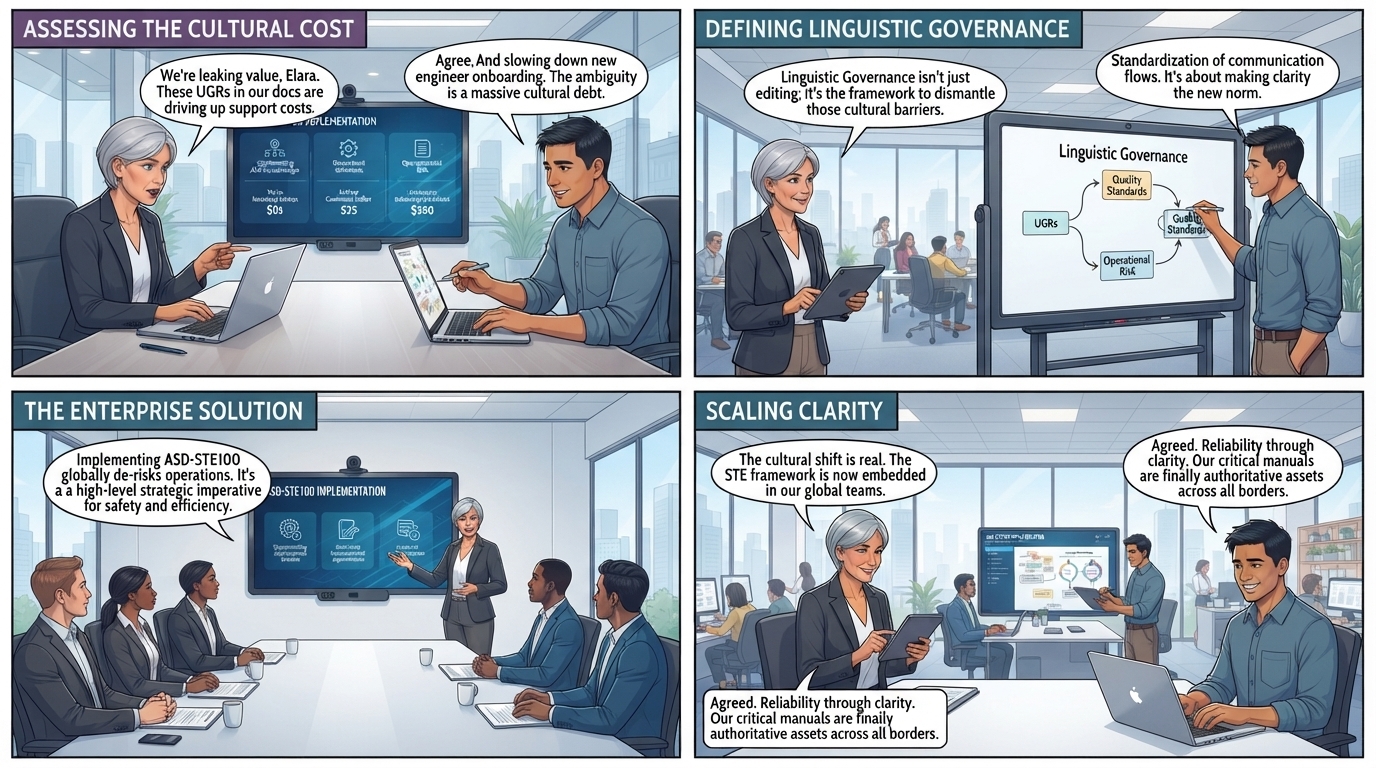
To solve this, companies need more than a content repository. They need strict linguistic governance. ASD-STE100 (Simplified Technical English) was specifically designed to eliminate ambiguity in complex technical documentation.

  • Controlled vocabulary restricts words and enforces rigid grammatical rules so that every sentence has one unambiguous meaning.

  • Reduced translation friction ensures that standardised source text translates cleanly into multiple languages, eliminating the costly iterations and review cycles that plague multi-market product manuals.

  • Agile regulatory updates allow documentation teams to update precise terminology at the source without rewriting entire manuals when regulations change across global markets.

The Training Delivery Standard

High-compliance industries do not need software shortcuts or generic grammar checklists. They require rigorous, proven linguistic architecture. Shufrans TechDocs delivers the professional implementation and mastery standards required for organisations to embed ASD-STE100 permanently into their operations.

  • Master the definitive specification through structured, industry-proven training tailored for engineering and technical documentation leaders.

  • Eliminate costly ambiguities at the authoring source to protect your products against customs delays and compliance hazards.

  • Streamline global localisation by turning product manuals into clean, audit-ready assets.

When technical documentation is engineered for absolute clarity, the entire compliance workflow changes. Instead of treating manuals as an afterthought or a last-minute scramble before product launch, engineering teams gain a predictable mechanism that scales effortlessly across international borders. Every warning label, safety instruction, and compliance notice becomes structurally immune to local misinterpretation.

Ultimately, investing in rigorous linguistic standardisation protects your bottom line by removing friction from every stage of the product lifecycle. By bridging the gap between complex regulatory mandates and precise authoring standards, your organisation ensures that compliance is no longer a recurring operational risk, but a seamless competitive advantage.

At Shufrans TechDocs, we help aerospace leaders secure total linguistic control over their operations. We move beyond passive software tools by providing expert, human-centric STE training and implementation programmes tailored directly to engineering teams. By standardising technical data at the source, we remove ambiguity to ensure your documentation is accurate for human operators, readable for automated systems, and fully compliant with global safety standards.

To learn how to eliminate ambiguity from your technical documentation and protect your operational timelines, connect with the team at Shufrans TechDocs.


Why Structured Language Outperforms AI Guesswork

Why Structured Language Outperforms AI Guesswork

Every time a new AI tool hits the market, the conversation shifts to what software can automate. We talk about translation speeds, draft generation, and automated summaries. We rarely talk about what happens when you feed messy, ambiguous documentation into a machine and let it scale your worst habits across every market you serve.

In sectors where a single maintenance error can shut down an entire rail network or ground a fleet, the challenge is no longer about generating more content. It is about control.

The Automation Trap

Organisations rushing to digitise legacy manuals or deploy automated translation workflows often assume technology will fix messy writing on the fly.

It does the exact opposite.

Generative tools amplify whatever they are given. If your source text is bloated, contradictory, or packed with local jargon, an AI model or machine translation engine will faithfully reproduce those flaws at scale, turning minor linguistic slips into systemic operational risks. When procedures span multiple languages and cross-border engineering teams, ambiguity is not just poor style, it is a financial and operational liability.

Why Structured Language Outperforms AI Guesswork

Engineering is deterministic. A technician on a shop floor or a mining site does not need a probable interpretation of a maintenance procedure. They need absolute clarity.

Controlling how technical information is authored solves this at the root:

  • Machine Readiness: Clean, rule-based source text is the only reliable foundation for AI training and automated localisation.
  • Zero Cognitive Load: Global teams and non-native speakers execute complex assembly and troubleshooting tasks faster when instructions leave zero room for guesswork.
  • Risk Mitigation: Standardised authoring rules eliminate the vague phrasing that causes costly downtime, equipment damage, and compliance failures.

Training for the Age of AI

Software cannot take legal liability for a failed maintenance procedure. The technical writers, engineers, instructional designers, and editors who govern your documentation remain the critical gatekeepers of your bottom line.

If your teams are building out AI workflows without first tightening the quality of their source communication, you are simply automating errors. Investing in structured language training for engineers, writers, and translators ensures your operations stay resilient, compliant, and profitable in an automated world.

Are your teams relying on AI to fix bad documentation, or are you building the linguistic standards required to make automation actually work? Let’s discuss how targeted training can future-proof your operations.

🔗 Reserve a 30-min STE Feasibility Session: https://calendly.com/shufranstechdocs/30min

At Shufrans TechDocs, we help aerospace leaders secure total linguistic control over their operations. We move beyond passive software tools by providing expert, human-centric STE training and implementation programmes tailored directly to engineering teams. By standardising technical data at the source, we remove ambiguity to ensure your documentation is accurate for human operators, readable for automated systems, and fully compliant with global safety standards.

To learn how to eliminate ambiguity from your technical documentation and protect your operational timelines, connect with the team at Shufrans TechDocs.


The Cost of Loose Language: Why Technical Documentation Fails at Scale

The Cost of Loose Language: Why Technical Documentation Fails at Scale

Across complex industrial operations—from commercial aerospace maintenance and energy plants to international engineering projects—the most persistent operational risk is rarely mechanical failure. It is linguistic failure.

When a manual instruction leaves room for interpretation, the human mind fills the gap. In high-stakes environments, that subjective judgment call turns into extended review cycles, execution variance, and heavy financial or safety exposure.

The Weight of Unspoken Words

Modern engineering ecosystems grow denser by the day. Complex supply chains span continents, multi-agency teams collaborate on technical missions, and field technicians execute intricate repairs under severe time pressures. Yet, the foundational medium connecting these moving parts remains human language.

When documentation relies on stylistic flair, varied vocabulary, or loose sentence structures, it creates a hidden cognitive tax. If three different technicians can interpret a single maintenance directive in three different ways, the system is fundamentally broken at the root.

The Root Cause of Operational Friction

In many organisations, technical writing is treated as an afterthought rather than a core engineering asset. Engineers focus heavily on the physical design or the software architecture, leaving the accompanying documentation to individual writing styles.

This decentralized approach leads to fragmented terminology across manuals, service bulletins, and training guides. Over time, these small inconsistencies accumulate, creating massive bottlenecks when teams try to scale their operations globally or onboard new partners.

What Linguistic Governance Solves

True operational efficiency begins with strict linguistic discipline. Proven frameworks like the ASD-STE100 specification strip away ambiguity. By enforcing a controlled vocabulary and strict structural rules, technical communication moves from an art form to a precise engineering instrument.

  • Eliminating Execution Variance: Clear procedures ensure that a technical instruction means precisely the same thing in Singapore, Copenhagen, or Toulouse.
  • Reducing Review Friction: Standardised writing cuts through endless editorial loops, allowing technical outputs to reach the field faster.
  • Protecting Operational Integrity: Precision in writing directly protects safety margins, ensuring that critical steps in MRO and energy plants leave zero room for error.

Operating at Modern Scale

Operating in today’s fast-paced industrial environment means volumes of documentation are expanding faster than ever. In an era where information velocity is at an all-time high, the sheer scale of technical output makes discipline harder to maintain, yet infinitely more vital. When organisations flood their ecosystems with raw volume without a governing standard, they scale up confusion rather than clarity.

Precision writing is no longer just about editing manuals. It is about protecting the entire operational chain from the ground up, ensuring that what is written on paper translates safely and accurately to the floor where the real work happens.

If you are curious about how these standards could look in your specific field, Shufrans TechDocs invites you to reserve a chat session.

🔗 Reserve a 30-min STE Feasibility Session: https://calendly.com/shufranstechdocs/30min

Let us make precision the new standard for technical success.

View our full training calendar and secure your spot here: https://www.shufrans-techdocs.com/events/