September 2026 | Shufrans TechDocs Home // September 2026 | Shufrans TechDocs

Beyond the Buzzwords: Why True ASD-STE100 Compliance is Critical for Aerospace and Nuclear Engineering Safety

Beyond the Buzzwords: Why True ASD-STE100 Compliance is Critical for Aerospace and Nuclear Engineering Safety

The Hidden Vulnerability in Nuclear Facilities

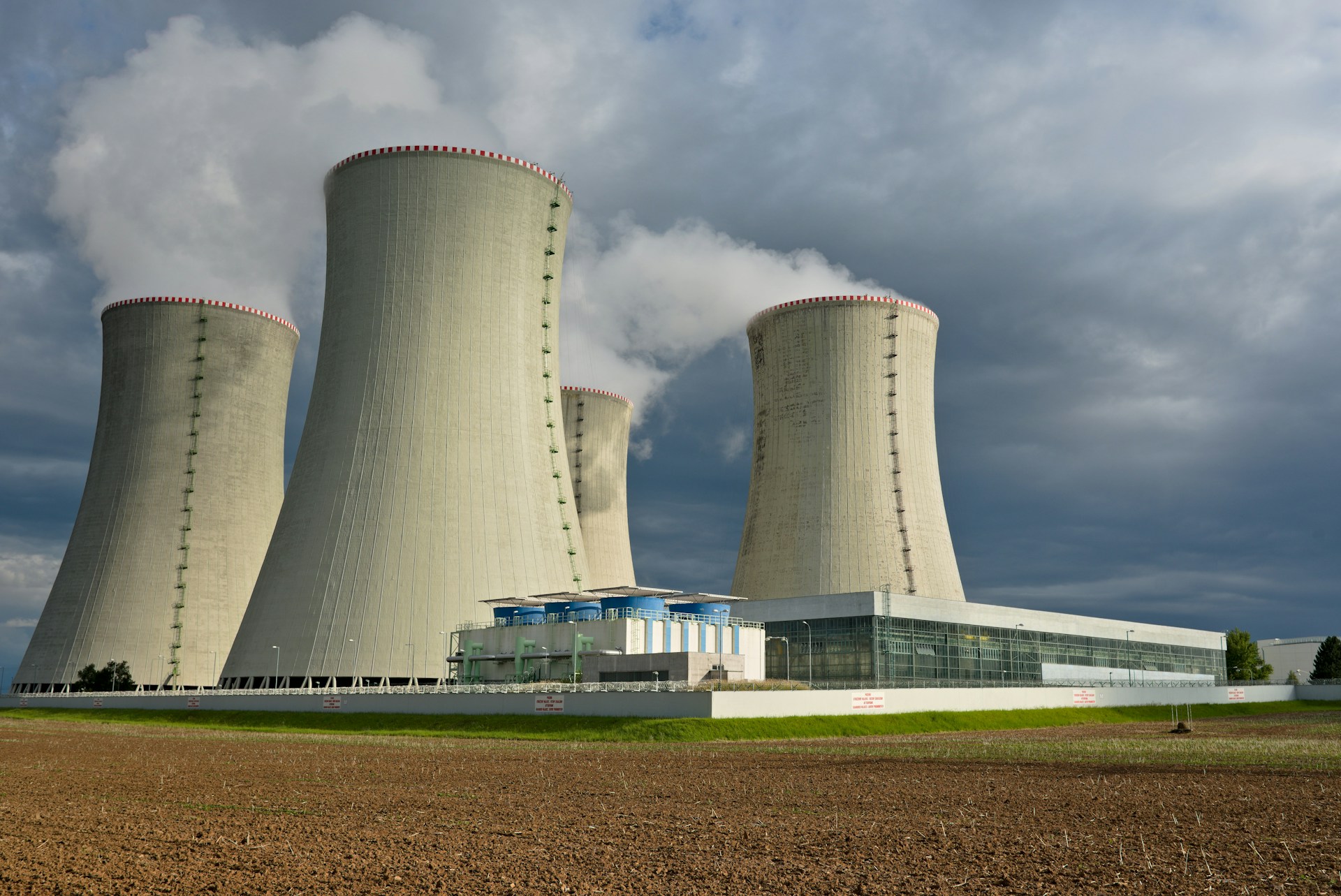
Walk into a nuclear power plant control room or turbine hall, and you will find an obsession with hardware redundancy. Every primary safety system has a physical backup. Every critical valve and cooling loop is cross-checked against multiple failsafes. Yet, hand a reactor operator or maintenance technician a 400-page operating procedure written in bloated corporate prose, and that entire safety margin evaporates.

Nuclear engineering documentation compliance relies on more than just ticking regulatory boxes; it requires absolute clarity. When an ambiguous sentence in a shutdown manual or testing protocol triggers a misinterpretation, the resulting delay or operational error can compromise safety. This is why achieving strict documentation compliance requires moving away from loose prose and adopting controlled language standards like ASD-STE100.

In aerospace and nuclear engineering documentation compliance, an ambiguous sentence in a troubleshooting guide causes mistakes, delays, and costly rework. Despite that, most organisations treat technical documentation like a compliance afterthought—something tossed over to whoever has free time before a deadline.

To solve this, industries rely on Simplified Technical English (STE)—an international writing specification designed to remove guesswork from technical documents. Originally developed for the aerospace sector and formally maintained under the specification known as ASD-STE100, this standard restricts writers to a controlled vocabulary and strict grammar rules.

It is not about running text through a basic spell-checker or satisfying a bureaucratic audit. It is a practical engineering control designed to make complex instructions unambiguous.

The Cost of Ambiguity in Nuclear and Aerospace

Traditional technical writing often suffers from unnecessary literary variation. Writers swap out verbs, bury actions inside passive voice, and write long, multi-clause sentences that require multiple passes to parse.

When an aerospace technician works on flight control systems under tight turnaround times, or a nuclear technician reviews shutdown procedures during an outage, they do not calmly analyse prose—they execute actions. If a step relies on loose modifiers or vague verbs, interpretation fractures.

The practical costs show up quickly:

  • Wasted Time: Engineers burn hours decoding poorly worded instructions or calling engineering support to clarify what a step actually means.
  • Workarounds: Frustrated technicians stop reading the manual, relying on tribal knowledge and shortcuts that bypass safety checks.
  • Operational Risk: Misinterpreting an action verb during turbine overhaul or valve calibration can damage expensive hardware or trigger unexpected shutdowns.

Surface-level calls for “clear communication” do not fix this. You need structural boundaries, which is why the ASD-STE100 specification enforces a controlled vocabulary where every word has one approved meaning.

Controlling Vocabulary and Syntax

ASD-STE100 restricts writers to roughly 500 approved general terms, paired exclusively with vetted technical nouns. Words like check, inspect, verify, and test are never allowed to bleed into one another. Each has a specific operational definition.

In a nuclear facility or an aerospace maintenance depot, that distinction is non-negotiable. If a procedure blurs the line between checking a pressure gauge and testing a system under load, an operator might glance at a dial instead of running a diagnostic sequence.

The standard enforces this through mechanical rules:

  • Fixed Verb Definitions: Synonyms are banned. An action verb means one precise physical action every time.
  • The Imperative Mandate: Instructions must start with the action verb, leaving no doubt about who does what.
  • Strict Word Limits: Procedural sentences are capped at 20 words. Descriptive text stops at 25.
  • No Gerunds or Noun Piles: Heavy noun clusters are broken down into clean subject-verb-object structures.

S1000D Integration

Large aerospace and nuclear projects involve multi-vendor ecosystems where suppliers, contractors, and regulators must share data seamlessly. That requires modular data standards like S1000D.

An XML container standard is only as good as the text inside it. S1000D provides the structure; ASD-STE100 provides the linguistic rules. Together, they deliver:

  • Cleaner Translation: Removing idioms and grammatical clutter makes source text easier for human translators and machine engines across international supply chains.
  • Lower Localization Costs: Standardised English yields higher translation memory matches, cutting endless rewrites.
  • Safe Content Reuse: Modular data modules move between aircraft platforms or reactor designs without losing semantic integrity.

Implementing STE

You cannot deploy ASD-STE100 by treating it as a software plugin or a final edit. Changing how engineers author documents requires a structured approach:

  1. Run a Baseline Audit: Pull a sample of current maintenance manuals to measure sentence lengths and unapproved terminology.
  2. Set Governance: Appoint STE champions and embed the rules into corporate style guides and authoring templates.
  3. Train the Writers: Run practical workshops for technical writers and subject matter experts focusing on controlled vocabulary and syntax.
  4. Automate Guardrails: Integrate checking tools into the authoring environment so writers catch non-compliant terms as they type.
  5. Measure Results: Track metrics like technical query tickets, translation costs, and procedural errors.

Practical Precision

In aerospace and nuclear engineering documentation compliance, documents are a functional tool, not a stylistic showcase. Treating manuals as a clerical afterthought invites operational friction. Proper ASD-STE100 compliance aligns documentation directly with engineering intent.

Ready to eliminate ambiguity in your manuals?

Shufrans TechDocs helps engineering teams in aerospace and nuclear sectors implement practical ASD-STE100 compliance through specialised training and governance consulting. Contact us today to discuss your documentation workflow.

 

The Multi-Jurisdiction Trap: Why Fragmented Technical Language Breaks Cross-Border Fleet Support

The Multi-Jurisdiction Trap: Why Fragmented Technical Language Breaks Cross-Border Fleet Support

When high-value, safety-critical assets—such as rolling stock, aerospace propulsion units, or defense launcher systems—are deployed across international markets, they rarely operate within a single linguistic bubble. A locomotive maintained in South Korea, an aircraft engine serviced in Azerbaijan, or a semiconductor subsystem installed in Europe relies on a complex web of local technicians, regional partners, and third-party contractors.

Yet, many global engineering enterprises commit a foundational operational error: they write their technical documentation for a single domestic audience, assuming that natural English will seamlessly translate across borders.

When maintenance manuals, standard work instructions (SWIs), and troubleshooting guides are packed with idioms, regional terminology, and unstructured phrasing, they become high-risk liabilities the moment they cross an international border.

The Cost of Multi-Site Misinterpretation

In global field operations, an ambiguous instruction is not merely a linguistic inconvenience; it is an operational hazard. When local technicians encounter unconstrained, complex technical literature, downtime multiplies.

  1. Inconsistent Service Execution: If two regional hubs interpret a complex component replacement procedure differently due to vague phrasing, maintenance quality fractures.

  2. Prolonged Mean Time to Repair (MTTR): Technicians spend critical minutes decoding convoluted prose rather than executing the repair, directly degrading fleet availability and customer uptime.

  3. Audit and Liability Exposure: Cross-border regulatory audits demand absolute procedural repeatability. If local service records reveal that maintenance actions deviated because the master manual was open to interpretation, the organisation faces severe compliance penalties.

Localisation agencies and automated translation tools cannot solve this structural flaw. If the source text is inherently ambiguous, translation tools merely scale that ambiguity into multiple languages, turning minor phrasing errors into widespread operational risks.


Establishing a Universal Operational Standard

Protecting global assets requires a single, ironclad rule: operational instructions must mean the exact same thing whether they are read in Singapore, Rotterdam, or Seoul.

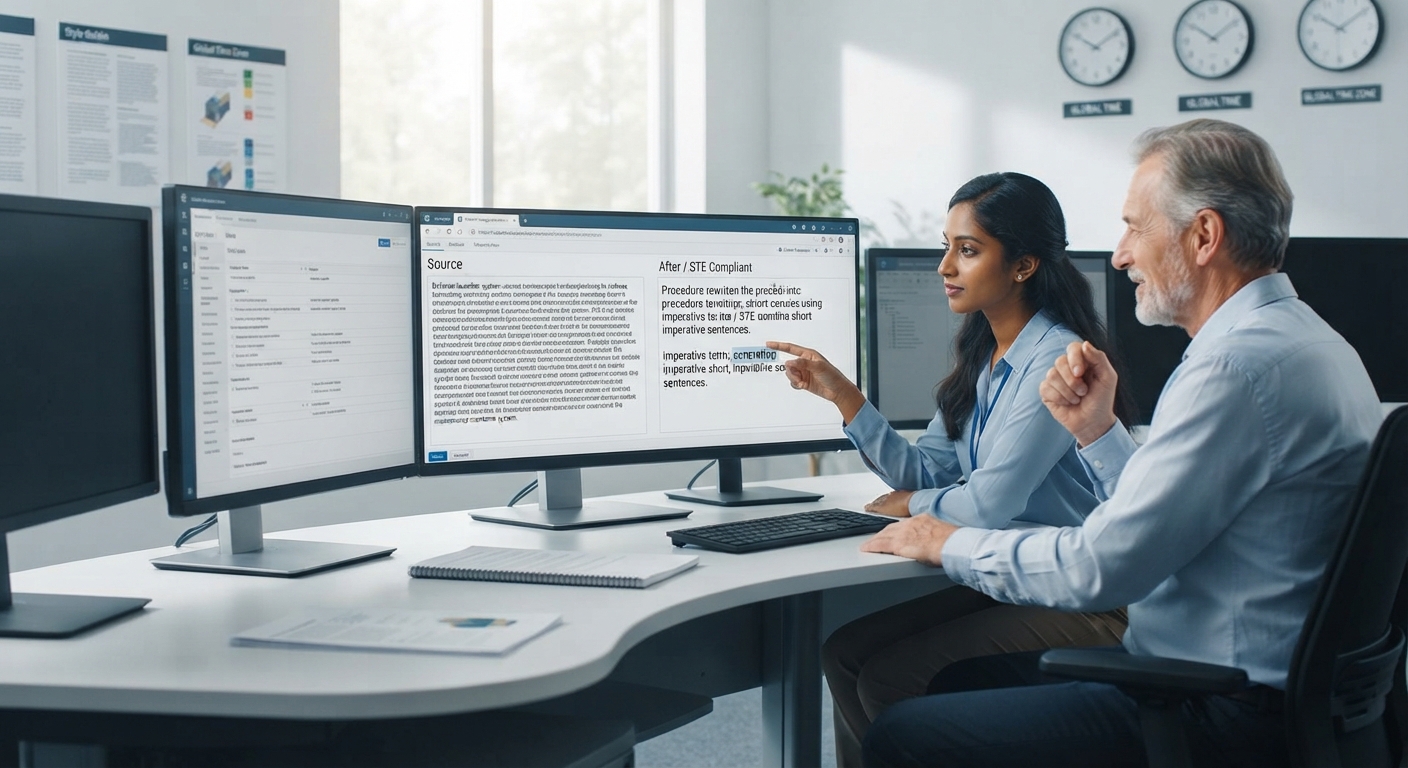
This is why leading high-stakes sectors rely on ASD-STE100 Simplified Technical English (STE). By enforcing strict, standardized writing rules—such as restricting every approved word to a single meaning, enforcing the imperative voice for actions, and eliminating subjective modifiers—STE strips away semantic friction. It creates a controlled vocabulary that human technicians can execute instantly and automated translation systems can process without error.

Bridge the Gap with Shufrans TechDocs

Eliminating documentation ambiguity across international networks requires more than passive software checkers; it demands specialized, human-centric training that transforms how engineering teams author technical data at the source.

With twenty years of specialised experience delivering rigorous ASD-STE100 implementation and training programmes across aviation, rail, defense, and high-tech sectors, Shufrans TechDocs helps global engineering organisations secure total linguistic control over their operations.

Whether you are looking to streamline cross-border maintenance handoffs or future-proof your technical publications for global compliance, we provide the expert training and implementation framework your team needs.

🔗 Ready to eliminate operational ambiguity? Reserve a 30-min STE Feasibility Session with Shufrans TechDocs: https://calendly.com/shufranstechdocs/30min


From Tender Pitch to Technical Reality: The High Cost of Ambiguity in Complex Engineering

From Tender Pitch to Technical Reality: The High Cost of Ambiguity in Complex Engineering

Winning a major industrial or defence tender requires flawless, claim-safe copy that satisfies procurement boards, political stakeholders, and regulatory committees. Yet, once the contract is secured and the system transitions from the boardroom to the field, the marketing prose stops mattering. What determines the success or failure of a multi-million-dollar deployment is whether an operator on a crowded hangar deck or a technician in a multi-plant manufacturing facility can execute a complex maintenance procedure without hesitation or misinterpretation.

The vulnerability usually begins the moment a winning proposal is handed over to engineering and localisation teams. Many global enterprises pour vast resources into crafting watertight tender documents, only to watch their internal documentation fragment the moment it crosses international borders and undergoes translation. As artificial intelligence content, rapid localisation tools, and multi-sourced spec sheets continue to expand the sheer volume of written material, organisations face a critical operational blind spot: producing more documentation does not equal operational clarity. In fact, it often compounds the risk.


🔗 Reserve a 30-min STE Feasibility Session: https://calendly.com/shufranstechdocs/30min

If your organisation is looking to bridge the gap between boardroom promises and plant-floor reality, Shufrans TechDocs specialises in implementing rigorous ASD-STE100 Simplified Technical English standards from the ground up. Get in touch to discuss how we can secure your procedural clarity.


At Shufrans TechDocs, we help aerospace leaders secure total linguistic control over their operations. We move beyond passive software tools by providing expert, human-centric STE training and implementation programmes tailored directly to engineering teams. By standardising technical data at the source, we remove ambiguity to ensure your documentation is accurate for human operators, readable for automated systems, and fully compliant with global safety standards.


Fixing Documentation Drift: Why Upstream Language Rules Beat Layout Standards

Fixing Documentation Drift: Why Upstream Language Rules Beat Layout Standards

When an engineering firm releases a complex system, product variants quickly follow. The core architecture remains identical, but a control panel shifts, a valve location moves, or a feature appears on one variant and not the next.

Documentation follows the same chaotic cycle. Early on, the technical author copies the previous manual, edits what changed, and ships. That approach holds up until the number of variants multiplies, at which point systemic symptoms appear. The same pressure-relief valve is described one way by the mechanical team and another by the electrical group. A safety correction made for a high-priority client never reaches the technical files being built alongside it. Superseded specifications survive in sections nobody reread.

Standardising the layout and table of contents solves part of the problem. But when technical manuals are written in natural English, layout standardisation only creates an orderly wrapper for unconstrained ambiguity.

True technical standardisation requires controlling the language itself through Simplified Technical English. Here are the core pillars required to fix documentation drift at the authoring stage.

Enforce Controlled Terminology and Single Meanings When the same physical component appears under different names across a product family, readers assume they are dealing with different parts. A retention bracket can easily pick up four distinct labels across three variant manuals without anyone deciding it should. Designate a single, approved term of record for every asset, part, and action. STE rules dictate that every approved word must have only one meaning, and every concept must be represented by only one term. As soon as a part carries synonyms, users hesitate, internal consistency collapses, and downstream localisation costs multiply.

Standardise Procedural Voice and Sentence Shape Natural technical writing varies wildly depending on who is at the keyboard. One writer prefers passive descriptions, another uses imperative commands mixed with conditional clauses. Enforce structural rules for sentence design. Instructions must always begin with an approved imperative verb, placing the action in the first word. Descriptive sentences must keep the active voice and name the object that acts. By fixing sentence patterns across the document, technical readers stop parsing ambiguous grammatical structures and focus entirely on operational changes.


Standardise Safety Information and Hazard Formats Safety warnings are the one area where writer discretion introduces lethal exposure. When safety messages vary across models of the same family, it creates severe compliance liabilities during third-party safety audits or product liability disputes. Combine standard safety hierarchy rules with strict STE constraints.

Safety messages must follow a rigid structure: state the hazard, explain why it is dangerous, describe the consequence, and specify the prevention. Every sentence within the warning block must pass through the same syntactic rules, eliminating descriptive modifiers and subjective adverbs that dilute the warning’s urgency.

Standardise Baseline Content Blocks A maintenance procedure or system check that applies across a dozen variants does not need to be drafted twelve times by twelve different engineers. Isolate approved, STE-compliant blocks of procedural text and turn them into modular standard content. When a function behaves identically under the same conditions, the verified sentence structure becomes a reusable master asset. If a specific operational threshold differs on a variant, change only that parameter and leave the rest of the certified sentence untouched.


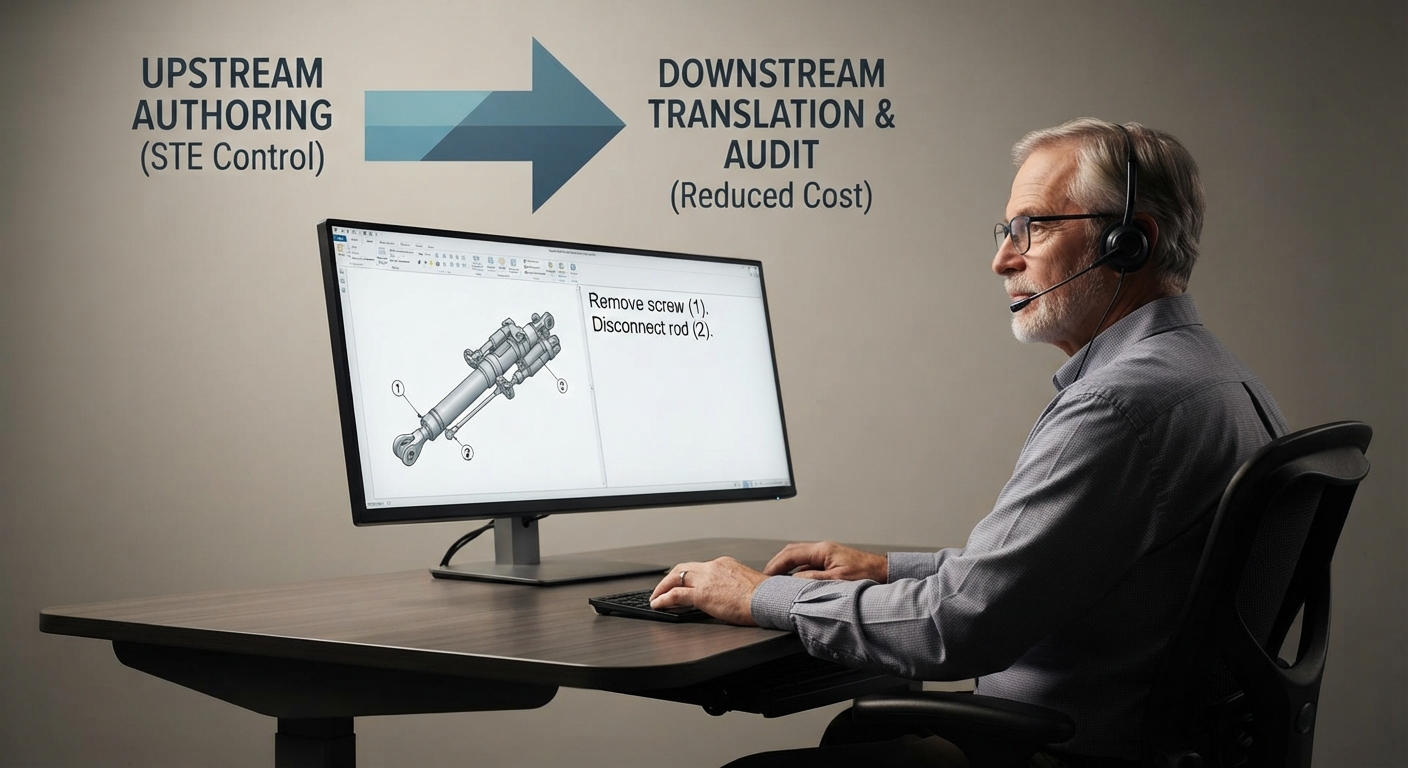
Establish Upstream Writing Rules Over Downstream Localisation Many engineering organisations treat technical standardisation as a translation problem, fixing errors only after the manual has been written and sent overseas. By then, the structural ambiguity is already baked into the source text. Publish an internal style guide based on ASD-STE100 before writing begins. Define approved technical verbs, prohibit vague modifiers, and mandate strict sentence length limits. When the source text is written under strict linguistic governance, downstream translation and technical audits require a fraction of the time and budget.

Standardising technical manuals comes down to imposing rules that govern how a product family is described from the ground up. With over twenty years of specialised experience delivering Simplified Technical English implementation and training across complex industrial sectors, Shufrans TechDocs helps engineering teams eliminate documentation drift at the authoring stage.

With an STE-based standard in place, authoring time drops, review cycles shorten, and the quality gap between different engineering teams disappears. More importantly, technical files stop triggering non-conformities during regulatory audits, ensuring that your operational documentation matches the absolute precision of the hardware you build.

🔗 Reserve a 30-min STE Feasibility Session: https://calendly.com/shufranstechdocs/30min

At Shufrans TechDocs, we help aerospace leaders secure total linguistic control over their operations. We move beyond passive software tools by providing expert, human-centric STE training and implementation programmes tailored directly to engineering teams. By standardising technical data at the source, we remove ambiguity to ensure your documentation is accurate for human operators, readable for automated systems, and fully compliant with global safety standards.

The Quiet Risk: Why Uncontrolled English Undermines Engineering Compliance

The Quiet Risk: Why Uncontrolled English Undermines Engineering Compliance

Engineering organisations subject every physical component, software algorithm, and manufacturing process to rigorous validation. Yet, the instructions guiding how operators, technicians, and auditors interact with those systems are frequently left to individual writing styles.

When standard operating procedures (SOPs), maintenance manuals, and regulatory dossiers rely on conversational phrasing, they introduce controlled variation into environments that demand absolute predictability. In high-consequence sectors like aerospace, medical devices, automotive, and heavy industry, that linguistic gap is a major operational liability.

The Structural Vulnerability of Natural Language

Technical writers and engineers are experts in their fields, but natural language is built for interpretation rather than precision. When drafting documentation without structural constraints, standard writing habits routinely introduce three specific vulnerabilities:

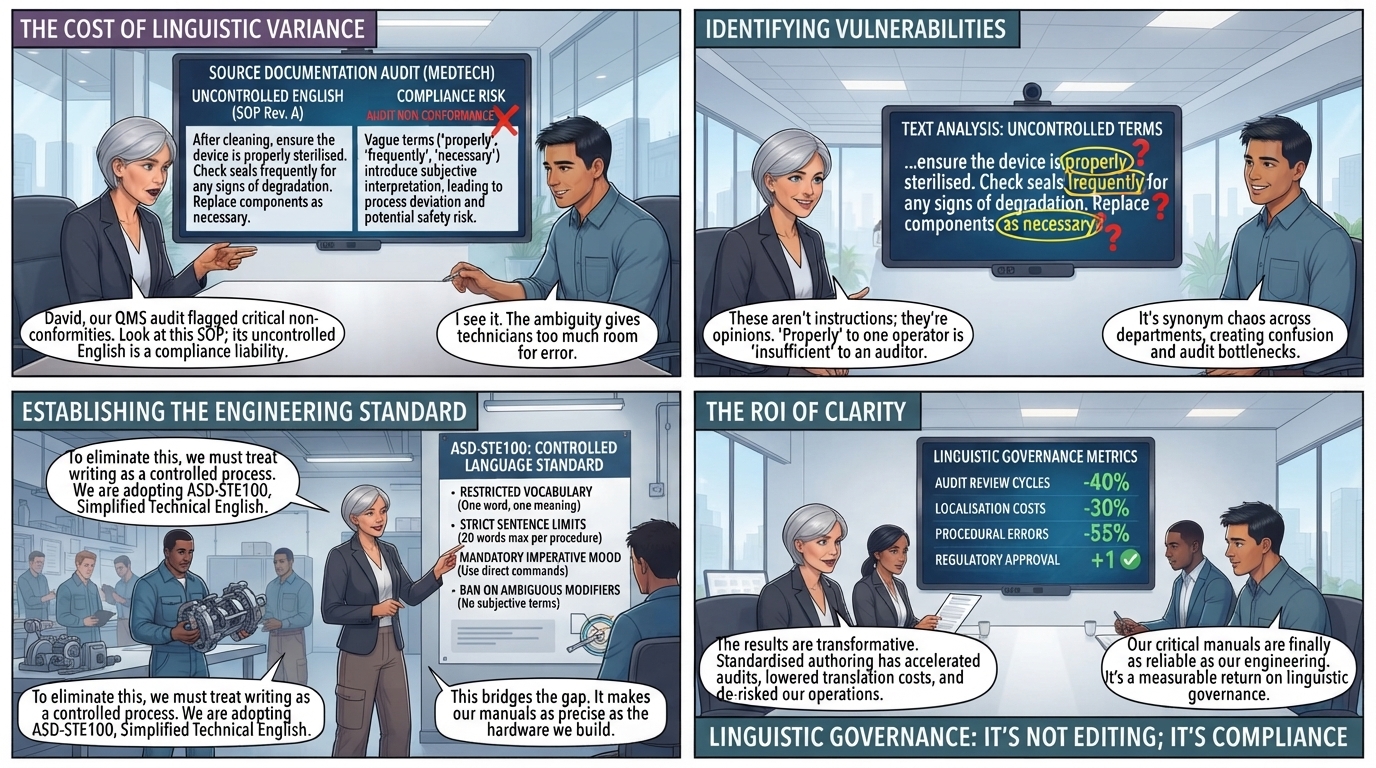
  • Lexical Inconsistency: Different authors use multiple terms for the same component or action. One section calls for disconnect, another for detach, and a third for unplug, creating confusion for readers and rendering translation memories inefficient.
  • Subjective Parameters: Words like appropriate, sufficient, frequent, or excessive introduce personal judgement into instructions that require measurable thresholds. A technician’s definition of “frequent maintenance” rarely matches an auditor’s interpretation.
  • Complex Syntax: Long, multi-clause sentences bury the primary action, increasing cognitive load under operational pressure and elevating the risk of procedural error.

During an audit or regulatory review, these inconsistencies translate directly into audit non-conformities, review bottlenecks, and prolonged approval cycles.

Bridging the Gap with ASD-STE100

To eliminate this friction, organisations must treat technical authoring as a controlled engineering process. This requires implementing ASD-STE100 (Simplified Technical English)—an international specification originally engineered for complex aerospace systems to remove linguistic uncertainty.

ASD-STE100 brings the same methodological discipline to text that engineers apply to hardware design:

  • A Standardised Vocabulary: A controlled dictionary limits each word to a single approved meaning and part of speech, eliminating unauthorised synonyms and ambiguity.
  • Strict Length Limits: Procedural sentences are restricted to a maximum of 20 words, while descriptive text is capped at 25 words, ensuring information is processed quickly and accurately.
  • Explicit Action-Oriented Phrasing: Writers must use the imperative mood for instructions, ensuring the required task is unmistakable and direct.

The Commercial Impact of Linguistic Governance

Adopting a controlled language standard transforms technical documentation from an administrative bottleneck into an asset for operational excellence. When source texts adhere to a predictable grammatical baseline:

  1. Review Cycles Accelerate: Quality assurance and regulatory teams spend less time untangling vague phrasing and more time evaluating core compliance.
  2. Localisation Costs Drop: Clean, standardised source text maximises translation memory reuse and optimises machine translation accuracy across global markets.
  3. Safety Risks Decrease: Operators in the field execute maintenance procedures without second-guessing ambiguous instructions.

Securing Your Documentation Pipeline

Investing in physical safety systems while ignoring the clarity of the instructions governing them leaves a critical vulnerability open. Standardising authoring output protects your compliance posture, safeguards your audit readiness, and ensures your documentation matches the quality of your engineering.

If your organisation is ready to eliminate documentation ambiguity and streamline compliance workflows, let us evaluate your technical text.

Reserve a 30-min STE Feasibility Session to discuss how linguistic governance can protect your engineering operations.