technical documentation Archives | Shufrans TechDocs Home // technical documentation Archives | Shufrans TechDocs

The Quiet Risk: Why Uncontrolled English Undermines Engineering Compliance

The Quiet Risk: Why Uncontrolled English Undermines Engineering Compliance

Engineering organisations subject every physical component, software algorithm, and manufacturing process to rigorous validation. Yet, the instructions guiding how operators, technicians, and auditors interact with those systems are frequently left to individual writing styles.

When standard operating procedures (SOPs), maintenance manuals, and regulatory dossiers rely on conversational phrasing, they introduce controlled variation into environments that demand absolute predictability. In high-consequence sectors like aerospace, medical devices, automotive, and heavy industry, that linguistic gap is a major operational liability.

The Structural Vulnerability of Natural Language

Technical writers and engineers are experts in their fields, but natural language is built for interpretation rather than precision. When drafting documentation without structural constraints, standard writing habits routinely introduce three specific vulnerabilities:

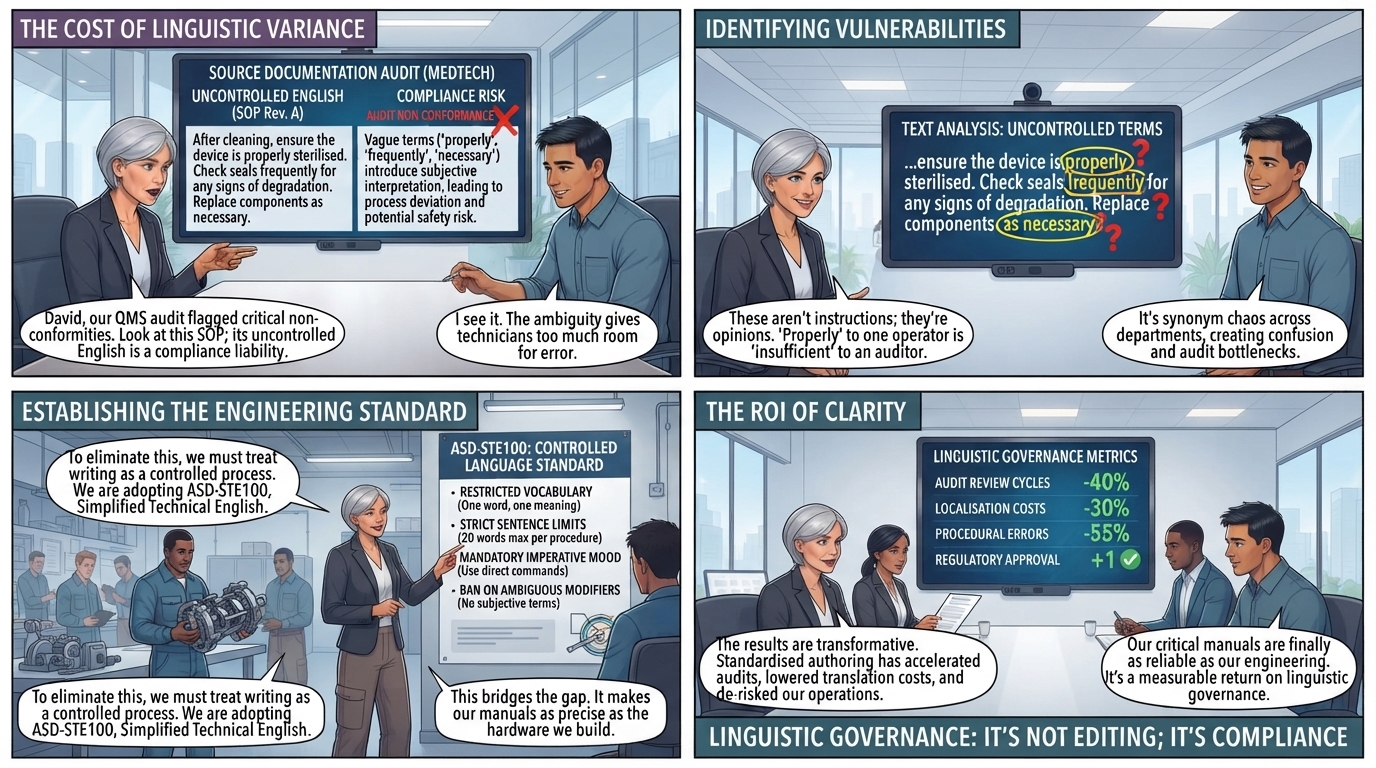
  • Lexical Inconsistency: Different authors use multiple terms for the same component or action. One section calls for disconnect, another for detach, and a third for unplug, creating confusion for readers and rendering translation memories inefficient.
  • Subjective Parameters: Words like appropriate, sufficient, frequent, or excessive introduce personal judgement into instructions that require measurable thresholds. A technician’s definition of “frequent maintenance” rarely matches an auditor’s interpretation.
  • Complex Syntax: Long, multi-clause sentences bury the primary action, increasing cognitive load under operational pressure and elevating the risk of procedural error.

During an audit or regulatory review, these inconsistencies translate directly into audit non-conformities, review bottlenecks, and prolonged approval cycles.

Bridging the Gap with ASD-STE100

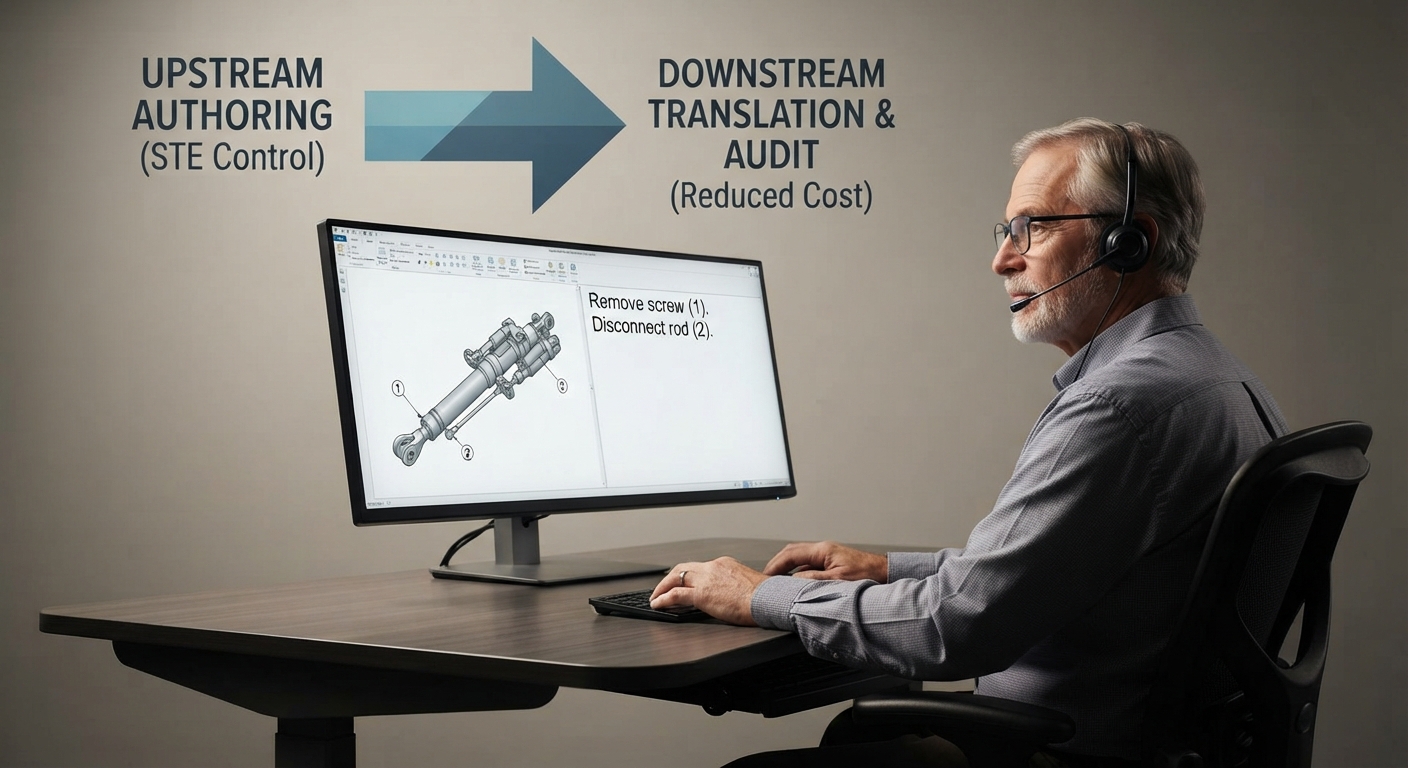
To eliminate this friction, organisations must treat technical authoring as a controlled engineering process. This requires implementing ASD-STE100 (Simplified Technical English)—an international specification originally engineered for complex aerospace systems to remove linguistic uncertainty.

ASD-STE100 brings the same methodological discipline to text that engineers apply to hardware design:

  • A Standardised Vocabulary: A controlled dictionary limits each word to a single approved meaning and part of speech, eliminating unauthorised synonyms and ambiguity.
  • Strict Length Limits: Procedural sentences are restricted to a maximum of 20 words, while descriptive text is capped at 25 words, ensuring information is processed quickly and accurately.
  • Explicit Action-Oriented Phrasing: Writers must use the imperative mood for instructions, ensuring the required task is unmistakable and direct.

The Commercial Impact of Linguistic Governance

Adopting a controlled language standard transforms technical documentation from an administrative bottleneck into an asset for operational excellence. When source texts adhere to a predictable grammatical baseline:

  1. Review Cycles Accelerate: Quality assurance and regulatory teams spend less time untangling vague phrasing and more time evaluating core compliance.
  2. Localisation Costs Drop: Clean, standardised source text maximises translation memory reuse and optimises machine translation accuracy across global markets.
  3. Safety Risks Decrease: Operators in the field execute maintenance procedures without second-guessing ambiguous instructions.

Securing Your Documentation Pipeline

Investing in physical safety systems while ignoring the clarity of the instructions governing them leaves a critical vulnerability open. Standardising authoring output protects your compliance posture, safeguards your audit readiness, and ensures your documentation matches the quality of your engineering.

If your organisation is ready to eliminate documentation ambiguity and streamline compliance workflows, let us evaluate your technical text.

Reserve a 30-min STE Feasibility Session to discuss how linguistic governance can protect your engineering operations.


The Silent Sabotage: Why Unwritten Ground Rules UGRs® Compromise Your Critical Manuals

The Silent Sabotage: Why Unwritten Ground Rules UGRs® Compromise Your Critical Manuals

In every high-hazard organisation—whether in MedTech, Energy, Aerospace, or Heavy Industry—leadership invests heavily in immaculate safety management systems, robust quality frameworks, and exhaustive compliance audits. Yet, despite these multi-million-dollar safety structures, costly operational errors and audit non-conformances still occur on the shop floor, the rig, and the cleanroom.

The root cause rarely lives in your formal policy manuals. It lives in your Unwritten Ground Rules (UGRs)—those pervasive, unvoiced workplace norms of “this is the way we do things around here.”

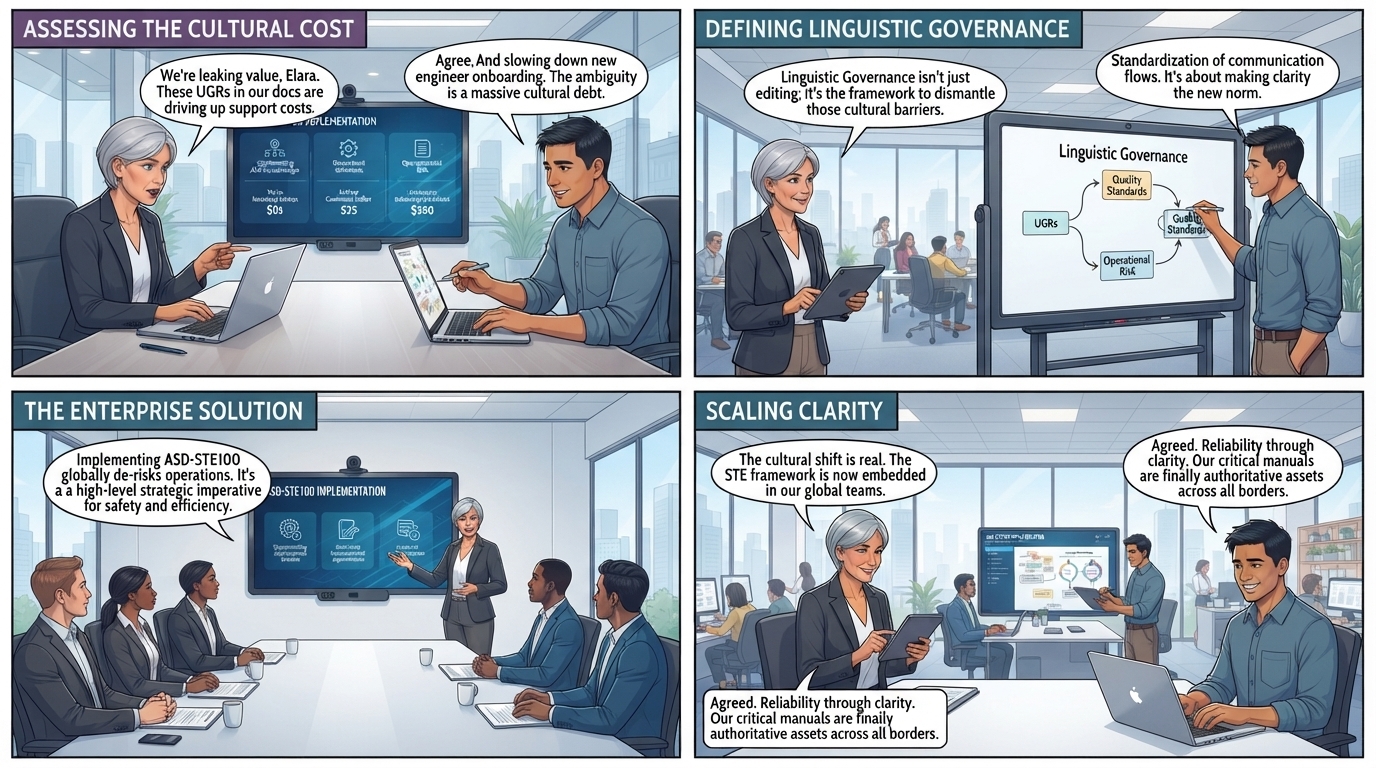
While UGRs typically get discussed in the context of leadership culture or safety behaviours, their most dangerous manifestation is entirely invisible. They quietly dictate how your engineering teams write, review, and approve technical documentation.

The Gap Between the Quality Manual and the Technical Page

Walk into any engineering department or technical publications office, and you will find formal processes designed for absolute precision. But look closer at the actual text inside the standard operating procedures, maintenance instructions, and device user manuals.

Deeply ingrained legacy UGRs silently shape what ends up on the page. Unspoken habits dictate that “if it sounds complex, academic, and dense, it must be rigorous” or “we’ve always written our technical manuals this way, so do not rock the boat.”

When these cultural norms take over, authors default to ambiguous, open-ended phrasing. Terms like appropriate, sufficient, adequate, or as needed slip past review boards unchallenged. Why? Because within the existing departmental culture, challenging a senior engineer’s convoluted phrasing or breaking a legacy template feels like an unnecessary battle. Silence becomes the path of least resistance.

When Linguistic Ambiguity Becomes an Operational Liability

The moment an ambiguous document leaves the engineering office and lands in the hands of a field technician, a quality inspector, or a clinical application specialist, that cultural silence turns into operational risk.

When a maintenance manual instructs a technician to “tighten the assembly to an appropriate torque” or “verify that the component is sufficiently cleared of debris,” it strips away objective reality. It forces skilled operators into split-second subjective guesswork during high-pressure execution phases.

This is where operational variance spikes. Human error during critical tasks rarely stems from incompetence. Instead, it stems from instructions that leave room for interpretation. Vague writing invites procedural drift, which in turn leads to safety incidents, audit findings, and catastrophic downtime. Poorly written technical instructions are not just a copyediting oversight. They are a direct symptom of a deeper cultural silence where cross-functional teams hesitate to demand absolute clarity.


Linguistic Governance as Cultural Intervention

Fixing this requires moving past the superficial view that technical authoring is just a box-checking exercise or a matter of running text through basic grammar software. True risk mitigation demands Linguistic Governance.

Implementing a controlled standard like Simplified Technical English is not merely about enforcing a vocabulary list. It is a systematic cultural and operational intervention that breaks the legacy habit of hiding behind complexity. By restricting a verb to a single meaning, eliminating jargon, and banning ambiguous modifiers, Simplified Technical English forces cross-functional alignment.

When engineering design, technical writing, and field operations operate under a single standard of absolute linguistic clarity, the cultural dynamic shifts. Authors no longer guess what an engineer meant, and technicians no longer gamble on what an instruction implies. It establishes shared ownership over safety-critical data.


Are legacy documentation habits driving up compliance variance in your engineering workflows? Let’s audit your linguistic risk.

🔗 Reserve a 30-min STE Feasibility Session: https://calendly.com/shufranstechdocs/30min

At Shufrans TechDocs, we help aerospace leaders secure total linguistic control over their operations. We move beyond passive software tools by providing expert, human-centric STE training and implementation programmes tailored directly to engineering teams. By standardising technical data at the source, we remove ambiguity to ensure your documentation is accurate for human operators, readable for automated systems, and fully compliant with global safety standards.

UGRs® (Unwritten Ground Rules) was created by Steve Simpson, a registered trademark.

The Multi-Million-Dollar Machine Built With a Mystery Manual

The Multi-Million-Dollar Machine Built With a Mystery Manual

When you discuss modernising technical documentation with industry leads, the response is often a polite brush-off: a quiet note that they are simply not interested right now, followed by a swift exit.

It is a fascinating reaction.

You have engineered a marvel of industrial machinery. It weighs 20 tonnes, handles complex high-throughput processing, operates under punishing conditions, and represents years of precision mechanical and electrical design. It is shipped to a plant halfway across the world.

Then, an operator misinterprets a single, poorly translated safety instruction in the manual because the source text was written with loose, ambiguous phrasing instead of clear engineering data.

A component jams. Production stops. Equipment is damaged, or worse, someone gets hurt.

Whose fault is it? The engineers blame the manual. But the Technical Documentation Lead sitting back at headquarters—the person who dismissed text standardisation with a wave of the hand because “we’ve always written manuals this way”—sleeps soundly, completely blind to the fact that their department is an operational hazard.


The Industrial Delusion: The ISO Paperwork Tra

When you talk to documentation leads in heavy machinery and traditional manufacturing about linguistic governance or Simplified Technical English, you usually get a predictable defence:

  • “We have our ISO audit sorted, so our quality is covered.”
  • “Our translation agency handles the phrasing.”
  • “We don’t have the bandwidth to retrain our authors.”

It is a fascinating display of professional cognitive dissonance. These are the exact same enterprises that will happily throw a fortune at auditors to pass an ISO paperwork check, certifying that a bloated, chaotic authoring process has been officially documented and filed away. They cling to the ‘if it ain’t broke, don’t fix it’ mentality, entirely missing the point that their documentation is not only broken—it is an expensive, silent failure point.

Yet, when it comes to the actual words commanding how a multi-million-dollar machine is safely operated and maintained, it remains a free-for-all of ambiguous syntax, cultural idiom, and creative prose. An ISO certificate proves you have a process on paper. It does not prove your instructions make sense to a foreign technician at 3:00 AM.

The True Cost of Status-Quo Comfort

Refusing to standardise source text isn’t a neutral administrative choice. It is an active decision to burn capital and invite risk:

  1. The Translation Black Hole: Dumping unstandardised, verbose source text into translation memory or AI tools guarantees exponential costs. You are paying good money year after year to have translators untangle convoluted sentences that never should have been written that way in the first place.
  2. The Safety Liability: In heavy-duty industrial processing, ambiguity is a hazard. Words like appropriate, sufficient, or check periodically are legal and operational landmines. If an instruction can be interpreted in two ways, someone will eventually choose the wrong one.
  3. The AI Dead-End: Companies love talking about digital transformation and AI-driven service assistants. But if your underlying documentation is written like a novel, your downstream AI models will hallucinate, misinterpret procedures, and fail catastrophically.

Stop Managing a Printing Press

If your definition of technical documentation is simply filling pages until a CE-compliance box is checked, you aren’t managing an engineering asset. You are managing an expensive printing press for liability.

Trust in engineering arrives on foot and leaves on horseback. Decades of building rigorous, high-performance machinery can be undermined in a single afternoon by a legacy mindset that treats safety-critical documentation as an afterthought.

True linguistic governance isn’t about adding red tape. It is about removing friction, slashing localisation budgets, and ensuring that safety-critical instructions translate seamlessly into any language, anywhere in the world.

Your engineering is too precise to let your words be an afterthought.

If your technical documentation team is tired of fighting translation drag, inflated localisation budgets, and unclear source text, let’s talk. At Shufrans TechDocs, we implement Simplified Technical English and Linguistic Governance for high-compliance engineering sectors that take safety and clarity seriously.


Who Owns the Regulatory Content in Your Product Manuals?

Who Owns the Regulatory Content in Your Product Manuals?

Product manuals and instructions for use carry dozens of items that exist simply because a regulation demands them. When a company ships products to more than ten markets, certification marks, warning texts, and disposal notices multiply into hundreds of combinations. If an organisation does not maintain strict governance over these items, a single rule change can take days just to scope out, and omissions usually surface only at customs or during market surveillance when the cost of fixing them has already escalated.

The Hidden Cost of Linguistic Ambiguity in Manuals

While regulatory compliance is often treated as a logistical checklist, the root cause of most compliance failures is linguistic. Standard English is full of nuance, synonyms, and subjective phrasing that invites misinterpretation. When technical authors write warning notices, installation steps, and safety directives without strict controls, they create hidden liabilities. Translators struggle to find exact equivalents, local authorities raise flags over vague compliance text, and end users face safety risks.

Why ASD-STE100 is a Proven Regulatory Control Mechanism

To solve this, companies need more than a content repository. They need strict linguistic governance. ASD-STE100 (Simplified Technical English) was specifically designed to eliminate ambiguity in complex technical documentation.

  • Controlled vocabulary restricts words and enforces rigid grammatical rules so that every sentence has one unambiguous meaning.

  • Reduced translation friction ensures that standardised source text translates cleanly into multiple languages, eliminating the costly iterations and review cycles that plague multi-market product manuals.

  • Agile regulatory updates allow documentation teams to update precise terminology at the source without rewriting entire manuals when regulations change across global markets.

The Training Delivery Standard

High-compliance industries do not need software shortcuts or generic grammar checklists. They require rigorous, proven linguistic architecture. Shufrans TechDocs delivers the professional implementation and mastery standards required for organisations to embed ASD-STE100 permanently into their operations.

  • Master the definitive specification through structured, industry-proven training tailored for engineering and technical documentation leaders.

  • Eliminate costly ambiguities at the authoring source to protect your products against customs delays and compliance hazards.

  • Streamline global localisation by turning product manuals into clean, audit-ready assets.

When technical documentation is engineered for absolute clarity, the entire compliance workflow changes. Instead of treating manuals as an afterthought or a last-minute scramble before product launch, engineering teams gain a predictable mechanism that scales effortlessly across international borders. Every warning label, safety instruction, and compliance notice becomes structurally immune to local misinterpretation.

Ultimately, investing in rigorous linguistic standardisation protects your bottom line by removing friction from every stage of the product lifecycle. By bridging the gap between complex regulatory mandates and precise authoring standards, your organisation ensures that compliance is no longer a recurring operational risk, but a seamless competitive advantage.

At Shufrans TechDocs, we help aerospace leaders secure total linguistic control over their operations. We move beyond passive software tools by providing expert, human-centric STE training and implementation programmes tailored directly to engineering teams. By standardising technical data at the source, we remove ambiguity to ensure your documentation is accurate for human operators, readable for automated systems, and fully compliant with global safety standards.

To learn how to eliminate ambiguity from your technical documentation and protect your operational timelines, connect with the team at Shufrans TechDocs.


Why Structured Language Outperforms AI Guesswork

Why Structured Language Outperforms AI Guesswork

Every time a new AI tool hits the market, the conversation shifts to what software can automate. We talk about translation speeds, draft generation, and automated summaries. We rarely talk about what happens when you feed messy, ambiguous documentation into a machine and let it scale your worst habits across every market you serve.

In sectors where a single maintenance error can shut down an entire rail network or ground a fleet, the challenge is no longer about generating more content. It is about control.

The Automation Trap

Organisations rushing to digitise legacy manuals or deploy automated translation workflows often assume technology will fix messy writing on the fly.

It does the exact opposite.

Generative tools amplify whatever they are given. If your source text is bloated, contradictory, or packed with local jargon, an AI model or machine translation engine will faithfully reproduce those flaws at scale, turning minor linguistic slips into systemic operational risks. When procedures span multiple languages and cross-border engineering teams, ambiguity is not just poor style, it is a financial and operational liability.

Why Structured Language Outperforms AI Guesswork

Engineering is deterministic. A technician on a shop floor or a mining site does not need a probable interpretation of a maintenance procedure. They need absolute clarity.

Controlling how technical information is authored solves this at the root:

  • Machine Readiness: Clean, rule-based source text is the only reliable foundation for AI training and automated localisation.
  • Zero Cognitive Load: Global teams and non-native speakers execute complex assembly and troubleshooting tasks faster when instructions leave zero room for guesswork.
  • Risk Mitigation: Standardised authoring rules eliminate the vague phrasing that causes costly downtime, equipment damage, and compliance failures.

Training for the Age of AI

Software cannot take legal liability for a failed maintenance procedure. The technical writers, engineers, instructional designers, and editors who govern your documentation remain the critical gatekeepers of your bottom line.

If your teams are building out AI workflows without first tightening the quality of their source communication, you are simply automating errors. Investing in structured language training for engineers, writers, and translators ensures your operations stay resilient, compliant, and profitable in an automated world.

Are your teams relying on AI to fix bad documentation, or are you building the linguistic standards required to make automation actually work? Let’s discuss how targeted training can future-proof your operations.

🔗 Reserve a 30-min STE Feasibility Session: https://calendly.com/shufranstechdocs/30min

At Shufrans TechDocs, we help aerospace leaders secure total linguistic control over their operations. We move beyond passive software tools by providing expert, human-centric STE training and implementation programmes tailored directly to engineering teams. By standardising technical data at the source, we remove ambiguity to ensure your documentation is accurate for human operators, readable for automated systems, and fully compliant with global safety standards.

To learn how to eliminate ambiguity from your technical documentation and protect your operational timelines, connect with the team at Shufrans TechDocs.


The Cost of Loose Language: Why Technical Documentation Fails at Scale

The Cost of Loose Language: Why Technical Documentation Fails at Scale

Across complex industrial operations—from commercial aerospace maintenance and energy plants to international engineering projects—the most persistent operational risk is rarely mechanical failure. It is linguistic failure.

When a manual instruction leaves room for interpretation, the human mind fills the gap. In high-stakes environments, that subjective judgment call turns into extended review cycles, execution variance, and heavy financial or safety exposure.

The Weight of Unspoken Words

Modern engineering ecosystems grow denser by the day. Complex supply chains span continents, multi-agency teams collaborate on technical missions, and field technicians execute intricate repairs under severe time pressures. Yet, the foundational medium connecting these moving parts remains human language.

When documentation relies on stylistic flair, varied vocabulary, or loose sentence structures, it creates a hidden cognitive tax. If three different technicians can interpret a single maintenance directive in three different ways, the system is fundamentally broken at the root.

The Root Cause of Operational Friction

In many organisations, technical writing is treated as an afterthought rather than a core engineering asset. Engineers focus heavily on the physical design or the software architecture, leaving the accompanying documentation to individual writing styles.

This decentralized approach leads to fragmented terminology across manuals, service bulletins, and training guides. Over time, these small inconsistencies accumulate, creating massive bottlenecks when teams try to scale their operations globally or onboard new partners.

What Linguistic Governance Solves

True operational efficiency begins with strict linguistic discipline. Proven frameworks like the ASD-STE100 specification strip away ambiguity. By enforcing a controlled vocabulary and strict structural rules, technical communication moves from an art form to a precise engineering instrument.

  • Eliminating Execution Variance: Clear procedures ensure that a technical instruction means precisely the same thing in Singapore, Copenhagen, or Toulouse.
  • Reducing Review Friction: Standardised writing cuts through endless editorial loops, allowing technical outputs to reach the field faster.
  • Protecting Operational Integrity: Precision in writing directly protects safety margins, ensuring that critical steps in MRO and energy plants leave zero room for error.

Operating at Modern Scale

Operating in today’s fast-paced industrial environment means volumes of documentation are expanding faster than ever. In an era where information velocity is at an all-time high, the sheer scale of technical output makes discipline harder to maintain, yet infinitely more vital. When organisations flood their ecosystems with raw volume without a governing standard, they scale up confusion rather than clarity.

Precision writing is no longer just about editing manuals. It is about protecting the entire operational chain from the ground up, ensuring that what is written on paper translates safely and accurately to the floor where the real work happens.

If you are curious about how these standards could look in your specific field, Shufrans TechDocs invites you to reserve a chat session.

🔗 Reserve a 30-min STE Feasibility Session: https://calendly.com/shufranstechdocs/30min

Let us make precision the new standard for technical success.

View our full training calendar and secure your spot here: https://www.shufrans-techdocs.com/events/

The Invisible Safety Risk in Aerospace Documentation: Why Clear Grammar Isn’t Enough

The Invisible Safety Risk in Aerospace Documentation: Why Clear Grammar Isn’t Enough

When we think about aviation safety, our minds immediately go to mechanical reliability, strict engineering tolerances, and robust software systems. But there is a silent, less obvious vulnerability hiding inside the technical data layer of the global aviation supply chain, and that is linguistic ambiguity.

Every day, aircraft parts and technical data packages cross international borders. They are reviewed by major national bodies like the FAA and other Civil Aviation Authorities (CAAs), and handled by engineers and technicians worldwide. Yet, the manuals that dictate how these aircraft are maintained are frequently riddled with subjective language that leaves room for dangerous guesswork.

The Danger of “Vague Words” in Instructions for Continued Airworthiness (ICA)

Consider how often words like “appropriate”, “sufficient”, “regularly”, or “carefully” creep into Instructions for Continued Airworthiness (ICA) or service bulletins.

To an author sitting at an OEM headquarters in one country, an instruction to “check the casing regularly for sufficient clearance” might seem perfectly obvious. But to a foreign regulator validating that data, or a local technician on a noisy hangar floor thousands of miles away, those words introduce a massive human guessing game.

What constitutes a “sufficient” check? How often is “regularly”? What passes a safety audit under one jurisdiction can easily be flagged as a compliance failure by another authority during a state-to-state validation process. This linguistic mismatch does more than just create safety blind spots. It causes immediate regulatory friction, bilateral validation backlogs, and costly aircraft return-to-service delays.


Why Software Checkers Aren’t a Silver Bullet

To combat this, many aerospace organisations look for a quick fix by deploying automated grammar checkers. While these tools are excellent at catching typos or banned words, they operate at the very end of the line. They are passive and reactive.

A software checker cannot evaluate whether a maintenance step is logically planned or operationally safe. If an engineer writes a confusing, ambiguous instruction, a checker will simply give you a grammatically correct version of a flawed step. It creates a false sense of compliance.

True risk prevention requires training human authors to think, structure, and write with absolute clarity from the very beginning, before a single word is ever typed into a system.

Preparing the Data Layer for the Next Generation of Tech

This issue is becoming even more critical as aviation authorities evaluate advanced systems, such as automated maintenance tracking and predictive diagnostic tools.

Modern technical documentation is no longer just for human eyes. It serves as the baseline data layer that digital systems read to predict part failures or track maintenance history. If that data layer is filled with inconsistent terminology and vague language, the automated systems get confused. This leads to data errors, hallucinations, and flawed safety conclusions. Standardising language is no longer just a paperwork exercise. It is about future-proofing your data for the next generation of aviation technology.

Eradicating Ambiguity at the Source

To maintain absolute safety and seamless compliance across borders, the aerospace industry relies on international linguistic standards like ASD-STE100 (Simplified Technical English). STE replaces guesswork with precise metrics, limits words to one specific meaning, and ensures instructions are completely unmistakable.

At Shufrans TechDocs, we help aerospace leaders secure total linguistic control over their operations. We move beyond passive software tools by providing expert, human-centric STE training and implementation programmes tailored directly to engineering teams. By standardising technical data at the source, we remove ambiguity to ensure your documentation is accurate for human operators, readable for automated systems, and fully compliant with global safety standards.

To learn how to eliminate ambiguity from your technical documentation and protect your operational timelines, connect with the team at Shufrans TechDocs.


AI Data Clarity: The ASD-STE100 Simplified Technical English Mandate

AI Data Clarity: The ASD-STE100 Simplified Technical English Mandate

In mission-critical environments—from deep-sea engineering to air traffic control—the ultimate liability is not hardware failure, but linguistic ambiguity. Before a pilot takes off, a surgeon begins a procedure, or an engineer completes critical maintenance, they rely on language that is objectively clear. Every pre-flight checklist, surgical guide, and maintenance manual is a repository of critical information, demanding absolute trust in the creator’s precision.

In an age where Artificial Intelligence (AI) can instantly generate content, we must ask ourselves: who or what is responsible for that trust?

AI can give you words at the speed of light, but it cannot guarantee the clarity, precision, and safety that its human creators can. The true value of a skilled team today is its ability to provide the guardrails of trust that AI needs to be a reliable partner. This is where a rigorous standard like Simplified Technical English (STE) becomes invaluable.

The Erosion of Trust in Ambiguity

Ambiguity is the enemy of trust. When a sentence has more than one meaning, it introduces doubt. When a piece of equipment is described inconsistently, it creates confusion. In environments where precision is critical, doubt and confusion lead to errors, delays, and compromised safety.

STE is a framework that systematically eliminates this ambiguity. It’s not just about a list of approved words or a set of rules; it’s about a disciplined mindset that ensures every sentence is a direct, unambiguous statement of fact. This discipline is what builds an unshakeable foundation of trust between the creator of the documentation and the person who relies on it.

Your Team: The Architects of Trust

In the AI era, your in-house team is not just a group of writers; they are the architects of trust. They are the essential human element that provides:

  • Subject Matter Expertise: The engineer knows the machine’s inner workings. The technical writer understands how to translate that knowledge into a clear instruction. An AI can’t do this on its own. It requires a skilled professional to guide it, to vet its output, and to confirm that the final document is technically sound.

  • Ethical and Safety Judgment: An AI has no moral compass. It cannot weigh the potential risk of a poorly-worded instruction. Your team, trained in STE, can. They are equipped to identify where a small ambiguity could lead to a large problem.

  • Consistency and Control: STE gives your team a universal standard. Regardless of who is writing, reviewing, or editing, the documentation will have a single, unified voice of clarity and authority. This consistency, enforced by people, is a key component of a reliable system.


A Unified Team, A Unified Standard

The greatest value of STE is realised when it becomes a standard embraced by your entire team. Engineers, technical writers, and instructional designers all contribute to the final product. By adopting a common, disciplined language, they ensure a seamless flow of information from design to documentation to user implementation.

This is a strategic asset that has been proven to work for global leaders like M-Files and Akamai Technologies, who have transformed their communication into a strategic advantage that reduces risk and builds confidence with every document they create.

The strategic value of STE extends beyond error reduction; it serves as a foundational layer for ontology engineering. By enforcing a controlled vocabulary and a consistent syntax, STE transforms technical documentation into a clean, structured data source. This linguistic standardisation prevents semantic drift—where terms are interpreted inconsistently across departments or systems. For large organisations investing in knowledge graphs and AI-driven content analysis, this ontological clarity translates directly into significant cost savings, drastically cutting the time and resources needed for data harmonisation and machine learning training prep.

Take the Next Step to Building Trust

The future of technical communication is not about technology replacing people, but about people mastering technology to build safer, more reliable systems. It’s about using the power of AI while ensuring that the final output is held to the highest standard of human accountability.

Equip your team with the indispensable skills they need to be the guardians of clarity and the architects of trust. Join one of our upcoming online training sessions and give your team the critical advantage of ASD-STE100 proficiency.

Secure your spot in our upcoming October training sessions:

To learn more and begin your journey towards a more robust digital future, we invite you to explore the international standard and its practical application at www.asd-ste100.net.

Contact us today to explore how a partnership with Shufrans TechDocs can elevate your team to the next level of STE mastery.

🗓️ View our training calendar.

www.shufrans.com


VMI Group: Standardising Content for Enhanced Operational Excellence in High-Tech Machinery with Simplified Technical English

VMI Group: Standardising Content for Enhanced Operational Excellence in High-Tech Machinery with Simplified Technical English

Transforming Technical Communication and Training for Global Efficiency in Manufacturing

Client: VMI Group (Global Operations)

Industry: High-Tech Machinery (Tyre, Rubber, Can, and Care Industries)

Location: Epe, The Netherlands (On-site Training)

Challenge: Ensuring consistent, unambiguous technical documentation and training materials across diverse global teams and specialised functions within a complex machinery manufacturing environment.

Solution: A focused, three-day ASD-STE100 training and masterclass delivered by Shufrans TechDocs to a mixed group of technical communication and instructional design professionals. The third day was exclusively for masterclass participants who had previously completed an STE course.

Results: Enhanced clarity in documentation, improved efficiency in content creation, and strengthened precision in training delivery, directly impacting product lifecycle support and global communication.


The Challenge: Precision in a World of Complex Machinery

VMI Group stands as a global leader in designing and manufacturing high-tech machinery for demanding industries, including tyre, rubber, can, and care products. Their sophisticated equipment requires technical documentation and training materials of the highest clarity and precision to ensure operational safety, efficient maintenance, and effective knowledge transfer across their worldwide customer base and internal teams.

However, as with many global enterprises dealing with intricate technology, VMI Group faced the challenge of maintaining absolute consistency and unambiguous language across their varied documentation outputs. This complexity was compounded by a diverse team of professionals involved in content creation, including:

  • Instructional Designers & Curriculum Developers: Responsible for creating training materials that must be universally understood by operators and technicians.
  • Technical Writers & Senior Technical Writers: Tasked with authoring detailed manuals, specifications, and service guides for highly specialised machinery.
  • Linguists: Critical for ensuring accuracy in content that would inevitably be translated for international markets.
  • Engineers: Providing essential technical input that needed to be integrated into clear, actionable documentation.

Inconsistencies or ambiguities in any part of this documentation chain could lead to inefficiencies, rework, increased translation costs, and, crucially, potential operational errors in the field.


The Solution: Shufrans TechDocs’ Tailored STE Training & Masterclass

VMI Group partnered with Shufrans TechDocs for a comprehensive, three-day ASD-STE100 training and masterclass. Understanding the mixed bag of roles and diverse work areas (including extrusion processes) involved, Shufrans TechDocs delivered a programme designed to provide both foundational STE principles and advanced application for VMI Group’s specific needs.

The training was structured as follows:

  • Days 1 & 2 (Core STE Training): Covered fundamental STE principles, writing rules, and controlled vocabulary. This section was open to all participants.
  • Day 3 (Masterclass for Advanced Participants): Exclusively for individuals who had previously completed an STE course, this session delved into more complex scenarios, nuanced application, and advanced best practices for implementing STE across varied technical content.

The training emphasised practical application, utilising VMI Group’s own documentation examples where relevant, to ensure immediate and tangible skill transfer. Shufrans TechDocs’ expertise in ASD-STE100 ensured that VMI Group’s teams were equipped with the latest standards and best practices.

The Results: Unifying Communication, Enhancing Operational Excellence

By undertaking the ASD-STE100 training and masterclass with Shufrans TechDocs, VMI Group achieved measurable advancements in its technical communication:

  • Enhanced Documentation Clarity: All participants gained a unified understanding and application of STE, drastically minimising ambiguity in their technical documents and training materials. This directly translates to safer and more efficient machine operation and maintenance.
  • Improved Content Efficiency: Technical writers and instructional designers could create content more quickly and with greater consistency, reducing drafting time and internal review cycles.
  • Optimised Translation Workflows: Linguists gained highly consistent and unambiguous source text, leading to faster, more accurate, and more cost-effective translations for VMI Group’s global reach.
  • Stronger Cross-Functional Understanding: Engineers and field experts, now familiar with STE, could provide more precise input, fostering better collaboration with documentation teams.
  • Accelerated Professional Development: The training upskilled a broad range of professionals, enhancing their capabilities in critical communication, which is vital for continuous improvement in a high-tech manufacturing environment.

VMI Group’s investment in STE training with Shufrans TechDocs has proven to be a strategic move, empowering their teams to produce clear, consistent, and highly effective technical documentation and training materials, thereby supporting their commitment to innovation and global operational excellence.

If your organisation faces similar challenges in global technical communication, discover how Shufrans TechDocs can help. Learn more about our ASD-STE100 training and consulting services:

🗓️ View our training calendar.

www.shufrans.com

The Strategic Clarity of Simplified Technical English: Why Less Grammar Means More Precision

The Strategic Clarity of Simplified Technical English: Why Less Grammar Means More Precision

In the complex world of technical documentation, the pursuit of clarity is paramount. Yet, many still perceive “simplified” language as a reduction in sophistication. However, for those familiar with ASD-STE100 Simplified Technical English (STE), its precisely defined grammar—particularly the constrained use of verb tenses—is not a limitation, but a powerful feature designed to eliminate ambiguity and minimise errors.

At the heart of STE’s effectiveness is its disciplined approach to verb tenses. Unlike the vast array of options in general English, STE limits writers to a specific, unambiguous set: Present Tense, Past Tense, Infinitive, Future Tense, Past Participle (used as an adjective), and the Imperative. This intentional restriction drives immense benefits across an organisation, impacting everything from operational efficiency to strategic communication.

Precision for the Front Lines: How Limited Tenses Empower Technicians and Engineers

For the individuals directly interacting with products, machinery, and complex systems—your technicians and engineers—the clarity afforded by STE’s simplified tenses is transformative. When every instruction must be perfectly understood, ambiguity can lead to costly errors, safety hazards, and downtime.

  • Reduces Ambiguity: Complex or rarely used tenses in general English can lead to different interpretations, especially for non-native English speakers. By using simpler, direct tenses, STE ensures that instructions in maintenance manuals, operational procedures, and troubleshooting guides are understood universally and unequivocally. “PRESS THE START BUTTON” leaves no room for doubt about the action or its timing.
  • Faster Comprehension: Less cognitive load means quicker understanding. Engineers and technicians can rapidly grasp instructions without needing to parse intricate grammatical structures, leading to more efficient task execution.
  • Minimises Operational Mistakes: Clear, unambiguous commands directly translate to fewer errors in the field. This is critical in safety-sensitive industries, where a single misinterpretation can have severe consequences. Simplified tenses mean the intent of the author is preserved, every time.
  • Improved Efficiency: Time spent deciphering poorly written documents is time wasted. STE’s simplified tenses enable a smooth workflow, allowing technical staff to focus on their core tasks rather than struggling with linguistic complexities.

Elevating Insights: STE in White Papers and Technical Reports 

There’s a common misconception that simplification equates to “dumbing down” content, particularly in high-level documents like white papers and technical reports where managers seek sophistication. However, the true sophistication in such documents lies in precision, conciseness, and impactful clarity, not linguistic embellishment. STE’s principles, including its tense limitations, enhance these qualities.

  • Enhanced Precision: By advocating for direct statements and avoiding vague phrasing, STE encourages writers to express technical concepts with utmost accuracy. This avoids misinterpretation of data, findings, or recommendations. A report written in STE is lean, impactful, and analytically rigorous, free of unnecessary complexity.
  • Improved Readability for Decision-Makers: Managers and executives are busy. They need to quickly extract key insights and make informed decisions. Reports that are direct, factual, and easy to consume—thanks to simplified tenses and consistent vocabulary—facilitate faster understanding, leading to more timely and effective strategic choices.
  • Stronger Argumentation: When ideas are presented with unambiguous language, arguments become more compelling and defensible. The focus shifts from deciphering the writing style to understanding the presented facts and analysis.
  • Increased Credibility: Documents free from grammatical slips, awkward phrasing, or linguistic ambiguities inherently appear more authoritative and trustworthy. This bolsters the credibility of the presented technical concepts and the expertise of the authors.

Broadening Reach: The Usefulness of STE in Marketing and Corporate Communication

While STE is a controlled language for technical documentation, its underlying principles of clarity, conciseness, and consistent messaging are invaluable in broader communication contexts for technical industries and businesses. Applying STE’s ethos to marketing and corporate communications can significantly enhance their effectiveness.

  • Marketing & Product Communication: For technical products, clearly articulating features and benefits to a diverse audience (both technical and non-technical) is crucial. Simplified language in marketing materials, product descriptions, and user guides ensures that the value proposition is immediately understood, reducing customer support queries and increasing user adoption.
  • Consistent Brand Voice: Adopting a “simplified English” approach, informed by STE principles, ensures a consistent and approachable voice across all internal and external communications. This is particularly important for global companies where messaging can get diluted or misinterpreted across different regions and languages.
  • Enhanced Internal Communication: From HR policies to inter-departmental memos and internal training materials, applying principles of clarity and conciseness ensures that all employees—regardless of their primary language or technical background—understand critical information, fostering a more efficient and cohesive workforce.

The Verdict: Strategic Simplicity for a Complex World

The strength of ASD-STE100 Simplified Technical English lies not in dumbing down complex ideas, but in stripping away linguistic barriers that hinder comprehension and introduce errors. Its disciplined approach to verb tenses is a prime example of how structured simplification leads to profound gains in clarity, accuracy, and efficiency across an entire organisation. From the factory floor to the boardroom, and across your marketing efforts, leveraging STE is a strategic investment that pays dividends in reduced costs, improved safety, and enhanced global reach.

Ready to unlock the full potential of your organisation’s knowledge assets? Explore Shufrans Techdocs worldwide online instructor-led training sessions. We equip your professionals with the practical skills to implement STE, enabling them to create precise, compliant, and highly effective documentation. Plus, you’ll benefit from 120 days of post-training support to ensure lasting success.


Ready to explore how human expertise and strategic frameworks like STE can elevate your technical communication? Connect with Shufrans TechDocs today.

🗓️ View our training calendar.

www.shufrans.com