technical authoring Archives | Shufrans TechDocs Home // technical authoring Archives | Shufrans TechDocs

The Quiet Risk: Why Uncontrolled English Undermines Engineering Compliance

The Quiet Risk: Why Uncontrolled English Undermines Engineering Compliance

Engineering organisations subject every physical component, software algorithm, and manufacturing process to rigorous validation. Yet, the instructions guiding how operators, technicians, and auditors interact with those systems are frequently left to individual writing styles.

When standard operating procedures (SOPs), maintenance manuals, and regulatory dossiers rely on conversational phrasing, they introduce controlled variation into environments that demand absolute predictability. In high-consequence sectors like aerospace, medical devices, automotive, and heavy industry, that linguistic gap is a major operational liability.

The Structural Vulnerability of Natural Language

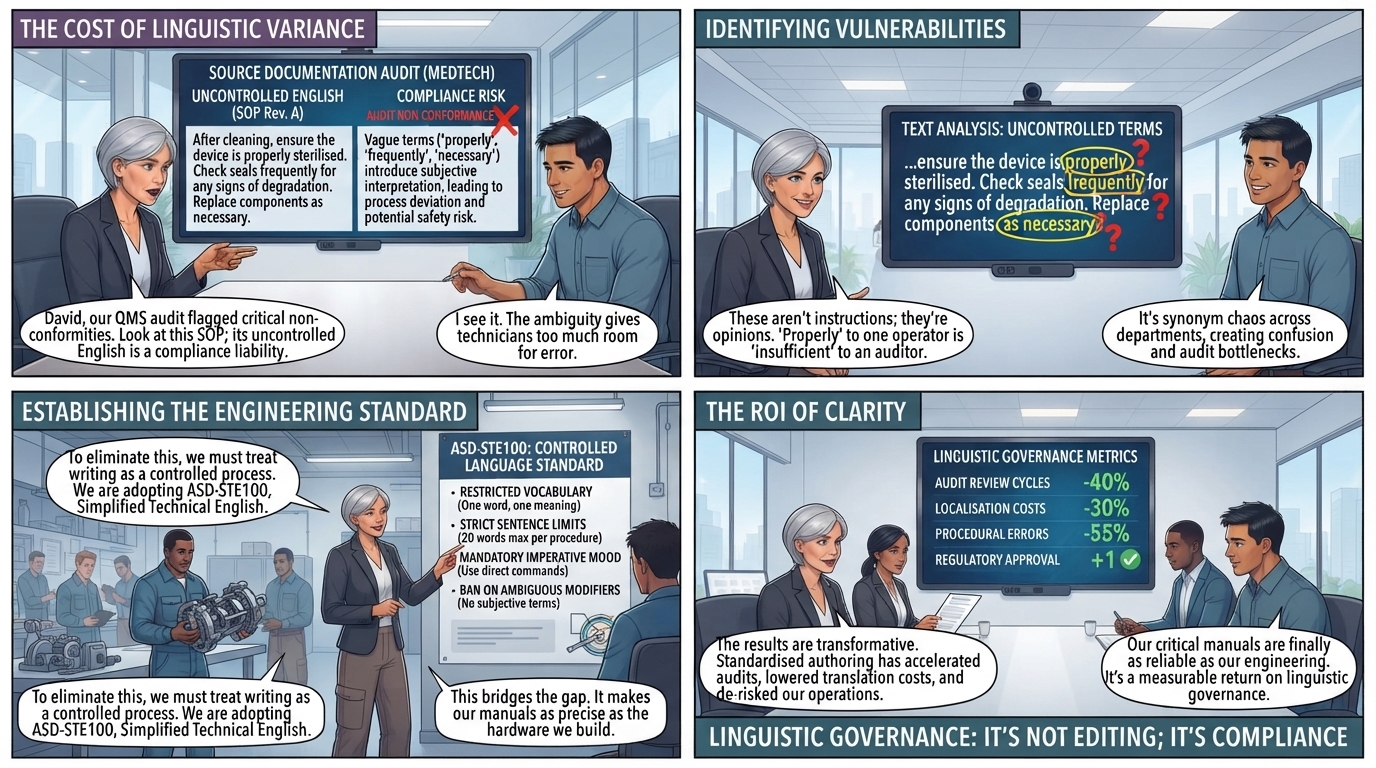
Technical writers and engineers are experts in their fields, but natural language is built for interpretation rather than precision. When drafting documentation without structural constraints, standard writing habits routinely introduce three specific vulnerabilities:

  • Lexical Inconsistency: Different authors use multiple terms for the same component or action. One section calls for disconnect, another for detach, and a third for unplug, creating confusion for readers and rendering translation memories inefficient.
  • Subjective Parameters: Words like appropriate, sufficient, frequent, or excessive introduce personal judgement into instructions that require measurable thresholds. A technician’s definition of “frequent maintenance” rarely matches an auditor’s interpretation.
  • Complex Syntax: Long, multi-clause sentences bury the primary action, increasing cognitive load under operational pressure and elevating the risk of procedural error.

During an audit or regulatory review, these inconsistencies translate directly into audit non-conformities, review bottlenecks, and prolonged approval cycles.

Bridging the Gap with ASD-STE100

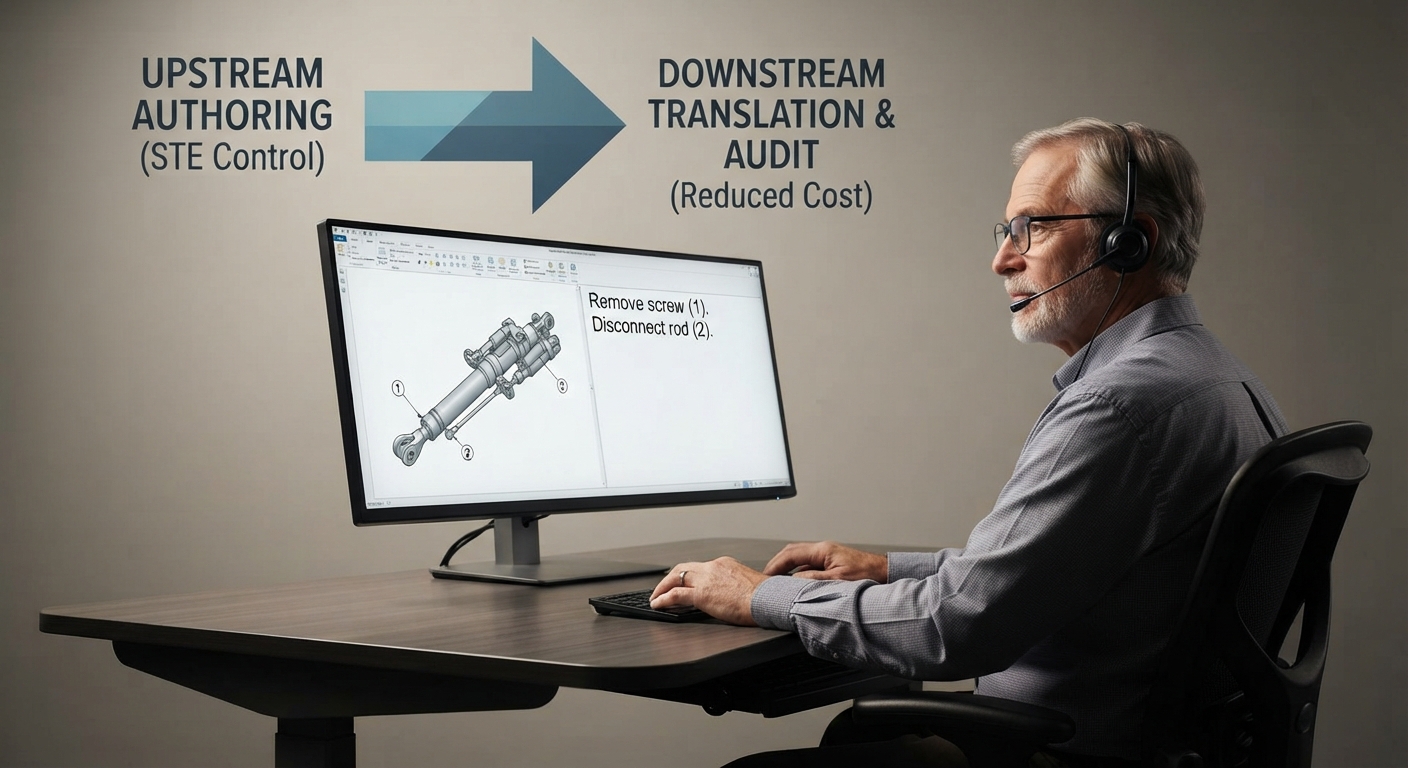
To eliminate this friction, organisations must treat technical authoring as a controlled engineering process. This requires implementing ASD-STE100 (Simplified Technical English)—an international specification originally engineered for complex aerospace systems to remove linguistic uncertainty.

ASD-STE100 brings the same methodological discipline to text that engineers apply to hardware design:

  • A Standardised Vocabulary: A controlled dictionary limits each word to a single approved meaning and part of speech, eliminating unauthorised synonyms and ambiguity.
  • Strict Length Limits: Procedural sentences are restricted to a maximum of 20 words, while descriptive text is capped at 25 words, ensuring information is processed quickly and accurately.
  • Explicit Action-Oriented Phrasing: Writers must use the imperative mood for instructions, ensuring the required task is unmistakable and direct.

The Commercial Impact of Linguistic Governance

Adopting a controlled language standard transforms technical documentation from an administrative bottleneck into an asset for operational excellence. When source texts adhere to a predictable grammatical baseline:

  1. Review Cycles Accelerate: Quality assurance and regulatory teams spend less time untangling vague phrasing and more time evaluating core compliance.
  2. Localisation Costs Drop: Clean, standardised source text maximises translation memory reuse and optimises machine translation accuracy across global markets.
  3. Safety Risks Decrease: Operators in the field execute maintenance procedures without second-guessing ambiguous instructions.

Securing Your Documentation Pipeline

Investing in physical safety systems while ignoring the clarity of the instructions governing them leaves a critical vulnerability open. Standardising authoring output protects your compliance posture, safeguards your audit readiness, and ensures your documentation matches the quality of your engineering.

If your organisation is ready to eliminate documentation ambiguity and streamline compliance workflows, let us evaluate your technical text.

Reserve a 30-min STE Feasibility Session to discuss how linguistic governance can protect your engineering operations.


The Silent Sabotage: Why Unwritten Ground Rules UGRs® Compromise Your Critical Manuals

The Silent Sabotage: Why Unwritten Ground Rules UGRs® Compromise Your Critical Manuals

In every high-hazard organisation—whether in MedTech, Energy, Aerospace, or Heavy Industry—leadership invests heavily in immaculate safety management systems, robust quality frameworks, and exhaustive compliance audits. Yet, despite these multi-million-dollar safety structures, costly operational errors and audit non-conformances still occur on the shop floor, the rig, and the cleanroom.

The root cause rarely lives in your formal policy manuals. It lives in your Unwritten Ground Rules (UGRs)—those pervasive, unvoiced workplace norms of “this is the way we do things around here.”

While UGRs typically get discussed in the context of leadership culture or safety behaviours, their most dangerous manifestation is entirely invisible. They quietly dictate how your engineering teams write, review, and approve technical documentation.

The Gap Between the Quality Manual and the Technical Page

Walk into any engineering department or technical publications office, and you will find formal processes designed for absolute precision. But look closer at the actual text inside the standard operating procedures, maintenance instructions, and device user manuals.

Deeply ingrained legacy UGRs silently shape what ends up on the page. Unspoken habits dictate that “if it sounds complex, academic, and dense, it must be rigorous” or “we’ve always written our technical manuals this way, so do not rock the boat.”

When these cultural norms take over, authors default to ambiguous, open-ended phrasing. Terms like appropriate, sufficient, adequate, or as needed slip past review boards unchallenged. Why? Because within the existing departmental culture, challenging a senior engineer’s convoluted phrasing or breaking a legacy template feels like an unnecessary battle. Silence becomes the path of least resistance.

When Linguistic Ambiguity Becomes an Operational Liability

The moment an ambiguous document leaves the engineering office and lands in the hands of a field technician, a quality inspector, or a clinical application specialist, that cultural silence turns into operational risk.

When a maintenance manual instructs a technician to “tighten the assembly to an appropriate torque” or “verify that the component is sufficiently cleared of debris,” it strips away objective reality. It forces skilled operators into split-second subjective guesswork during high-pressure execution phases.

This is where operational variance spikes. Human error during critical tasks rarely stems from incompetence. Instead, it stems from instructions that leave room for interpretation. Vague writing invites procedural drift, which in turn leads to safety incidents, audit findings, and catastrophic downtime. Poorly written technical instructions are not just a copyediting oversight. They are a direct symptom of a deeper cultural silence where cross-functional teams hesitate to demand absolute clarity.


Linguistic Governance as Cultural Intervention

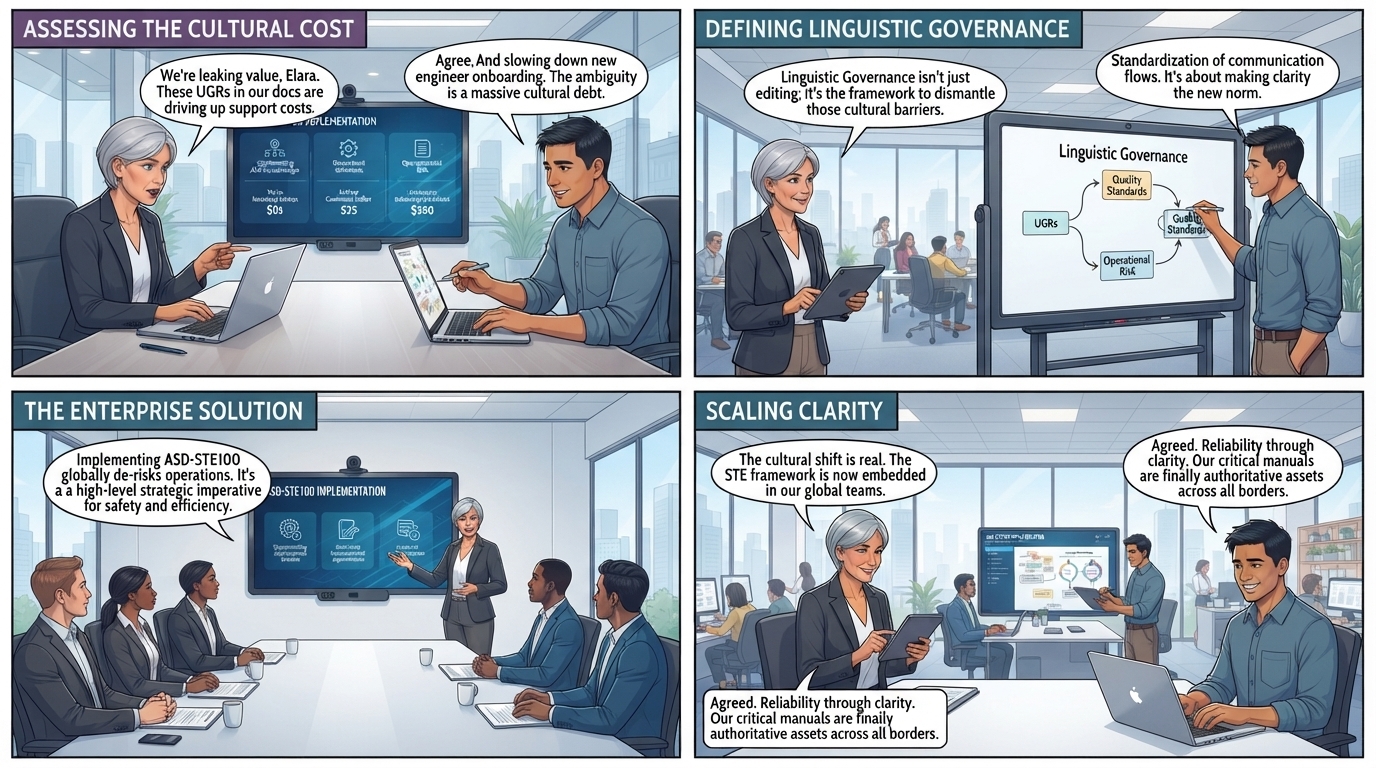
Fixing this requires moving past the superficial view that technical authoring is just a box-checking exercise or a matter of running text through basic grammar software. True risk mitigation demands Linguistic Governance.

Implementing a controlled standard like Simplified Technical English is not merely about enforcing a vocabulary list. It is a systematic cultural and operational intervention that breaks the legacy habit of hiding behind complexity. By restricting a verb to a single meaning, eliminating jargon, and banning ambiguous modifiers, Simplified Technical English forces cross-functional alignment.

When engineering design, technical writing, and field operations operate under a single standard of absolute linguistic clarity, the cultural dynamic shifts. Authors no longer guess what an engineer meant, and technicians no longer gamble on what an instruction implies. It establishes shared ownership over safety-critical data.


Are legacy documentation habits driving up compliance variance in your engineering workflows? Let’s audit your linguistic risk.

🔗 Reserve a 30-min STE Feasibility Session: https://calendly.com/shufranstechdocs/30min

At Shufrans TechDocs, we help aerospace leaders secure total linguistic control over their operations. We move beyond passive software tools by providing expert, human-centric STE training and implementation programmes tailored directly to engineering teams. By standardising technical data at the source, we remove ambiguity to ensure your documentation is accurate for human operators, readable for automated systems, and fully compliant with global safety standards.

UGRs® (Unwritten Ground Rules) was created by Steve Simpson, a registered trademark.

Who Owns the Regulatory Content in Your Product Manuals?

Who Owns the Regulatory Content in Your Product Manuals?

Product manuals and instructions for use carry dozens of items that exist simply because a regulation demands them. When a company ships products to more than ten markets, certification marks, warning texts, and disposal notices multiply into hundreds of combinations. If an organisation does not maintain strict governance over these items, a single rule change can take days just to scope out, and omissions usually surface only at customs or during market surveillance when the cost of fixing them has already escalated.

The Hidden Cost of Linguistic Ambiguity in Manuals

While regulatory compliance is often treated as a logistical checklist, the root cause of most compliance failures is linguistic. Standard English is full of nuance, synonyms, and subjective phrasing that invites misinterpretation. When technical authors write warning notices, installation steps, and safety directives without strict controls, they create hidden liabilities. Translators struggle to find exact equivalents, local authorities raise flags over vague compliance text, and end users face safety risks.

Why ASD-STE100 is a Proven Regulatory Control Mechanism

To solve this, companies need more than a content repository. They need strict linguistic governance. ASD-STE100 (Simplified Technical English) was specifically designed to eliminate ambiguity in complex technical documentation.

  • Controlled vocabulary restricts words and enforces rigid grammatical rules so that every sentence has one unambiguous meaning.

  • Reduced translation friction ensures that standardised source text translates cleanly into multiple languages, eliminating the costly iterations and review cycles that plague multi-market product manuals.

  • Agile regulatory updates allow documentation teams to update precise terminology at the source without rewriting entire manuals when regulations change across global markets.

The Training Delivery Standard

High-compliance industries do not need software shortcuts or generic grammar checklists. They require rigorous, proven linguistic architecture. Shufrans TechDocs delivers the professional implementation and mastery standards required for organisations to embed ASD-STE100 permanently into their operations.

  • Master the definitive specification through structured, industry-proven training tailored for engineering and technical documentation leaders.

  • Eliminate costly ambiguities at the authoring source to protect your products against customs delays and compliance hazards.

  • Streamline global localisation by turning product manuals into clean, audit-ready assets.

When technical documentation is engineered for absolute clarity, the entire compliance workflow changes. Instead of treating manuals as an afterthought or a last-minute scramble before product launch, engineering teams gain a predictable mechanism that scales effortlessly across international borders. Every warning label, safety instruction, and compliance notice becomes structurally immune to local misinterpretation.

Ultimately, investing in rigorous linguistic standardisation protects your bottom line by removing friction from every stage of the product lifecycle. By bridging the gap between complex regulatory mandates and precise authoring standards, your organisation ensures that compliance is no longer a recurring operational risk, but a seamless competitive advantage.

At Shufrans TechDocs, we help aerospace leaders secure total linguistic control over their operations. We move beyond passive software tools by providing expert, human-centric STE training and implementation programmes tailored directly to engineering teams. By standardising technical data at the source, we remove ambiguity to ensure your documentation is accurate for human operators, readable for automated systems, and fully compliant with global safety standards.

To learn how to eliminate ambiguity from your technical documentation and protect your operational timelines, connect with the team at Shufrans TechDocs.


The Cost of Loose Language: Why Technical Documentation Fails at Scale

The Cost of Loose Language: Why Technical Documentation Fails at Scale

Across complex industrial operations—from commercial aerospace maintenance and energy plants to international engineering projects—the most persistent operational risk is rarely mechanical failure. It is linguistic failure.

When a manual instruction leaves room for interpretation, the human mind fills the gap. In high-stakes environments, that subjective judgment call turns into extended review cycles, execution variance, and heavy financial or safety exposure.

The Weight of Unspoken Words

Modern engineering ecosystems grow denser by the day. Complex supply chains span continents, multi-agency teams collaborate on technical missions, and field technicians execute intricate repairs under severe time pressures. Yet, the foundational medium connecting these moving parts remains human language.

When documentation relies on stylistic flair, varied vocabulary, or loose sentence structures, it creates a hidden cognitive tax. If three different technicians can interpret a single maintenance directive in three different ways, the system is fundamentally broken at the root.

The Root Cause of Operational Friction

In many organisations, technical writing is treated as an afterthought rather than a core engineering asset. Engineers focus heavily on the physical design or the software architecture, leaving the accompanying documentation to individual writing styles.

This decentralized approach leads to fragmented terminology across manuals, service bulletins, and training guides. Over time, these small inconsistencies accumulate, creating massive bottlenecks when teams try to scale their operations globally or onboard new partners.

What Linguistic Governance Solves

True operational efficiency begins with strict linguistic discipline. Proven frameworks like the ASD-STE100 specification strip away ambiguity. By enforcing a controlled vocabulary and strict structural rules, technical communication moves from an art form to a precise engineering instrument.

  • Eliminating Execution Variance: Clear procedures ensure that a technical instruction means precisely the same thing in Singapore, Copenhagen, or Toulouse.
  • Reducing Review Friction: Standardised writing cuts through endless editorial loops, allowing technical outputs to reach the field faster.
  • Protecting Operational Integrity: Precision in writing directly protects safety margins, ensuring that critical steps in MRO and energy plants leave zero room for error.

Operating at Modern Scale

Operating in today’s fast-paced industrial environment means volumes of documentation are expanding faster than ever. In an era where information velocity is at an all-time high, the sheer scale of technical output makes discipline harder to maintain, yet infinitely more vital. When organisations flood their ecosystems with raw volume without a governing standard, they scale up confusion rather than clarity.

Precision writing is no longer just about editing manuals. It is about protecting the entire operational chain from the ground up, ensuring that what is written on paper translates safely and accurately to the floor where the real work happens.

If you are curious about how these standards could look in your specific field, Shufrans TechDocs invites you to reserve a chat session.

🔗 Reserve a 30-min STE Feasibility Session: https://calendly.com/shufranstechdocs/30min

Let us make precision the new standard for technical success.

View our full training calendar and secure your spot here: https://www.shufrans-techdocs.com/events/

Asia Pacific | Precision for Safety: Rigorous ASD-STE100 Simplified Technical English Compliance for Technical Documents

Asia Pacific | Precision for Safety: Rigorous ASD-STE100 Simplified Technical English Compliance for Technical Documents


Write effective user manuals & instructions with Simplified Technical English

APAC | Online Certified ASD-STE100 Training Workshop Programme

Dates: 14 & 15 September 2026

Plan later: 28 & 29 September 2026

Time: 09:00 to 16:00 UTC/GMT+8:00 [APAC]

Length of training: 2 days

Course registration ends one week before training commences.

*Course fee includes exercises, learning aids, certificate of completion, and 120-day post-training support.

⁺⁺A group discount of up to €500 is applicable when two or more participants sign up for the same event. Send us your questions: enquiry@shufrans-techdocs.com.

🏷️ A €210 fee discount is applicable when you also sign up for 🆕 Certified STE Masterclass | Asia Pacific (APAC) Online.

Rediscover clarity in documentation with STE

Simplified Technical English (STE) or ASD-STE100 is a controlled technical English language that is used to write technical manuals in a way that they can be more easily understood by an international audience. STE helps to make translations cheaper and more accurate.

STE can easily be adapted to all technical industries and beyond. Ms. Shumin Chen will show participants how to correctly and effectively use STE in practice. She will also address some of the mistakes commonly found in technical writing and the frequent incorrect use of common STE writing rules.

What customers are saying..

I am giving this training a 10/10. There was a good introductory and explanation to describe the 2-day training seminar. Rule 1.1 0 lets me use words that are: approved in the dictionary / technical names / technical verbs and is one rule I like very much because of its flexibility.

I think rule 1.1 is the most critical and important for STE dictionary. Sometimes I have to use non-approved words as an exception, but I will try to keep this rule 1.1 in my documents for good measure.

Although some of the exercises were tricky, they remind me of each rule application at that time. So they were practical for my role as a technical writer.

I want to recommend this course to current technical writers in Korea or engineers who are interested in writing their own documents effectively. Seung Eun Lee, Technical Writer, DB HiTek

Online STE Workshop Outline*

We’re committed to providing the highest quality learning experience in all our online workshops. Therefore, we’ve made the decision to cap all our online workshop session sizes at just five participants, starting 5 May 2025.

This intimate virtual environment fosters richer discussions, more personalised feedback, and a greater overall impact on your understanding and application of key technical communication standards like Simplified Technical English. Learn better, communicate better, across all our courses. This two-day Online STE Workshop includes interactive training, exercises, and a 120-day post-training consultation.

  • Day 1: Classroom Training
    1. Practical overview of Simplified Technical English
    2. How STE helps both native & non-native speakers of English
    3. Benefits of adopting the STE international writing standard
    4. Writing rules and how to apply them in practice
    5. How to use the general vocabulary.
    6. Approved and non-approved words discussion and the rationale behind.
  • Day 2: Application, Review, & Exercises
    1. How to deal with industry-specific terminology
    2. How to use STE for various documentation types
    3. How to implement STE with minimal disruption to on-going production and existing documentation
    4. Practical workshop session for applying STE rules to your own documents
    5. Review, edit, and discuss participants’ own documents to reinforce learning
    6. Classroom presentation of own documents.

* Shufrans also offers customised ASD-STE100 training solutions tailored to meet your specific requirements. These courses are normally provided at the customer’s premises.


Why select a Simplified Technical English training with Shufrans?

Shumin is a very knowledgeable STE instructor. She kept the course interesting and was always open to our questions/feedback. The introduction to Simplified Technical English has been greatly beneficial for my understanding of what the specification entails. In terms of preferred rules, I cannot pinpoint a specific set of STE writing rules as they are all valuable. This was my favorite part of the course as I enjoyed analyzing how other writers went about using STE to best apply it to their line of work.

The rewriting workshop was my favorite part of the course as I enjoyed analyzing how other writers went about using STE to best apply it to their line of work. I would highly recommend this course to all technical writers. Shumin Chen takes the time to clearly explain the rules of STE. A very attentive instructor, indeed. If given the chance, I would really enjoy working along side her. Michael Palmieri, Documentation Specialist, AON3D | The Advanced Additive Manufacturing Platform

What technical writing outcomes to expect?

Our interactive training, exercises and workshop, will teach participants to standardise content to:

  • Enhanced Communication & Efficiency: Authors will gain the skills to create clear, consistent, and easily translatable technical documentation, facilitating effective communication with a global audience and streamlining the writing process.
  • Improved Operational Safety & Reduced Downtime: By mastering STE principles, teams will produce unambiguous documentation that minimises misunderstandings, directly contributing to improved operational safety and a reduction in costly AOG/downtime.
  • Optimised Lifecycle Support & Cost Reduction: Training will enable modular writing and content reuse, leading to maximised consistency, optimised product lifecycle support, and a significant reduction in the overall cost of creating and maintaining technical publications.

Interested in learning more?

Speak to us today or learn more about our upcoming Online STE Workshops here.

Certified STE workshops online

Browse our convenient line-up of Simplified Technical English workshops scheduled at different timezones.


ASD-STE100 Trainer’s qualifications


Ms Shumin Chen will show participants how to correctly and effectively use Simplified Technical English (STE) in practice. She will also address some of the mistakes commonly found in technical writing and the frequently incorrect use of common STE writing rules.

According to Ms Chen, the benefits of STE are manifold – audience engagement through high-quality content, improved product safety, lower life cycle cost and reduced logistics footprint

Learn more about how you can create sustainable STE content and reap substantial cost-saving benefits as a result here.

twitter linkedin

Europe | Future-Proof Your Documentation: Mastering Simplified Technical English (ASD-STE100) Compliance

Europe | Future-Proof Your Documentation: Mastering Simplified Technical English (ASD-STE100) Compliance

Write effective user manuals & instructions with Simplified Technical English

Europe | Online Certified ASD-STE100 Simplified Technical English Training Workshop Programme

Dates: 21 & 22 September 2026

Plan later: 1 & 2 October 2026

Time: 08:00 to 15:00 CET

Length of training: 2 days

Course registration ends one week before training commences.

*Course fee includes exercises, learning aids, certificate of completion, and 120-day post-training support.

⁺⁺A group discount of up to €500 is applicable when two or more participants sign up for the same event. Send us your questions: enquiry@shufrans-techdocs.com.

🏷️ A €210 fee discount is applicable when you also sign up for 🆕 Certified STE Masterclass | Europe Online.

Summary of Simplified Technical English (STE)

Simplified Technical English (STE) or ASD-STE100 is a controlled technical English language that is used to write technical manuals in a way that they can be more easily understood by an international audience. STE helps to make translations cheaper and more accurate. Often a formal requirement for aircraft and defence maintenance documentation, STE can easily be adapted to all technical industries and beyond. Ms. Shumin Chen will teach participants how to correctly and effectively use STE in practice. She will also address some of the mistakes commonly found in technical writing and the frequent incorrect use of common STE writing rules.

Why select a Simplified Technical English training with Shufrans?

Shumin is a very knowledgeable STE instructor. She kept the course interesting and was always open to our questions/feedback. The introduction to Simplified Technical English has been greatly beneficial for my understanding of what the specification entails. In terms of preferred rules, I cannot pinpoint a specific set of STE writing rules as they are all valuable. This was my favorite part of the course as I enjoyed analyzing how other writers went about using STE to best apply it to their line of work.

The rewriting workshop was my favorite part of the course as I enjoyed analyzing how other writers went about using STE to best apply it to their line of work. I would highly recommend this course to all technical writers. Shumin Chen takes the time to clearly explain the rules of STE. A very attentive instructor, indeed. If given the chance, I would really enjoy working along side her. Michael Palmieri, Documentation Specialist, AON3D | The Advanced Additive Manufacturing Platform

STE Course Outline*

We’re committed to providing the highest quality learning experience in all our online workshops. Therefore, we’ve made the decision to cap all our online workshop session sizes at just five participants, starting 5 May 2025.

This intimate virtual environment fosters richer discussions, more personalised feedback, and a greater overall impact on your understanding and application of key technical communication standards like Simplified Technical English. Learn better, communicate better, across all our courses. This two-day Online STE Workshop includes interactive training, exercises, and a 120-day post-training consultation.

  • Day 1: Classroom Training
    1. Practical overview of Simplified Technical English
    2. How STE helps both native & non-native speakers of English
    3. Benefits of adopting the STE international writing standard
    4. Writing rules and how to apply them in practice
    5. How to use the general vocabulary.
    6. Approved and non-approved words discussion and the rationale behind.
  • Day 2: Application, Review, & Exercises
    1. How to deal with industry-specific terminology
    2. How to use STE for various documentation types
    3. How to implement STE with minimal disruption to on-going production and existing documentation
    4. Practical workshop session for applying STE rules to your own documents
    5. Review, edit, and discuss participants’ own documents to reinforce learning.
    6. Classroom presentation of own documents.

* Shufrans also offers customised ASD-STE100 training solutions tailored to meet your specific requirements. These courses are normally provided at the customer’s premises.

Who should attend this Simplified Technical English training?

  • Compliance managers
  • CIO, COO, CTO
  • Customer support managers
  • Documentation managers
  • Editors
  • Engineering managers
  • Engineers and SMEs who create documentation
  • Graphics specialists
  • ILS managers
  • Maintenance managers
  • Operation managers
  • Product managers
  • Project managers
  • Quality managers
  • Software research engineers
  • Technical illustrators
  • Technical writers
  • Translation managers
  • Translators.

What technical writing outcomes to expect?

Our interactive training, exercises and workshop, will teach participants to standardise content to:

  • Enhanced Communication & Efficiency: Authors will gain the skills to create clear, consistent, and easily translatable technical documentation, facilitating effective communication with a global audience and streamlining the writing process.
  • Improved Operational Safety & Reduced Downtime: By mastering STE principles, teams will produce unambiguous documentation that minimises misunderstandings, directly contributing to improved operational safety and a reduction in costly AOG/downtime.
  • Optimised Lifecycle Support & Cost Reduction: Training will enable modular writing and content reuse, leading to maximised consistency, optimised product lifecycle support, and a significant reduction in the overall cost of creating and maintaining technical publications.

What customers are saying..

The introduction was a good and concise way to familiarize yourself with STE basics. I’ve a background in plain language, so for example the rule on noun clusters makes perfect sense. I’m all about simplification, so substituting verbs like “eliminate” for verbs like “remove” or “stop” will be my new quest. The STE exercises were helpful in getting to grasp with STE during the training workshop. I’d very likely recommend this course to anyone planning to introduce STE as it’s got a great practical angle. Jenni Virtaluoto, PhD, Senior Lecturer, University of Jyväskylä, Finland

ASD-STE100 Trainer’s qualifications

Ms. Shumin Chen, principal trainer & consultant at Shufrans TechDocs received her professional on-the-job training in the field of STE under the tutelage of Dr Frans Wijma, a linguist and documentation expert. Together as an experienced global team, they provided their combined knowledge and dedication to benefit customers worldwide. To date, they have provided training and consultancy services to over 200 companies. Shufrans TechDocs is the only company with such vast experience in providing certified STE training.

Shumin has supported various companies with their STE and other documentation needs, based on standards where possible. Although STE was developed for the aerospace industry, more specifically for aircraft maintenance documentation, she found that it made a lot of sense to apply the same principles to other industries and types of documents as well. Few -if any- changes to the specification are necessary to adapt STE to industrial sectors ranging from machinery to IT, automotive to medical equipment.

Simplified Technical English STE examples


Americas | Mastering Simplified Technical English: Ensuring Clarity and Compliance in Technical Documentation

Americas | Mastering Simplified Technical English: Ensuring Clarity and Compliance in Technical Documentation


Write effective user manuals & instructions with ASD-STE100 Simplified Technical English

Americas | Online Certified ASD-STE100 Simplified Technical English Workshops

Dates: 23 to 25 September 2026

Plan later: 7 to 9 October 2026

Time: 08:00 to 12:30 Eastern Time (ET) or 15:00 to 19:30 Pacific Time (PT)

Length of training: 3 days

Course registration ends one week before training commences.

*Course fee includes exercises, learning aids, certificate of completion, and 120-day post-training support.

⁺⁺A group discount of up to €500 is applicable when two or more participants sign up for the same event. Send us your questions: enquiry@shufrans-techdocs.com.

🏷️ A €210 fee discount is applicable when you also sign up for 🆕 Certified STE Masterclass | US Canada Online.

Summary

Simplified Technical English (STE) is a controlled language that is used to write technical manuals in a way that they can be more easily understood by an international audience. STE helps to make translations cheaper and more accurate. Often a formal requirement for aircraft and defence maintenance documentation, STE can easily be adapted to all technical industries and beyond. Ms. Shumin Chen will show participants how to correctly and effectively use STE in practice. She will also address some of the mistakes commonly found in technical writing and the frequent incorrect use of common STE writing rules.

Course outline*

We’re committed to providing the highest quality learning experience in all our online workshops. Therefore, we’ve made the decision to cap all our online workshop session sizes at just five participants, starting 5 May 2025.

This intimate virtual environment fosters richer discussions, more personalised feedback, and a greater overall impact on your understanding and application of key technical communication standards like Simplified Technical English. Learn better, communicate better, across all our courses. This three-day Online STE Workshop includes interactive training, exercises, and a 120-day post-training consultation.

  • Day 1: Classroom Training
    1. Practical overview of Simplified Technical English
    2. How STE helps both native & non-native speakers of English
    3. Benefits of adopting the STE international writing standard
    4. Writing rules and how to apply them in practice.
  • Day 2: Application & Exercises
    1. How to use the general vocabulary.
    2. Approved and non-approved words discussion and the rationale behind.
    3. How to deal with industry-specific terminology
    4. How to use STE for various documentation types.
  • Day 3: Review, & Exercises
    1. Practical workshop session for applying STE rules to your own documents
    2. Review, edit, and discuss participants’ own documents to reinforce learning
    3. How to implement STE with minimal disruption to on-going production and existing documentation.
    4. Classroom presentation of own documents.

* Shufrans also offers customised ASD-STE100 training solutions tailored to meet your specific requirements. These courses are normally provided at the customer’s premises.

What customers are saying..

I was looking forward to the training and was not disappointed. I think that the training was valuable and would recommend that my colleagues take the training either on line or in person. Being able to send a sample document and then working on it together using my new STE skills was very helpful and valuable. Shumin was extremely knowledgeable and gave many practical examples. I hope to be able to make use of the support period post-training. Deborah Tonkin, Technical Information Engineer, Komatsu

Why select a Simplified Technical English training with Shufrans?

The introduction to ASD-STE100 was good and informative for someone like me with zero knowledge of the STE standard before. Rule 6.3 in STE writing summarizes the best of what I can take with me. There was quite a lot from the STE exercises to consume regarding grammar. Nevertheless, the worksheets were very good and helpful. I gained quite a lot of knowledge from them and they were the best part of this training workshop. Shumin was very professional and sharp as a razor. The best takeaway for me from her workshop is to give more thought to how I build my sentences rather than focussing on specific ‘allowed’ or ‘approved’ words. Jeppe Friis, Technical Inspector, Maersk Drilling Maintenance Support

Who should attend this ASD-STE100 workshop?

  • Compliance managers
  • CIO, COO, CTO
  • Customer support managers
  • Documentation managers
  • Editors
  • Engineering managers
  • Engineers and SMEs who create documentation
  • Graphics specialists
  • ILS managers
  • Maintenance managers
  • Operation managers
  • Product managers
  • Project managers
  • Quality managers
  • Software research engineers
  • Technical illustrators
  • Technical writers
  • Translation managers
  • Translators.

What ASD-STE100 workshop training outcomes to expect?

Our interactive training, exercises and workshop, will teach participants to standardise content to:

  • Enhanced Communication & Efficiency: Authors will gain the skills to create clear, consistent, and easily translatable technical documentation, facilitating effective communication with a global audience and streamlining the writing process.
  • Improved Operational Safety & Reduced Downtime: By mastering STE principles, teams will produce unambiguous documentation that minimises misunderstandings, directly contributing to improved operational safety and a reduction in costly AOG/downtime.
  • Optimised Lifecycle Support & Cost Reduction: Training will enable modular writing and content reuse, leading to maximised consistency, optimised product lifecycle support, and a significant reduction in the overall cost of creating and maintaining technical publications.

ASD-STE100 Trainer’s qualifications

Ms. Shumin Chen, principal trainer & consultant at Shufrans TechDocs received her professional on-the-job training in the field of STE under the tutelage of Dr Frans Wijma, a linguist and documentation expert. Together as an experienced global team, they provided their combined knowledge and dedication to benefit customers worldwide. To date, they have provided training and consultancy services to over 180 companies. Shufrans TechDocs is the only company with such vast experience in providing certified STE training.

Shumin has supported various companies with their STE and other documentation needs, based on standards where possible. Although STE was developed for the aerospace industry, more specifically for aircraft maintenance documentation, Shumin found that it made a lot of sense to apply the same principles to other industries and types of documents as well. Few -if any- changes to the specification are necessary to adapt STE to industries ranging from machinery to IT, automotive to medical equipment.


Middle East & Africa | Practical ASD-STE100 Simplified Technical English Workshops: Ensuring Documentation Compliance

Middle East & Africa | Practical ASD-STE100 Simplified Technical English Workshops: Ensuring Documentation Compliance


Middle East & Africa Online ASD-STE100 Technical Writing Workshop

MEA | Online Certified ASD-STE100 Training Workshop Programme

Dates: 16 & 17 September 2026

Plan later: 5 & 6 October 2026

Time: 09:00 to 16:00 Gulf Standard Time (GST)

Length of training: 2 days

Course registration ends one week before training commences.

*Course fee includes exercises, learning aids, certificate of completion, and 120-day post-training support.

⁺⁺A group discount of up to €500 is applicable when two or more participants sign up for the same event. is applicable when two or more participants sign up for the same event. Send us your questions: enquiry@shufrans-techdocs.com.

🏷️ A €210 fee discount is applicable when you also sign up for 🆕 Certified STE Masterclass | Asia Pacific (APAC) Online.

Rediscover clarity in documentation with STE

Simplified Technical English (STE) or ASD-STE100 is a controlled technical English language that is used to write technical manuals in a way that they can be more easily understood by an international audience. STE helps to make translations cheaper and more accurate.

ASD-STE100 is mandated by several commercial and military specifications (MIL-SPEC) that control the style and content of maintenance documentation. Military defence standards (MIL-SPEC / MIL-STD) such as MIL-STD-3048, as well as technical documentation standards like S1000D and ATA iSpec 2200 recommend the use of ASD-STE100. In ASD-STE100, technical authors are encouraged to keep sentences brief and paragraphs short, while ensuring the completeness of information.

Often a formal requirement for aircraft and defence maintenance documentation, STE can easily be adapted to all technical industries and beyond. Ms. Shumin Chen will show participants how to correctly and effectively use STE in practice. She will also address some of the mistakes commonly found in technical writing and the frequently incorrect use of common STE writing rules.

The ASD-STE100 workshop conducted by Shufrans TechDocs made for a very good introduction to STE for new as well as intermediate users of the STE writing standard. The presentation on rules was very clear and I liked the emphasis on the fact that the rules are weighted and how one can use them flexibly. The exercises completed during this training were good and provided real world examples in technical writing in a practical way. I’d very likely recommend this course to someone else. This course is a must for any new technical writers or technical publication employees. Neil Winson, Technical Writer, Airbus Helicopters

MEA Online STE Workshop Course Outline*

We’re committed to providing the highest quality learning experience in all our online workshops. Therefore, we’ve made the decision to cap all our online workshop session sizes at just five participants, starting 5 May 2025.

This intimate virtual environment fosters richer discussions, more personalised feedback, and a greater overall impact on your understanding and application of key technical communication standards like Simplified Technical English. Learn better, communicate better, across all our courses. This two-day Online STE Workshop includes interactive training, exercises, and a 120-day post-training consultation.

  • Day 1: Classroom Training
    1. Practical overview of Simplified Technical English
    2. How STE helps both native & non-native speakers of English
    3. Benefits of adopting the STE international writing standard
    4. Writing rules and how to apply them in practice
    5. How to use the general vocabulary.
    6. Approved and non-approved words discussion and the rationale behind.
  • Day 2: Application, Review, & Exercises
    1. How to deal with industry-specific terminology
    2. How to use STE for various documentation types
    3. How to implement STE with minimal disruption to on-going production and existing documentation
    4. Practical workshop session for applying STE rules to your own documents
    5. Review, edit, and discuss participants’ own documents to reinforce learning
    6. Classroom presentation of own documents.

* Shufrans also offers customised ASD-STE100 training solutions tailored to meet your specific requirements. These courses are normally provided at the customer’s premises.

Who should attend this Simplified Technical English training?

  • Compliance managers
  • CIO, COO, CTO
  • Customer support managers
  • Documentation managers
  • Editors
  • Engineering managers
  • Engineers and SMEs who create documentation
  • Graphics specialists
  • ILS managers
  • Maintenance managers
  • Operation managers
  • Product managers
  • Project managers
  • Quality managers
  • Software research engineers
  • Technical illustrators
  • Technical writers
  • Translation managers
  • Translators.

What training outcomes to expect?

Our interactive training, exercises and workshop, will teach participants to standardise content to:

  • Enhanced Communication & Efficiency: Authors will gain the skills to create clear, consistent, and easily translatable technical documentation, facilitating effective communication with a global audience and streamlining the writing process.
  • Improved Operational Safety & Reduced Downtime: By mastering STE principles, teams will produce unambiguous documentation that minimises misunderstandings, directly contributing to improved operational safety and a reduction in costly AOG/downtime.
  • Optimised Lifecycle Support & Cost Reduction: Training will enable modular writing and content reuse, leading to maximised consistency, optimised product lifecycle support, and a significant reduction in the overall cost of creating and maintaining technical publications.

ASD-STE100 Trainer’s qualifications

Ms. Shumin Chen, principal trainer & consultant at Shufrans TechDocs received her professional on-the-job training in the field of STE under the tutelage of Dr Frans Wijma, a linguist and documentation expert. Together as an experienced global team, they provided their combined knowledge and dedication to benefit customers worldwide. To date, they have provided training and consultancy services to over 200 companies. Shufrans TechDocs is the only company with such vast experience in providing certified STE training.

Shumin has supported various companies with their ASD-STE100 technical writing and other documentation needs, based on standards where possible. Although STE was developed for the aerospace industry, more specifically for aircraft maintenance documentation, Shumin found that it made a lot of sense to apply the same principles to other industries and types of documents as well. Few -if any- changes to the specification are necessary to adapt STE to industries ranging from machinery to IT, automotive to medical equipment.

Can Simplified Technical English be used for various documentation types?

Can Simplified Technical English be used for various documentation types?

Remote webinar: Simplified Technical English

Dates: Wednesday, 28 August 2019

Time: 12:00 PM to 1:00 PM, Australian Eastern Standard Time (AEST)

Register

ASD-STE100 Simplified Technical English is a guideline that regulates the wording and writing style used in technical publications. Originally developed for the aerospace industry, it is now widely used also outside the aviation industry, including companies in the defence, machinery, electronics, semiconductor, medical equipment, IT, and hi-tech industries.

This presentation explores the usability of Simplified Technical English outside of maintenance documentation. We will discuss industry examples that demonstrate the versatility of this documentation standard that has been in active use since the 1980s.


Middle East & Africa Online Workshop: ASD-STE100 Simplified Technical English workshop for all industries

Middle East & Africa Online Workshop: ASD-STE100 Simplified Technical English workshop for all industries

ASD-STE100 Simplified Technical English workshop for all industries

Dates: 27 & 28 January 2020

Plan later: 

  1. 19 & 20 February 2020
  2. 4 & 5 March 2020.

Time: 09:00 to 17:00 Gulf Standard Time [MEA]

Length of training: 2 days

Course fee: 450 EUR**

Course registration ends one week before training commences.

**Course fee includes exercises, learning aids, certificate of completion, and 90-day post-training support.

Summary

Simplified Technical English (STE) is a controlled language that is used to write technical manuals in such a way that they can be more easily understood by an international audience. STE helps to make translations cheaper and more accurate. Often a formal requirement for aircraft and defence maintenance documentation, STE can easily be adapted to all technical industries and beyond. Ms. Shumin Chen will teach participants how to correctly and effectively use STE in practice. She will also address some of the mistakes commonly found in technical writing and the frequently incorrect use of common STE writing rules.

I’ve found all the rules introduced in this workshop equally valuable and applicable in my field of work. The ASD-STE100 Specification is very useful for searching examples and finding STE compliant alternatives. It was also great that we has such a large number of practical exercises. Personally, it would be more valuable to have more context available. This helps us judge how to apply STE optimally. Thank you Shumin! Your workshop was concise, clear, and pragmatic. I also liked the occasional humour! 🙂 Diane Goodrick, Information Architect/ Author Trainer, Schindler Group.

Course outline*

  • Day 1: Classroom Training
    1. Practical overview of Simplified Technical English
    2. How STE helps both native & non-native speakers of English
    3. Benefits of adopting the STE international writing standard
    4. Writing rules and how to apply them in practice
    5. How to use the general vocabulary.
    6. Approved and non-approved words discussion and the rationale behind.
  • Day 2: Application, Review, & Exercises
    1. How to deal with industry-specific terminology
    2. How to use STE for various documentation types
    3. How to implement STE with minimal disruption to on-going production and existing documentation
    4. Practical workshop session for applying STE rules to your own documents
    5. Review, edit, and discuss participants’ own documents to reinforce learning
    6. Classroom presentation of own documents.

* Shufrans also offers customised ASD-STE100 training solutions tailored to meet your specific requirements. These courses are normally provided at the customer’s premises.


Who should attend?

  • Compliance managers
  • CIO, COO, CTO
  • Customer support managers
  • Documentation managers
  • Editors
  • Engineering managers
  • Engineers and SMEs who create documentation
  • Graphics specialists
  • ILS managers
  • Maintenance managers
  • Operation managers
  • Product managers
  • Project managers
  • Quality managers
  • Software research engineers
  • Technical illustrators
  • Technical writers
  • Translation managers
  • Translators.

What training outcomes to expect?

Our interactive training, exercises and workshop, will teach participants to standardise content to:

  • Author more efficiently
  • Communicate more effectively with a global audience
  • Improve operational safety
  • Reduce AOG / downtime
  • Facilitate modular writing and reuse
  • Facilitate teamwork
  • Facilitate translation
  • Maximise consistency
  • Optimise product lifecycle support
  • Reduce the cost of creating and maintaining technical publications.

Trainer’s qualifications

Ms. Shumin Chen, principal trainer & consultant at Shufrans TechDocs received her professional on-the-job training in the field of STE under the tutelage of Dr Frans Wijma, a linguist and documentation expert. Together as an experienced global team, they provided their combined knowledge and dedication to benefit customers worldwide. To date, they have provided training and consultancy services to over 180 companies. Shufrans TechDocs is the only company with such vast experience in providing certified STE training.

Shumin has supported various companies with their STE and other documentation needs, based on standards where possible. Although STE was developed for the aerospace industry, more specifically for aircraft maintenance documentation, Shumin found that it made a lot of sense to apply the same principles to other industries and types of documents as well. Few -if any- changes to the specification are necessary to adapt STE to industries ranging from machinery to IT, automotive to medical equipment.