linguistic governance Archives | Shufrans TechDocs Home // linguistic governance Archives | Shufrans TechDocs

The Quiet Risk: Why Uncontrolled English Undermines Engineering Compliance

The Quiet Risk: Why Uncontrolled English Undermines Engineering Compliance

Engineering organisations subject every physical component, software algorithm, and manufacturing process to rigorous validation. Yet, the instructions guiding how operators, technicians, and auditors interact with those systems are frequently left to individual writing styles.

When standard operating procedures (SOPs), maintenance manuals, and regulatory dossiers rely on conversational phrasing, they introduce controlled variation into environments that demand absolute predictability. In high-consequence sectors like aerospace, medical devices, automotive, and heavy industry, that linguistic gap is a major operational liability.

The Structural Vulnerability of Natural Language

Technical writers and engineers are experts in their fields, but natural language is built for interpretation rather than precision. When drafting documentation without structural constraints, standard writing habits routinely introduce three specific vulnerabilities:

  • Lexical Inconsistency: Different authors use multiple terms for the same component or action. One section calls for disconnect, another for detach, and a third for unplug, creating confusion for readers and rendering translation memories inefficient.
  • Subjective Parameters: Words like appropriate, sufficient, frequent, or excessive introduce personal judgement into instructions that require measurable thresholds. A technician’s definition of “frequent maintenance” rarely matches an auditor’s interpretation.
  • Complex Syntax: Long, multi-clause sentences bury the primary action, increasing cognitive load under operational pressure and elevating the risk of procedural error.

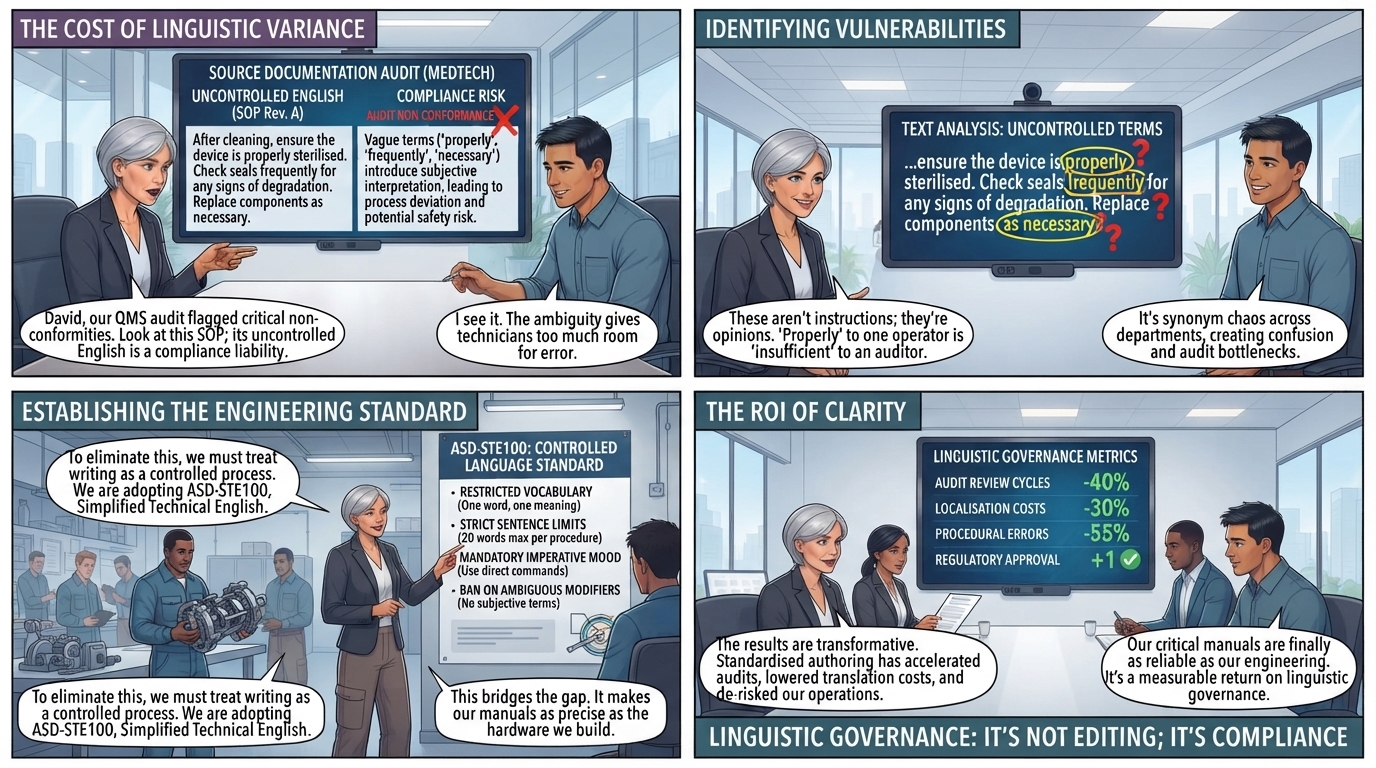
During an audit or regulatory review, these inconsistencies translate directly into audit non-conformities, review bottlenecks, and prolonged approval cycles.

Bridging the Gap with ASD-STE100

To eliminate this friction, organisations must treat technical authoring as a controlled engineering process. This requires implementing ASD-STE100 (Simplified Technical English)—an international specification originally engineered for complex aerospace systems to remove linguistic uncertainty.

ASD-STE100 brings the same methodological discipline to text that engineers apply to hardware design:

  • A Standardised Vocabulary: A controlled dictionary limits each word to a single approved meaning and part of speech, eliminating unauthorised synonyms and ambiguity.
  • Strict Length Limits: Procedural sentences are restricted to a maximum of 20 words, while descriptive text is capped at 25 words, ensuring information is processed quickly and accurately.
  • Explicit Action-Oriented Phrasing: Writers must use the imperative mood for instructions, ensuring the required task is unmistakable and direct.

The Commercial Impact of Linguistic Governance

Adopting a controlled language standard transforms technical documentation from an administrative bottleneck into an asset for operational excellence. When source texts adhere to a predictable grammatical baseline:

  1. Review Cycles Accelerate: Quality assurance and regulatory teams spend less time untangling vague phrasing and more time evaluating core compliance.
  2. Localisation Costs Drop: Clean, standardised source text maximises translation memory reuse and optimises machine translation accuracy across global markets.
  3. Safety Risks Decrease: Operators in the field execute maintenance procedures without second-guessing ambiguous instructions.

Securing Your Documentation Pipeline

Investing in physical safety systems while ignoring the clarity of the instructions governing them leaves a critical vulnerability open. Standardising authoring output protects your compliance posture, safeguards your audit readiness, and ensures your documentation matches the quality of your engineering.

If your organisation is ready to eliminate documentation ambiguity and streamline compliance workflows, let us evaluate your technical text.

Reserve a 30-min STE Feasibility Session to discuss how linguistic governance can protect your engineering operations.


The Silent Sabotage: Why Unwritten Ground Rules UGRs® Compromise Your Critical Manuals

The Silent Sabotage: Why Unwritten Ground Rules UGRs® Compromise Your Critical Manuals

In every high-hazard organisation—whether in MedTech, Energy, Aerospace, or Heavy Industry—leadership invests heavily in immaculate safety management systems, robust quality frameworks, and exhaustive compliance audits. Yet, despite these multi-million-dollar safety structures, costly operational errors and audit non-conformances still occur on the shop floor, the rig, and the cleanroom.

The root cause rarely lives in your formal policy manuals. It lives in your Unwritten Ground Rules (UGRs)—those pervasive, unvoiced workplace norms of “this is the way we do things around here.”

While UGRs typically get discussed in the context of leadership culture or safety behaviours, their most dangerous manifestation is entirely invisible. They quietly dictate how your engineering teams write, review, and approve technical documentation.

The Gap Between the Quality Manual and the Technical Page

Walk into any engineering department or technical publications office, and you will find formal processes designed for absolute precision. But look closer at the actual text inside the standard operating procedures, maintenance instructions, and device user manuals.

Deeply ingrained legacy UGRs silently shape what ends up on the page. Unspoken habits dictate that “if it sounds complex, academic, and dense, it must be rigorous” or “we’ve always written our technical manuals this way, so do not rock the boat.”

When these cultural norms take over, authors default to ambiguous, open-ended phrasing. Terms like appropriate, sufficient, adequate, or as needed slip past review boards unchallenged. Why? Because within the existing departmental culture, challenging a senior engineer’s convoluted phrasing or breaking a legacy template feels like an unnecessary battle. Silence becomes the path of least resistance.

When Linguistic Ambiguity Becomes an Operational Liability

The moment an ambiguous document leaves the engineering office and lands in the hands of a field technician, a quality inspector, or a clinical application specialist, that cultural silence turns into operational risk.

When a maintenance manual instructs a technician to “tighten the assembly to an appropriate torque” or “verify that the component is sufficiently cleared of debris,” it strips away objective reality. It forces skilled operators into split-second subjective guesswork during high-pressure execution phases.

This is where operational variance spikes. Human error during critical tasks rarely stems from incompetence. Instead, it stems from instructions that leave room for interpretation. Vague writing invites procedural drift, which in turn leads to safety incidents, audit findings, and catastrophic downtime. Poorly written technical instructions are not just a copyediting oversight. They are a direct symptom of a deeper cultural silence where cross-functional teams hesitate to demand absolute clarity.


Linguistic Governance as Cultural Intervention

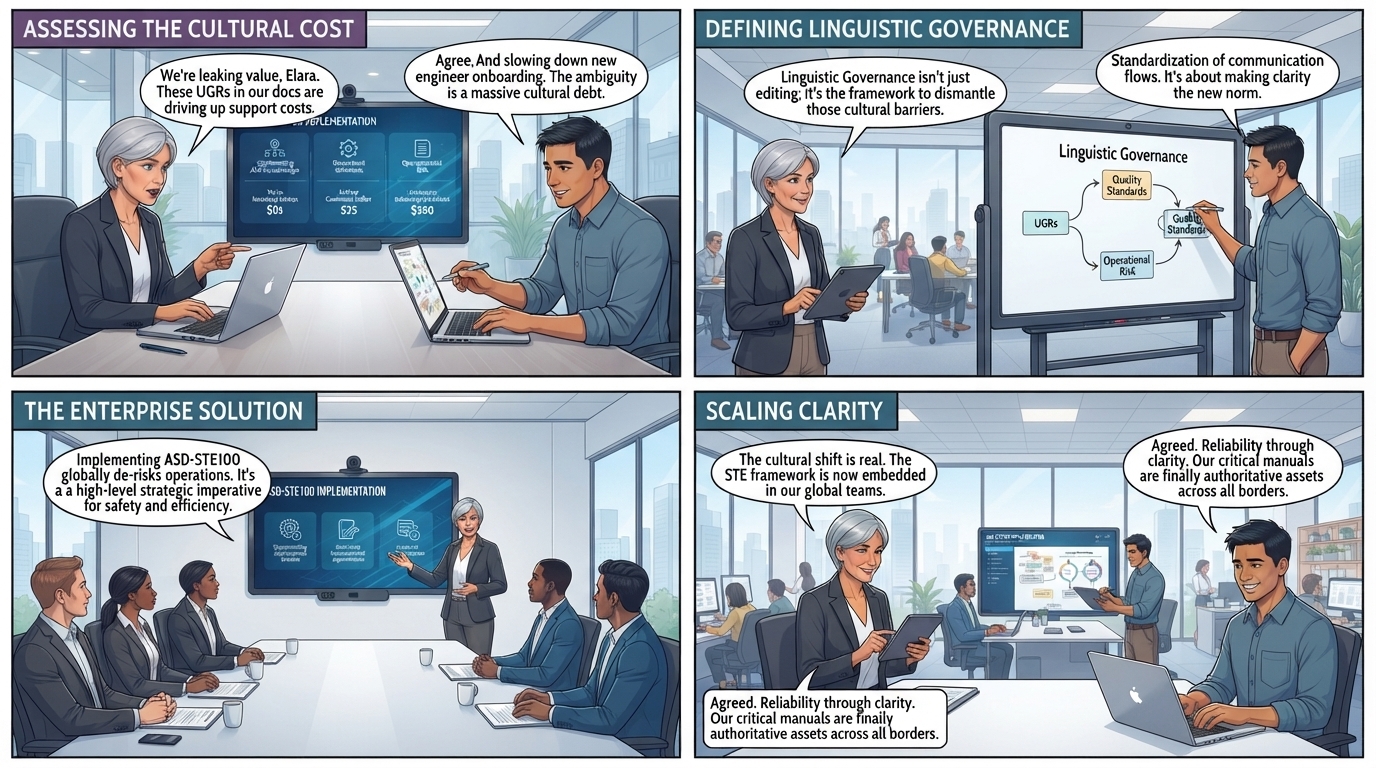
Fixing this requires moving past the superficial view that technical authoring is just a box-checking exercise or a matter of running text through basic grammar software. True risk mitigation demands Linguistic Governance.

Implementing a controlled standard like Simplified Technical English is not merely about enforcing a vocabulary list. It is a systematic cultural and operational intervention that breaks the legacy habit of hiding behind complexity. By restricting a verb to a single meaning, eliminating jargon, and banning ambiguous modifiers, Simplified Technical English forces cross-functional alignment.

When engineering design, technical writing, and field operations operate under a single standard of absolute linguistic clarity, the cultural dynamic shifts. Authors no longer guess what an engineer meant, and technicians no longer gamble on what an instruction implies. It establishes shared ownership over safety-critical data.


Are legacy documentation habits driving up compliance variance in your engineering workflows? Let’s audit your linguistic risk.

🔗 Reserve a 30-min STE Feasibility Session: https://calendly.com/shufranstechdocs/30min

At Shufrans TechDocs, we help aerospace leaders secure total linguistic control over their operations. We move beyond passive software tools by providing expert, human-centric STE training and implementation programmes tailored directly to engineering teams. By standardising technical data at the source, we remove ambiguity to ensure your documentation is accurate for human operators, readable for automated systems, and fully compliant with global safety standards.

UGRs® (Unwritten Ground Rules) was created by Steve Simpson, a registered trademark.

The Multi-Million-Dollar Machine Built With a Mystery Manual

The Multi-Million-Dollar Machine Built With a Mystery Manual

When you discuss modernising technical documentation with industry leads, the response is often a polite brush-off: a quiet note that they are simply not interested right now, followed by a swift exit.

It is a fascinating reaction.

You have engineered a marvel of industrial machinery. It weighs 20 tonnes, handles complex high-throughput processing, operates under punishing conditions, and represents years of precision mechanical and electrical design. It is shipped to a plant halfway across the world.

Then, an operator misinterprets a single, poorly translated safety instruction in the manual because the source text was written with loose, ambiguous phrasing instead of clear engineering data.

A component jams. Production stops. Equipment is damaged, or worse, someone gets hurt.

Whose fault is it? The engineers blame the manual. But the Technical Documentation Lead sitting back at headquarters—the person who dismissed text standardisation with a wave of the hand because “we’ve always written manuals this way”—sleeps soundly, completely blind to the fact that their department is an operational hazard.


The Industrial Delusion: The ISO Paperwork Tra

When you talk to documentation leads in heavy machinery and traditional manufacturing about linguistic governance or Simplified Technical English, you usually get a predictable defence:

  • “We have our ISO audit sorted, so our quality is covered.”
  • “Our translation agency handles the phrasing.”
  • “We don’t have the bandwidth to retrain our authors.”

It is a fascinating display of professional cognitive dissonance. These are the exact same enterprises that will happily throw a fortune at auditors to pass an ISO paperwork check, certifying that a bloated, chaotic authoring process has been officially documented and filed away. They cling to the ‘if it ain’t broke, don’t fix it’ mentality, entirely missing the point that their documentation is not only broken—it is an expensive, silent failure point.

Yet, when it comes to the actual words commanding how a multi-million-dollar machine is safely operated and maintained, it remains a free-for-all of ambiguous syntax, cultural idiom, and creative prose. An ISO certificate proves you have a process on paper. It does not prove your instructions make sense to a foreign technician at 3:00 AM.

The True Cost of Status-Quo Comfort

Refusing to standardise source text isn’t a neutral administrative choice. It is an active decision to burn capital and invite risk:

  1. The Translation Black Hole: Dumping unstandardised, verbose source text into translation memory or AI tools guarantees exponential costs. You are paying good money year after year to have translators untangle convoluted sentences that never should have been written that way in the first place.
  2. The Safety Liability: In heavy-duty industrial processing, ambiguity is a hazard. Words like appropriate, sufficient, or check periodically are legal and operational landmines. If an instruction can be interpreted in two ways, someone will eventually choose the wrong one.
  3. The AI Dead-End: Companies love talking about digital transformation and AI-driven service assistants. But if your underlying documentation is written like a novel, your downstream AI models will hallucinate, misinterpret procedures, and fail catastrophically.

Stop Managing a Printing Press

If your definition of technical documentation is simply filling pages until a CE-compliance box is checked, you aren’t managing an engineering asset. You are managing an expensive printing press for liability.

Trust in engineering arrives on foot and leaves on horseback. Decades of building rigorous, high-performance machinery can be undermined in a single afternoon by a legacy mindset that treats safety-critical documentation as an afterthought.

True linguistic governance isn’t about adding red tape. It is about removing friction, slashing localisation budgets, and ensuring that safety-critical instructions translate seamlessly into any language, anywhere in the world.

Your engineering is too precise to let your words be an afterthought.

If your technical documentation team is tired of fighting translation drag, inflated localisation budgets, and unclear source text, let’s talk. At Shufrans TechDocs, we implement Simplified Technical English and Linguistic Governance for high-compliance engineering sectors that take safety and clarity seriously.


Who Owns the Regulatory Content in Your Product Manuals?

Who Owns the Regulatory Content in Your Product Manuals?

Product manuals and instructions for use carry dozens of items that exist simply because a regulation demands them. When a company ships products to more than ten markets, certification marks, warning texts, and disposal notices multiply into hundreds of combinations. If an organisation does not maintain strict governance over these items, a single rule change can take days just to scope out, and omissions usually surface only at customs or during market surveillance when the cost of fixing them has already escalated.

The Hidden Cost of Linguistic Ambiguity in Manuals

While regulatory compliance is often treated as a logistical checklist, the root cause of most compliance failures is linguistic. Standard English is full of nuance, synonyms, and subjective phrasing that invites misinterpretation. When technical authors write warning notices, installation steps, and safety directives without strict controls, they create hidden liabilities. Translators struggle to find exact equivalents, local authorities raise flags over vague compliance text, and end users face safety risks.

Why ASD-STE100 is a Proven Regulatory Control Mechanism

To solve this, companies need more than a content repository. They need strict linguistic governance. ASD-STE100 (Simplified Technical English) was specifically designed to eliminate ambiguity in complex technical documentation.

  • Controlled vocabulary restricts words and enforces rigid grammatical rules so that every sentence has one unambiguous meaning.

  • Reduced translation friction ensures that standardised source text translates cleanly into multiple languages, eliminating the costly iterations and review cycles that plague multi-market product manuals.

  • Agile regulatory updates allow documentation teams to update precise terminology at the source without rewriting entire manuals when regulations change across global markets.

The Training Delivery Standard

High-compliance industries do not need software shortcuts or generic grammar checklists. They require rigorous, proven linguistic architecture. Shufrans TechDocs delivers the professional implementation and mastery standards required for organisations to embed ASD-STE100 permanently into their operations.

  • Master the definitive specification through structured, industry-proven training tailored for engineering and technical documentation leaders.

  • Eliminate costly ambiguities at the authoring source to protect your products against customs delays and compliance hazards.

  • Streamline global localisation by turning product manuals into clean, audit-ready assets.

When technical documentation is engineered for absolute clarity, the entire compliance workflow changes. Instead of treating manuals as an afterthought or a last-minute scramble before product launch, engineering teams gain a predictable mechanism that scales effortlessly across international borders. Every warning label, safety instruction, and compliance notice becomes structurally immune to local misinterpretation.

Ultimately, investing in rigorous linguistic standardisation protects your bottom line by removing friction from every stage of the product lifecycle. By bridging the gap between complex regulatory mandates and precise authoring standards, your organisation ensures that compliance is no longer a recurring operational risk, but a seamless competitive advantage.

At Shufrans TechDocs, we help aerospace leaders secure total linguistic control over their operations. We move beyond passive software tools by providing expert, human-centric STE training and implementation programmes tailored directly to engineering teams. By standardising technical data at the source, we remove ambiguity to ensure your documentation is accurate for human operators, readable for automated systems, and fully compliant with global safety standards.

To learn how to eliminate ambiguity from your technical documentation and protect your operational timelines, connect with the team at Shufrans TechDocs.


Why Structured Language Outperforms AI Guesswork

Why Structured Language Outperforms AI Guesswork

Every time a new AI tool hits the market, the conversation shifts to what software can automate. We talk about translation speeds, draft generation, and automated summaries. We rarely talk about what happens when you feed messy, ambiguous documentation into a machine and let it scale your worst habits across every market you serve.

In sectors where a single maintenance error can shut down an entire rail network or ground a fleet, the challenge is no longer about generating more content. It is about control.

The Automation Trap

Organisations rushing to digitise legacy manuals or deploy automated translation workflows often assume technology will fix messy writing on the fly.

It does the exact opposite.

Generative tools amplify whatever they are given. If your source text is bloated, contradictory, or packed with local jargon, an AI model or machine translation engine will faithfully reproduce those flaws at scale, turning minor linguistic slips into systemic operational risks. When procedures span multiple languages and cross-border engineering teams, ambiguity is not just poor style, it is a financial and operational liability.

Why Structured Language Outperforms AI Guesswork

Engineering is deterministic. A technician on a shop floor or a mining site does not need a probable interpretation of a maintenance procedure. They need absolute clarity.

Controlling how technical information is authored solves this at the root:

  • Machine Readiness: Clean, rule-based source text is the only reliable foundation for AI training and automated localisation.
  • Zero Cognitive Load: Global teams and non-native speakers execute complex assembly and troubleshooting tasks faster when instructions leave zero room for guesswork.
  • Risk Mitigation: Standardised authoring rules eliminate the vague phrasing that causes costly downtime, equipment damage, and compliance failures.

Training for the Age of AI

Software cannot take legal liability for a failed maintenance procedure. The technical writers, engineers, instructional designers, and editors who govern your documentation remain the critical gatekeepers of your bottom line.

If your teams are building out AI workflows without first tightening the quality of their source communication, you are simply automating errors. Investing in structured language training for engineers, writers, and translators ensures your operations stay resilient, compliant, and profitable in an automated world.

Are your teams relying on AI to fix bad documentation, or are you building the linguistic standards required to make automation actually work? Let’s discuss how targeted training can future-proof your operations.

🔗 Reserve a 30-min STE Feasibility Session: https://calendly.com/shufranstechdocs/30min

At Shufrans TechDocs, we help aerospace leaders secure total linguistic control over their operations. We move beyond passive software tools by providing expert, human-centric STE training and implementation programmes tailored directly to engineering teams. By standardising technical data at the source, we remove ambiguity to ensure your documentation is accurate for human operators, readable for automated systems, and fully compliant with global safety standards.

To learn how to eliminate ambiguity from your technical documentation and protect your operational timelines, connect with the team at Shufrans TechDocs.


The Cost of Loose Language: Why Technical Documentation Fails at Scale

The Cost of Loose Language: Why Technical Documentation Fails at Scale

Across complex industrial operations—from commercial aerospace maintenance and energy plants to international engineering projects—the most persistent operational risk is rarely mechanical failure. It is linguistic failure.

When a manual instruction leaves room for interpretation, the human mind fills the gap. In high-stakes environments, that subjective judgment call turns into extended review cycles, execution variance, and heavy financial or safety exposure.

The Weight of Unspoken Words

Modern engineering ecosystems grow denser by the day. Complex supply chains span continents, multi-agency teams collaborate on technical missions, and field technicians execute intricate repairs under severe time pressures. Yet, the foundational medium connecting these moving parts remains human language.

When documentation relies on stylistic flair, varied vocabulary, or loose sentence structures, it creates a hidden cognitive tax. If three different technicians can interpret a single maintenance directive in three different ways, the system is fundamentally broken at the root.

The Root Cause of Operational Friction

In many organisations, technical writing is treated as an afterthought rather than a core engineering asset. Engineers focus heavily on the physical design or the software architecture, leaving the accompanying documentation to individual writing styles.

This decentralized approach leads to fragmented terminology across manuals, service bulletins, and training guides. Over time, these small inconsistencies accumulate, creating massive bottlenecks when teams try to scale their operations globally or onboard new partners.

What Linguistic Governance Solves

True operational efficiency begins with strict linguistic discipline. Proven frameworks like the ASD-STE100 specification strip away ambiguity. By enforcing a controlled vocabulary and strict structural rules, technical communication moves from an art form to a precise engineering instrument.

  • Eliminating Execution Variance: Clear procedures ensure that a technical instruction means precisely the same thing in Singapore, Copenhagen, or Toulouse.
  • Reducing Review Friction: Standardised writing cuts through endless editorial loops, allowing technical outputs to reach the field faster.
  • Protecting Operational Integrity: Precision in writing directly protects safety margins, ensuring that critical steps in MRO and energy plants leave zero room for error.

Operating at Modern Scale

Operating in today’s fast-paced industrial environment means volumes of documentation are expanding faster than ever. In an era where information velocity is at an all-time high, the sheer scale of technical output makes discipline harder to maintain, yet infinitely more vital. When organisations flood their ecosystems with raw volume without a governing standard, they scale up confusion rather than clarity.

Precision writing is no longer just about editing manuals. It is about protecting the entire operational chain from the ground up, ensuring that what is written on paper translates safely and accurately to the floor where the real work happens.

If you are curious about how these standards could look in your specific field, Shufrans TechDocs invites you to reserve a chat session.

🔗 Reserve a 30-min STE Feasibility Session: https://calendly.com/shufranstechdocs/30min

Let us make precision the new standard for technical success.

View our full training calendar and secure your spot here: https://www.shufrans-techdocs.com/events/

9 Years Later, a Slice of Cream Cake, and Why ‘Good Enough’ English is a Universal Cognitive Tax

9 Years Later, a Slice of Cream Cake, and Why ‘Good Enough’ English is a Universal Cognitive Tax

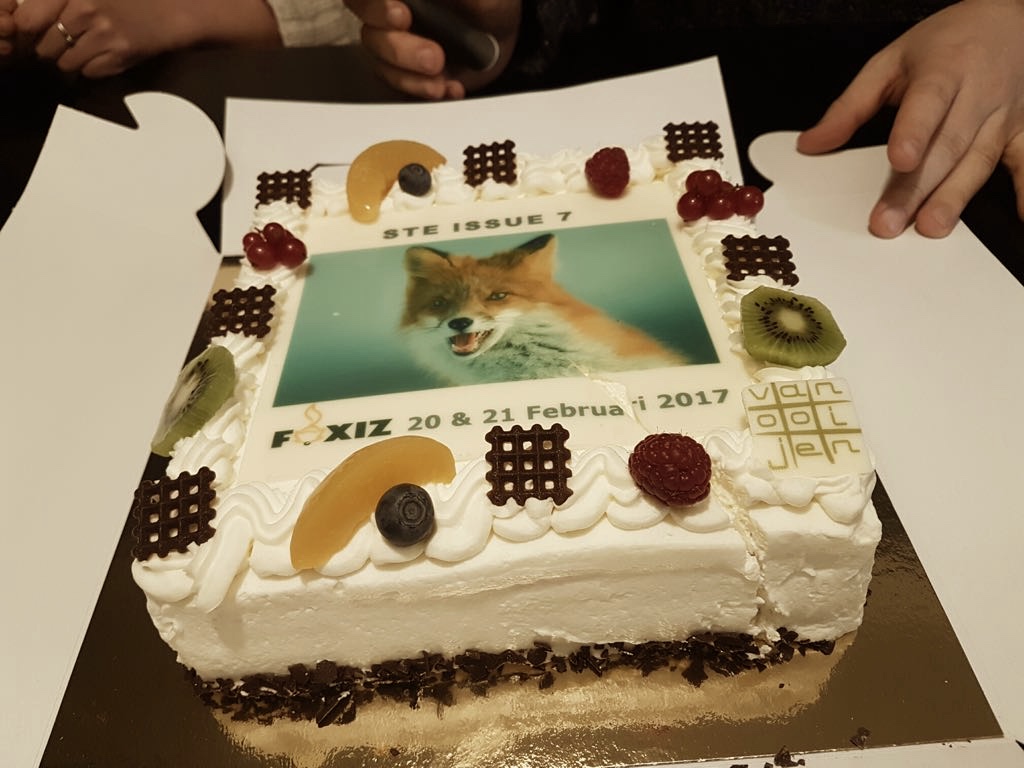
Shufrans TechDocs is currently marking a significant milestone as our principal trainer has reached 20 years of delivering technical documentation expertise and training to high-compliance industries. Such milestones prompt reflection on the evolution of linguistic standards. A retrospective look at our archives brought us to a few photographs from February 2017, taken during our ASD-STE100 Simplified Technical English training in Tiel, Holland.

During that session, our team and the participants celebrated the release of STE Issue 7 with a traditional cream cake. Beyond the rigorous application of controlled language rules, our trainer also hosted a traditional tea ceremony to provide a structured intermission from the technical material. These images highlight a persistent challenge, particularly the ongoing friction that technical authors and editors encounter daily when advocating for corporate linguistic governance.

A recent post-implementation review of our 2017 masterclass cohort confirms that a pervasive structural bottleneck remains unaddressed in web governance and software deployment documentation.

Modern software teams frequently use automated systems to extract user documentation directly from source code or system configurations. This process is efficient on paper. However, automated outputs that bypass rule-based linguistic standards consistently default to unstructured, traditional, and ambiguous prose.

When editors attempt to standardise this text to comply with ASD-STE100 guidelines during peer review, engineering teams often resist. Their argument is predictable: the wording is acceptable because the basic grammar is correct.

For technical communicators and developers managing this friction across globally distributed networks, the following arguments establish the objective business case for controlled language.


A recent post-implementation review of our 2017 masterclass cohort confirms that a pervasive structural bottleneck remains unaddressed in web governance and software deployment documentation.

Modern software teams frequently use automated systems to extract user documentation directly from source code or system configurations. This process is efficient on paper. However, automated outputs that bypass rule-based linguistic standards consistently default to unstructured, traditional, and ambiguous prose.

When editors attempt to standardise this text to comply with ASD-STE100 guidelines during peer review, engineering teams often resist. Their argument is predictable: the wording is acceptable because the basic grammar is correct.

For technical communicators and developers managing this friction across globally distributed networks, the following arguments establish the objective business case for controlled language.

The Reality of the Accessibility Card

Organisations routinely categorise web governance and documentation accessibility as an isolated compliance box, viewing it as a secondary accommodation for users with specific cognitive or physical challenges.

Shufrans TechDocs treats accessibility as a core functional requirement. Ambiguous text imposes a universal cognitive tax on all readers. Whether the user is a native speaker, an international client using English as a second language, or a systems engineer troubleshooting a critical failure under operational pressure, unstructured language forces the human brain to expend extra processing capacity simply to decode intent.

When technical content includes subjective attributes like “appropriate” or “sufficient” or relies on complex, passive structures, it compromises user efficiency. Forcing an operator to interpret meaning constitutes a structural product failure, irrespective of user ability. True accessibility ensures immediate, deterministic comprehension for every user across the global operational ecosystem.

Automation Requires Deterministic Constraints

When development teams automate documentation retrieval from source code, the operational logic driving that text generation must incorporate STE rules as core parameters.

Automated language generators excel at producing fluent prose. However, without deterministic boundaries, these engines systematically introduce rhetorical padding, passive structures, and polysemous verbs. Filtering automated output through a controlled language framework like ASD-STE100 ensures that software documentation remains predictable, standardised, and immediately actionable.

For technical communicators and editors enforcing these standards, linguistic governance is not a pedantic exercise in word choice. It is a necessary mechanism to safeguard data integrity and minimise cognitive strain across the digital enterprise.


The Cost of Creative Writing in Aviation Maintenance: Why Curriculum Integration Beats Passive Distance Learning

The Cost of Creative Writing in Aviation Maintenance: Why Curriculum Integration Beats Passive Distance Learning

In aviation engineering, linguistic clarity is a matter of operational safety and structural efficiency. Yet, a significant gap remains in how the aerospace ecosystem trains both incoming graduates and experienced engineers.

While technical training rightly focuses on avionics, airframe structures, and mechanical precision, the language used to document and maintain these systems is often treated as an afterthought. Engineering professionals frequently enter the workforce relying on standard, expressive English to write maintenance logs, repair reports, and service bulletins.

In a high-stakes MRO (Maintenance, Repair, and Overhaul) environment, linguistic ambiguity is a measurable operational risk. This is why global aerospace relies on ASD-STE100 (Simplified Technical English) to normalise technical data.

Embedding Safety into the Curriculum

Progressive technical training academies are shifting their approach, realising that training in international technical writing standards should not be treated as an afterthought or a post-employment luxury. Instead, they are integrating ASD-STE100 principles directly into basic aviation engineering and avionics curricula, specifically embedding it into foundational technical writing subjects.

By equipping students with these precise text standards from day one of their aviation careers, these forward-thinking academies ensure their graduates are industry-ready. For major MRO providers and aerospace manufacturers, hiring graduates who already understand controlled language provides an immediate operational advantage. It reduces internal training overheads, protects data integrity, and strengthens the maintenance safety chain from the point of entry.

However, achieving successful curriculum integration requires specialised, contextual execution. Applying a mass-market, one-size-fits-all approach to a safety-critical environment introduces distinct failure modes.

Evaluating the Risk of Passive Training Models

When organisations look to adopt ASD-STE100, procurement teams are often faced with a choice between specialist, interactive instruction and high-volume, pre-recorded distance-learning portals. While mass-enrolment online platforms are highly efficient for broad academic theory, data shows they underperform in high-compliance technical environments.

Technical documentation varies drastically across engineering sectors. An avionics curriculum faces entirely different documentation challenges and nomenclature than a heavy maintenance syllabus or a component overhaul pathway.

Evaluating the Risk of Passive Training Models

When organisations look to adopt ASD-STE100, procurement teams are often faced with a choice between specialist, interactive instruction and high-volume, pre-recorded distance-learning portals. While mass-enrolment online platforms are highly efficient for broad academic theory, data shows they underperform in high-compliance technical environments.

Technical documentation varies drastically across engineering sectors. An avionics curriculum faces entirely different documentation challenges and nomenclature than a heavy maintenance syllabus or a component overhaul pathway.

When instructors and engineers are subjected to generic, passive distance learning, several structural gaps emerge:

  • Absence of Technical Context: Universal, “out-of-the-can” modules cannot adapt to complex, proprietary maintenance manuals or specific institutional curriculum frameworks.
  • Lack of Synchronous Feedback: Controlled languages require behavioural change. Without real-time dialogue, learners cannot get immediate correction on their specific writing errors or clear up misinterpretations of the rules.
  • Low Operational Retention: Passive, slide-clicking exercises rarely translate into practical compliance once the engineer or instructor returns to their daily workspace.

To truly transform an aviation curriculum or an engineering team, training must be delivered via dynamic, instructor-led frameworks that use the actual data structures of the institution. Every experience must be customised, not pre-recorded

Safeguarding the Investment: Why Post-Training Support is Critical

Adopting a controlled language standard like ASD-STE100 represents a profound behavioural shift. For educators integrating these principles into a new programme syllabus, or engineers writing live reports, the real test occurs weeks after the workshop concludes. The critical phase happens when a writer is sitting at their desk attempting to restructure lesson plans, design assessments, or rewrite highly complex technical manuals.

Without expert guidance during this transition period, documentation quality frequently degrades, and the initial training investment is lost.

This is why robust, expert-led instruction must be accompanied by an extended operational safety net. Incorporating dedicated, 120-day post-training remote support ensures that as personnel apply STE to live materials, they have access to expert validation and text review. This ongoing quality assurance is what bridges the gap between classroom theory and strict regulatory compliance.

Aviation safety begins with physical precision on the hangar floor, but it is sustained by absolute clarity in the technical record. To safeguard operations and future-proof talent pipelines, the aviation ecosystem must look past the convenience of canned distance education and invest in targeted, interactive precision.

To learn how to eliminate ambiguity from your technical documentation and protect your operational timelines, connect with the team at Shufrans TechDocs.


The Unbearable Lightness of Ambiguity: Why Technical Documentation Needs Linguistic Governance

The Unbearable Lightness of Ambiguity: Why Technical Documentation Needs Linguistic Governance

By Shumin (Soumaiya) Chen

In his classic novel, Milan Kundera wrote about the “unbearable lightness of being”—a state where a total absence of rules and constraints causes life to lose its anchor, leaving everything floating in a void of insignificance. In the high-stakes engineering, manufacturing, and aerospace sectors, technical authors face a remarkably similar hazard.

We call it Linguistic Lightness.

When technical authors are given absolute freedom to write documentation, language becomes unanchored. Writers can choose any unapproved verb, stack complex noun clusters, or deploy vague descriptive phrases. On paper, it looks like creative freedom; in reality, it creates an unmanageable operational void.

The Hidden Operational Cost of Unstandardised Phrasing

Consider a typical instruction found in many industrial asset manuals:

“Tapping the ‘System Status’ icon navigates to the Event log page when an auxiliary system inspection is due.”

To a human author, that sentence feels perfectly natural. However, to an operator under pressure, a multinational engineering team, or a localization translator, unstandardised phrasing introduces immediate ambiguity.

  • What constitutes an abstract “event”?

  • Which exact sub-components are included in an “auxiliary system”?

  • What happens if a non-native speaker misinterprets when an inspection is “due”?

When technical text lacks standardization, clear communication breaks down. And when communication fails on a manufacturing floor, a defence asset, or an offshore platform, the consequences are measured in operational downtime, safety hazards, and regulatory non-compliance.


Mitigating Risk Through ASD-STE100 Implementation

To mitigate this risk, global industrial organizations must establish strict linguistic governance across their technical content. We achieve this by implementing ASD-STE100 (Simplified Technical English).

ASD-STE100 acts as a structural anchor. It strips away the “lightness” of subjective writing by enforcing a controlled vocabulary and a rigid set of writing rules. It leaves no room for creative interpretation because it ensures every word has exactly one approved meaning.

When you standardise technical data through a linguistic governance framework, you achieve three critical outcomes:

  1. Human Error Mitigation: Field technicians receive precise, actionable commands that eliminate guessing games.

  2. AI and RAG Accuracy: Clean, standardized documentation serves as high-fidelity training data for LLMs and enterprise AI search tools, preventing hallucination.

  3. Reduced Localization Costs: Eliminating linguistic variance slashes translation timelines and translation memory costs.

Establishing Linguistic Governance in 2026

Uncontrolled language is a hidden liability to asset integrity and operational safety. Technical documentation should never be “light” or open to interpretation—it requires absolute structural weight.

At Shufrans TechDocs, we bring 20 years of experience to helping enterprises implement ASD-STE100 training and workflows. We ensure your documentation standardisation complies with global aerospace, defence, and industrial requirements while de-risking your complex data lifecycles.

An earlier version of this thought leadership piece was shared by Shumin (Soumaiya) Chen on LinkedIn. Follow her profile real-time insights on linguistic standardization.

[/row