Simplified Technical English Archives | Page 3 of 6 | Shufrans TechDocs Home // Simplified Technical English Archives | Page 3 of 6 | Shufrans TechDocs

STC Webinar: STE as a simplistic dichotomy or quite something else?

STC Webinar: STE as a simplistic dichotomy or quite something else?

Society for Technical Communication (STC Webinar: India Chapter) is hosting the Simplified Technical English Webinar conducted by Shufrans TechDocs on 5 September (Saturday), at 11:00 AM IST (100mins+15mins for Q&A).

Simplified Technical English: A simplistic dichotomy or quite something else?

Dates: Saturday, 5 September 2020

Time: 11:00 AM to 12:45 PM, India Standard Time (IST)

Simplified Technical English (STE) or ASD-STE100 is a controlled technical English language that is used to write technical manuals in a way that they can be more easily understood by an international audience. Often a formal requirement for aircraft and defence maintenance documentation, STE can easily be adapted to all technical industries and beyond. 

This STC webinar explores the usability of Simplified Technical English outside of maintenance documentation. We will discuss industry examples that demonstrate the versatility of this documentation standard that has been in active use since the 1980s.

As a very simple example, one of our customers actually makes coffee machines.  Coffee machines seem to have nothing to do with aircraft. However, 98% of passenger aircraft actually have coffee machines on board, and they need their documentation in Simplified English. Now, if this coffee machine happens to be in an office, or in a medical practitioner’s practice, or in a cafeteria, would it require documentation that is all that different from the documentation on board an aircraft? No, because if anything at all, we just restrict the rules a little bit less. Aerospace tends to be a little bit more restrictive, we just relax the rules a little bit for other industries.

Programme Highlights

  1. The applicability of Simplified Technical English across different industries
  2. How STE is different from company style guides
  3. STE case studies from different industries.
  4. STE writing rules 
  5. Customising vocabulary & terminology 
  6. Reaping the benefits of STE.
  7. STE in a nutshell
  8. Implementing STE with minimal disruption to on-going production and existing documentation
  9. Ensuring a seamless transition to STE writing at work.

About the Speaker

Since 2006, Ms Shumin Chen has been working as a consultant with customers in various industries worldwide: aerospace & defence, banking, consumer products, healthcare, IT, medical, and fitness equipment. She has helped many companies with their documentation needs, based on standards where possible, and is widely regarded as a leading expert in ASD-STE100 Simplified Technical English training, aviation documentation and multilingual documentation.

Ms Chen now heads the ASD-STE100 training arm of Shufrans TechDocs in Singapore. In her current role, Ms Chen continues to focus on the practical implementation of international standards to facilitate the efficient creation and management of multilingual documentation.


Asia Pacific | Precision for Safety: Rigorous ASD-STE100 Simplified Technical English Compliance for Technical Documents

Asia Pacific | Precision for Safety: Rigorous ASD-STE100 Simplified Technical English Compliance for Technical Documents


Write effective user manuals & instructions with Simplified Technical English

APAC | Online Certified ASD-STE100 Training Workshop Programme

Dates: 14 & 15 September 2026

Plan later: 28 & 29 September 2026

Time: 09:00 to 16:00 UTC/GMT+8:00 [APAC]

Length of training: 2 days

Course registration ends one week before training commences.

*Course fee includes exercises, learning aids, certificate of completion, and 120-day post-training support.

⁺⁺A group discount of up to €500 is applicable when two or more participants sign up for the same event. Send us your questions: enquiry@shufrans-techdocs.com.

🏷️ A €210 fee discount is applicable when you also sign up for 🆕 Certified STE Masterclass | Asia Pacific (APAC) Online.

Rediscover clarity in documentation with STE

Simplified Technical English (STE) or ASD-STE100 is a controlled technical English language that is used to write technical manuals in a way that they can be more easily understood by an international audience. STE helps to make translations cheaper and more accurate.

STE can easily be adapted to all technical industries and beyond. Ms. Shumin Chen will show participants how to correctly and effectively use STE in practice. She will also address some of the mistakes commonly found in technical writing and the frequent incorrect use of common STE writing rules.

What customers are saying..

I am giving this training a 10/10. There was a good introductory and explanation to describe the 2-day training seminar. Rule 1.1 0 lets me use words that are: approved in the dictionary / technical names / technical verbs and is one rule I like very much because of its flexibility.

I think rule 1.1 is the most critical and important for STE dictionary. Sometimes I have to use non-approved words as an exception, but I will try to keep this rule 1.1 in my documents for good measure.

Although some of the exercises were tricky, they remind me of each rule application at that time. So they were practical for my role as a technical writer.

I want to recommend this course to current technical writers in Korea or engineers who are interested in writing their own documents effectively. Seung Eun Lee, Technical Writer, DB HiTek

Online STE Workshop Outline*

We’re committed to providing the highest quality learning experience in all our online workshops. Therefore, we’ve made the decision to cap all our online workshop session sizes at just five participants, starting 5 May 2025.

This intimate virtual environment fosters richer discussions, more personalised feedback, and a greater overall impact on your understanding and application of key technical communication standards like Simplified Technical English. Learn better, communicate better, across all our courses. This two-day Online STE Workshop includes interactive training, exercises, and a 120-day post-training consultation.

  • Day 1: Classroom Training
    1. Practical overview of Simplified Technical English
    2. How STE helps both native & non-native speakers of English
    3. Benefits of adopting the STE international writing standard
    4. Writing rules and how to apply them in practice
    5. How to use the general vocabulary.
    6. Approved and non-approved words discussion and the rationale behind.
  • Day 2: Application, Review, & Exercises
    1. How to deal with industry-specific terminology
    2. How to use STE for various documentation types
    3. How to implement STE with minimal disruption to on-going production and existing documentation
    4. Practical workshop session for applying STE rules to your own documents
    5. Review, edit, and discuss participants’ own documents to reinforce learning
    6. Classroom presentation of own documents.

* Shufrans also offers customised ASD-STE100 training solutions tailored to meet your specific requirements. These courses are normally provided at the customer’s premises.


Why select a Simplified Technical English training with Shufrans?

Shumin is a very knowledgeable STE instructor. She kept the course interesting and was always open to our questions/feedback. The introduction to Simplified Technical English has been greatly beneficial for my understanding of what the specification entails. In terms of preferred rules, I cannot pinpoint a specific set of STE writing rules as they are all valuable. This was my favorite part of the course as I enjoyed analyzing how other writers went about using STE to best apply it to their line of work.

The rewriting workshop was my favorite part of the course as I enjoyed analyzing how other writers went about using STE to best apply it to their line of work. I would highly recommend this course to all technical writers. Shumin Chen takes the time to clearly explain the rules of STE. A very attentive instructor, indeed. If given the chance, I would really enjoy working along side her. Michael Palmieri, Documentation Specialist, AON3D | The Advanced Additive Manufacturing Platform

What technical writing outcomes to expect?

Our interactive training, exercises and workshop, will teach participants to standardise content to:

  • Enhanced Communication & Efficiency: Authors will gain the skills to create clear, consistent, and easily translatable technical documentation, facilitating effective communication with a global audience and streamlining the writing process.
  • Improved Operational Safety & Reduced Downtime: By mastering STE principles, teams will produce unambiguous documentation that minimises misunderstandings, directly contributing to improved operational safety and a reduction in costly AOG/downtime.
  • Optimised Lifecycle Support & Cost Reduction: Training will enable modular writing and content reuse, leading to maximised consistency, optimised product lifecycle support, and a significant reduction in the overall cost of creating and maintaining technical publications.

Interested in learning more?

Speak to us today or learn more about our upcoming Online STE Workshops here.

Certified STE workshops online

Browse our convenient line-up of Simplified Technical English workshops scheduled at different timezones.


ASD-STE100 Trainer’s qualifications


Ms Shumin Chen will show participants how to correctly and effectively use Simplified Technical English (STE) in practice. She will also address some of the mistakes commonly found in technical writing and the frequently incorrect use of common STE writing rules.

According to Ms Chen, the benefits of STE are manifold – audience engagement through high-quality content, improved product safety, lower life cycle cost and reduced logistics footprint

Learn more about how you can create sustainable STE content and reap substantial cost-saving benefits as a result here.

twitter linkedin

Europe | Future-Proof Your Documentation: Mastering Simplified Technical English (ASD-STE100) Compliance

Europe | Future-Proof Your Documentation: Mastering Simplified Technical English (ASD-STE100) Compliance

Write effective user manuals & instructions with Simplified Technical English

Europe | Online Certified ASD-STE100 Simplified Technical English Training Workshop Programme

Dates: 21 & 22 September 2026

Plan later: 1 & 2 October 2026

Time: 08:00 to 15:00 CET

Length of training: 2 days

Course registration ends one week before training commences.

*Course fee includes exercises, learning aids, certificate of completion, and 120-day post-training support.

⁺⁺A group discount of up to €500 is applicable when two or more participants sign up for the same event. Send us your questions: enquiry@shufrans-techdocs.com.

🏷️ A €210 fee discount is applicable when you also sign up for 🆕 Certified STE Masterclass | Europe Online.

Summary of Simplified Technical English (STE)

Simplified Technical English (STE) or ASD-STE100 is a controlled technical English language that is used to write technical manuals in a way that they can be more easily understood by an international audience. STE helps to make translations cheaper and more accurate. Often a formal requirement for aircraft and defence maintenance documentation, STE can easily be adapted to all technical industries and beyond. Ms. Shumin Chen will teach participants how to correctly and effectively use STE in practice. She will also address some of the mistakes commonly found in technical writing and the frequent incorrect use of common STE writing rules.

Why select a Simplified Technical English training with Shufrans?

Shumin is a very knowledgeable STE instructor. She kept the course interesting and was always open to our questions/feedback. The introduction to Simplified Technical English has been greatly beneficial for my understanding of what the specification entails. In terms of preferred rules, I cannot pinpoint a specific set of STE writing rules as they are all valuable. This was my favorite part of the course as I enjoyed analyzing how other writers went about using STE to best apply it to their line of work.

The rewriting workshop was my favorite part of the course as I enjoyed analyzing how other writers went about using STE to best apply it to their line of work. I would highly recommend this course to all technical writers. Shumin Chen takes the time to clearly explain the rules of STE. A very attentive instructor, indeed. If given the chance, I would really enjoy working along side her. Michael Palmieri, Documentation Specialist, AON3D | The Advanced Additive Manufacturing Platform

STE Course Outline*

We’re committed to providing the highest quality learning experience in all our online workshops. Therefore, we’ve made the decision to cap all our online workshop session sizes at just five participants, starting 5 May 2025.

This intimate virtual environment fosters richer discussions, more personalised feedback, and a greater overall impact on your understanding and application of key technical communication standards like Simplified Technical English. Learn better, communicate better, across all our courses. This two-day Online STE Workshop includes interactive training, exercises, and a 120-day post-training consultation.

  • Day 1: Classroom Training
    1. Practical overview of Simplified Technical English
    2. How STE helps both native & non-native speakers of English
    3. Benefits of adopting the STE international writing standard
    4. Writing rules and how to apply them in practice
    5. How to use the general vocabulary.
    6. Approved and non-approved words discussion and the rationale behind.
  • Day 2: Application, Review, & Exercises
    1. How to deal with industry-specific terminology
    2. How to use STE for various documentation types
    3. How to implement STE with minimal disruption to on-going production and existing documentation
    4. Practical workshop session for applying STE rules to your own documents
    5. Review, edit, and discuss participants’ own documents to reinforce learning.
    6. Classroom presentation of own documents.

* Shufrans also offers customised ASD-STE100 training solutions tailored to meet your specific requirements. These courses are normally provided at the customer’s premises.

Who should attend this Simplified Technical English training?

  • Compliance managers
  • CIO, COO, CTO
  • Customer support managers
  • Documentation managers
  • Editors
  • Engineering managers
  • Engineers and SMEs who create documentation
  • Graphics specialists
  • ILS managers
  • Maintenance managers
  • Operation managers
  • Product managers
  • Project managers
  • Quality managers
  • Software research engineers
  • Technical illustrators
  • Technical writers
  • Translation managers
  • Translators.

What technical writing outcomes to expect?

Our interactive training, exercises and workshop, will teach participants to standardise content to:

  • Enhanced Communication & Efficiency: Authors will gain the skills to create clear, consistent, and easily translatable technical documentation, facilitating effective communication with a global audience and streamlining the writing process.
  • Improved Operational Safety & Reduced Downtime: By mastering STE principles, teams will produce unambiguous documentation that minimises misunderstandings, directly contributing to improved operational safety and a reduction in costly AOG/downtime.
  • Optimised Lifecycle Support & Cost Reduction: Training will enable modular writing and content reuse, leading to maximised consistency, optimised product lifecycle support, and a significant reduction in the overall cost of creating and maintaining technical publications.

What customers are saying..

The introduction was a good and concise way to familiarize yourself with STE basics. I’ve a background in plain language, so for example the rule on noun clusters makes perfect sense. I’m all about simplification, so substituting verbs like “eliminate” for verbs like “remove” or “stop” will be my new quest. The STE exercises were helpful in getting to grasp with STE during the training workshop. I’d very likely recommend this course to anyone planning to introduce STE as it’s got a great practical angle. Jenni Virtaluoto, PhD, Senior Lecturer, University of Jyväskylä, Finland

ASD-STE100 Trainer’s qualifications

Ms. Shumin Chen, principal trainer & consultant at Shufrans TechDocs received her professional on-the-job training in the field of STE under the tutelage of Dr Frans Wijma, a linguist and documentation expert. Together as an experienced global team, they provided their combined knowledge and dedication to benefit customers worldwide. To date, they have provided training and consultancy services to over 200 companies. Shufrans TechDocs is the only company with such vast experience in providing certified STE training.

Shumin has supported various companies with their STE and other documentation needs, based on standards where possible. Although STE was developed for the aerospace industry, more specifically for aircraft maintenance documentation, she found that it made a lot of sense to apply the same principles to other industries and types of documents as well. Few -if any- changes to the specification are necessary to adapt STE to industrial sectors ranging from machinery to IT, automotive to medical equipment.

Simplified Technical English STE examples


6 Words that Technical Writers Struggle to Break Up With in Simplified Technical English

6 Words that Technical Writers Struggle to Break Up With in Simplified Technical English

TCLoc Master article on 6 Words that Technical Writers Struggle to Break Up With in Simplified Technical English by Ms. Shumin Chen, Principal ASD-STE100 Trainer & Consultant.

First published on TCLoc Master Blog • University of Strasbourg • 26 August 2019

Product documentation can potentially be confusing, incoherent, and ambiguous in many situations. Recognising language ambiguity usually takes months, if not longer. Several aggravating factors include:

  • A constant need to churn out or translate volumes of documentation, manuals, and working standards.
  • Rarely questioning the relevance or validity of legacy documentation.
  • Allowing unclear parts of your technical content to snowball into substantial chunks that will eventually make up parts of your “user-unfriendly” help guides.

Finally, let us not forget the insidiously familiar workplace jargon that often explains why we tend to ignore simpler alternatives that could help us express our thoughts with greater clarity.

From workplace jargon to user-friendly words

Sometimes, realising the level of complexity of one’s technical content involves an epiphany of sorts once the writer catches a glimpse of technical writing in Simplified Technical English (STE). This is true for one of our clients, who is both an experienced technical author and documentation manager:

“A training course helped me better appreciate the objectives of Simplified Technical English from a technical writer’s perspective. I like the fact that STE promotes the use of less complex sentence structures and does away with unnecessary words like: ‘would’, ‘should’, and ‘might’.”

Do we have a problem? If so, fix it!

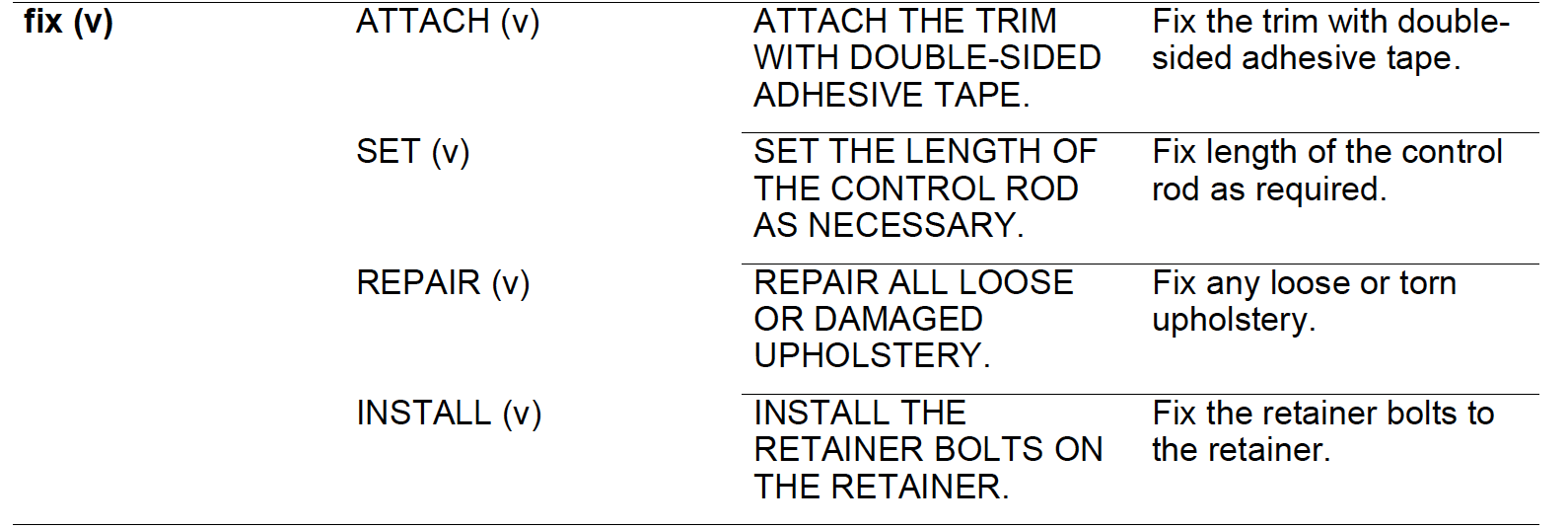
For example, if you look up the meaning of the word “fix” in a standard dictionary, the definitions are aplenty, from “fixing a technical difficulty” to “fixing up a meal in the kitchen”. Given the many possible meanings that hold true for the verb “to fix”, one could also distil as many interpretations of the word in a sentence.

According to Simplified Technical English, Issue 7, January 2017, there is a solution for this. Instead of “fix”, synonyms such as “ATTACH*”, “SET”, “REPAIR”, and “INSTALL”  powerfully extend our understanding and knowledge of what “fix” really entails when paired with various contextual clues.
The next five words: are you thinking of these too?

Keeping in mind that these are not the only unproductive words I talk about in my workshops, they are among the most frequently discussed ones.

The word “should” usually indicates duty or correctness that points to a desirable or expected state. However, it still allows the possibility of non-compliance. “MUST”, on the other hand, makes it clear that the instructions are mandatory and leaves no room for a different reading.

Besides the roughly 900 approved words found in the STE general vocabulary, the STE specification also includes a list of non-approved words. “Would” is one of those words that is easily replaced by a more straightforward and approved STE word like “CAN”.

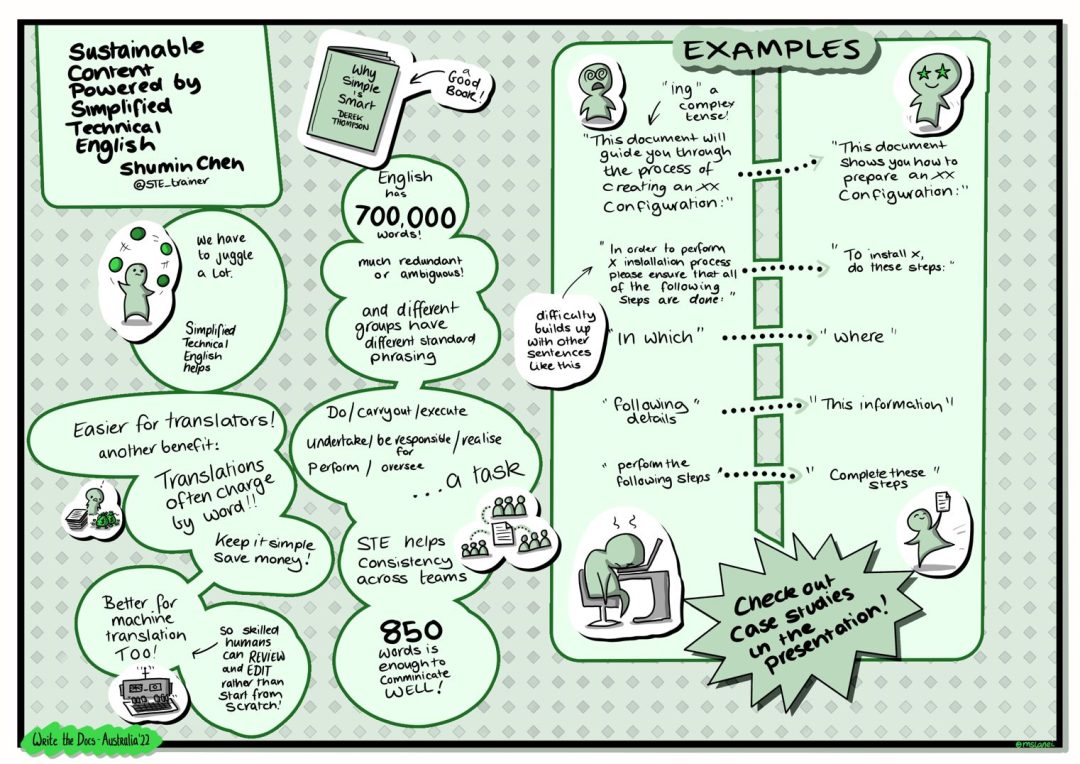
In the STE general dictionary, the approved word examples in the 2nd column are very useful for technical writers who are transitioning from Standard English to Simplified English. This is because they provide the writer with the correct use of words in a real-life context that would be difficult to think of independently. Here, we see that “CAN” is once again a very helpful alternative to the verb “may”. Using too many words that point to the same or similar meanings can be, at times, overwhelming for your readers, especially when documentation becomes lengthier and more detailed.  

By now, the effects of STE on everyday words that pose as potential roadblocks to concise writing are clear. Instead of “transfer”, STE encourages the use of “MOVE” or “INSTALL”. This adds granularity to your choice of verbs, making technical work instructions more detailed and easier to follow.

The preference in STE for the verb “MAKE SURE” over “confirm” is again another unique characteristic of this standard. This is very likely so because the maintenance committee (made up of a diverse mix of linguists, engineers, and translators) deems “MAKE SURE” a more fitting word with more frequent usage to back their word choice. 

What are some popular words in STE that trained technical writers have adopted to date?

We spoke to more than 30 technical writers and this is by far the most comprehensive response to date:

“My favourite STE verbs are ‘APPLY’, ‘ATTACH’, ‘MAKE SURE’, and ‘SHOW’. The verb ‘APPLY’ has multiple use cases for our documents. The verb ‘ATTACH’ is a great utility verb because common alternatives like ‘mount’ are not approved. The verb ‘MAKE SURE’ is extremely helpful in cautions and warnings, as well as in some procedural steps. Finally, the verb ‘SHOW’ is extremely helpful when I write about background processes and how things work in general.” 

STE as a game-changer in our technical communication landscape

Can you envision a future where STE serves as the primary language reference for content creation and development in your field? 

We would like to hear from you. Leave your ideas in the comments section below!

Can Simplified Technical English be used for various documentation types?

Can Simplified Technical English be used for various documentation types?

Remote webinar: Simplified Technical English

Dates: Wednesday, 28 August 2019

Time: 12:00 PM to 1:00 PM, Australian Eastern Standard Time (AEST)

Register

ASD-STE100 Simplified Technical English is a guideline that regulates the wording and writing style used in technical publications. Originally developed for the aerospace industry, it is now widely used also outside the aviation industry, including companies in the defence, machinery, electronics, semiconductor, medical equipment, IT, and hi-tech industries.

This presentation explores the usability of Simplified Technical English outside of maintenance documentation. We will discuss industry examples that demonstrate the versatility of this documentation standard that has been in active use since the 1980s.


Why ‘fix’​ is a useless word – and four preferred alternatives from Simplified Technical English

Why ‘fix’​ is a useless word – and four preferred alternatives from Simplified Technical English

According to Simplified Technical English, Issue 7, January 2017, having these four words at hand – ATTACH, SET, REPAIR, AND INSTALL – powerfully extends our understanding and knowledge of what ‘fix’ really means.


Simplified Technical English expertly divides this easily misunderstood word into specific actions that are necessarily taken based on prevailing circumstances.

Under the tutelage of an experienced STE trainer, we probably have many more ways of expressing ourselves unambiguously in technical work instructions than our informal day-to-day language knows how to recognise.


Find out more:

What is Simplified Technical English?

How do we apply Simplified Technical English in practice?

Which types of training are available for me as an individual writer, as a team, or as scattered teams in offices worldwide?


Copyright © 2019 Shufrans TechDocs. All rights reserved. No part of this article may be reproduced or transmitted in any form or by any means whatsoever without express written permission from the author, except in the case of brief quotations embodied in critical articles and reviews. 


Instructor-led Simplified Technical English (STE) training worldwide

Instructor-led Simplified Technical English (STE) training worldwide

Instructor-led training: We offer more than just a training service

  1. Are you a manager who has to constantly worry about the varying technical English proficiency levels of your staff?
  2. As an engineer, are you facing difficulties explaining your concepts to your technical writing team?
  3. In your role as a technical communicator, do you often struggle to convert complex ideas into brilliant content?

If you answered yes to any of the above, join us at the next instructor-led Simplified Technical English training workshop sessions online:

Write effective user manuals & instructions with Simplified Technical English

Length of training: 2 to 3 days

Course registration ends one week before training commences

Shufrans’ ILT STE workshop sessions are an effective means of delivering information, as they allow for real-time feedback, questions and answers, manipulation, and changeable delivery to suit the needs of learners in a conducive learning environment. ILT is also the most widely-used method for extended enterprise training, which trains customers and partners, with an 80% usage rate.

STE stands for Simplified Technical English. It offers native & non-native English speakers alike an efficient platform to improve your technical English language competency when writing for a global audience.

  1. For technical writers: simplified wording and grammar will improve readability and safety compliance of your documentation and product respectively.
  2. For engineers and programmers: Breeze through the writing of test cases, technical documents, and business emails in a highly standardised and regulated manner. STE opens up effective communication channels, hence avoiding potential miscommunication issues at work while improving the overall professional impression that you portray.
  3. For translators, translation PMs, and localisation engineers: With STE working for your team in the background, you can streamline your preparation of translation memory/terminology based on leaner documentation, lowered translation & localisation costs, and faster delivery.
  4. For LSPs and technical writing services companies: Diversify your business portfolio with an in-depth knowledge of STE as an international controlled English language standard.

Online Simplified Technical English Programme Highlights

  1. Highly efficient: We will cover all 382 pages of the ASD-STE100 Specification in two days for immediate implementation.
  2. Practicality: cross-industry cases sharing by trainers with excellent pragmatic approach.
  3. Follow-up period: 4-month post-training consultation starts immediately after the training to ensure a seamless transition to STE writing at work.
  4. Experienced trainer: Ms Shumin Chen, Co-founder & Head of ASD-STE100 training & implementation of Shufrans TechDocs.

Our Training Service Package guarantees the following:

  1. Reduces your content development time and efforts
  2. Significantly lowers post-processing (e.g. translation) cost
  3. One-stop content quality solution
  4. Overall quality improvement.

Instructor-led training (ILT) represents 66% of corporate training and development; it reaches 76% in high-performing companies and 80% in high-consequence industries: healthcare industry, pharmaceutical industry, finance, utilities, etc.


APAC Online Workshop: Write effective user manuals & instructions with Simplified Technical English

APAC Online Workshop: Write effective user manuals & instructions with Simplified Technical English

Write effective user manuals & instructions with Simplified Technical English

Dates:  3 & 4 February 2020

Plan later: 

  1. 27 & 28 February 2020.

Time: 09:00 to 17:00 UTC/GMT +08:00 [Asia Pacific]

Length of training: 2 days

Course fee: 450 EUR**

Course registration ends one week before training commences.

**Course fee includes exercises, learning aids, certificate of completion, and 90-day post-training support.

Summary

Simplified Technical English (STE) is a controlled language that is used to write technical manuals in such a way that they can be more easily understood by an international audience. STE helps to make translations cheaper and more accurate. Often a formal requirement for aircraft and defence maintenance documentation, STE can easily be adapted to all technical industries and beyond. Ms. Shumin Chen will teach participants how to correctly and effectively use STE in practice. She will also address some of the mistakes commonly found in technical writing and the frequently incorrect use of common STE writing rules.

Shumin gave us a an all-rounded presentation to Simplified Technical English. Personally, rule 1.3: To use only approved words with their approved meaning holds the key to successful controlled language implementation. Rules 3.4, 3.6, 4.1, 5.3, and 5.5 are also among my favourites. The approved verb TO MAKE SURE THAT can come in very handy for technical writers as well. The presentation of STE rules offers quite a detailed overview that includes not only language rules but good, old technical authoring principles in general. It has been very helpful for us to learn and understand the concept of STE. I have found Shumin to be very competent in STE and will defnitely recommend her course! Eric, Head of Corporate Technical Documentation (CTD), Schindler Group.

Course outline*

  • Day 1: Classroom Training
    1. Practical overview of Simplified Technical English
    2. How STE helps both native & non-native speakers of English
    3. Benefits of adopting the STE international writing standard
    4. Writing rules and how to apply them in practice
    5. How to use the general vocabulary.
    6. Approved and non-approved words discussion and the rationale behind.
  • Day 2: Application, Review, & Exercises
    1. How to deal with industry-specific terminology
    2. How to use STE for various documentation types
    3. How to implement STE with minimal disruption to on-going production and existing documentation
    4. Practical workshop session for applying STE rules to your own documents
    5. Review, edit, and discuss participants’ own documents to reinforce learning
    6. Classroom presentation of own documents.

* Shufrans also offers customised ASD-STE100 training solutions tailored to meet your specific requirements. These courses are normally provided at the customer’s premises.

Who should attend?

  • Compliance managers
  • CIO, COO, CTO
  • Customer support managers
  • Documentation managers
  • Editors
  • Engineering managers
  • Engineers and SMEs who create documentation
  • Graphics specialists
  • ILS managers
  • Maintenance managers
  • Operation managers
  • Product managers
  • Project managers
  • Quality managers
  • Software research engineers
  • Technical illustrators
  • Technical writers
  • Translation managers
  • Translators.

What training outcomes to expect?

Our interactive training, exercises and workshop, will teach participants to standardise content to:

  • Author more efficiently
  • Communicate more effectively with a global audience
  • Improve operational safety
  • Reduce AOG / downtime
  • Facilitate modular writing and reuse
  • Facilitate teamwork
  • Facilitate translation
  • Maximise consistency
  • Optimise product lifecycle support
  • Reduce the cost of creating and maintaining technical publications.

Trainer’s qualifications

Ms. Shumin Chen, principal trainer & consultant at Shufrans TechDocs received her professional on-the-job training in the field of STE under the tutelage of Dr Frans Wijma, a linguist and documentation expert. Together as an experienced global team, they provided their combined knowledge and dedication to benefit customers worldwide. To date, they have provided training and consultancy services to over 180 companies. Shufrans TechDocs is the only company with such vast experience in providing certified STE training.

Shumin has supported various companies with their STE and other documentation needs, based on standards where possible. Although STE was developed for the aerospace industry, more specifically for aircraft maintenance documentation, Shumin found that it made a lot of sense to apply the same principles to other industries and types of documents as well. Few -if any- changes to the specification are necessary to adapt STE to industries ranging from machinery to IT, automotive to medical equipment.

Empowering Excellence: Shufrans TechDocs’ STE Impact on Maersk Drilling Maintenance Support

Empowering Excellence: Shufrans TechDocs’ STE Impact on Maersk Drilling Maintenance Support

Enhancing Teams and Optimising Documentation Across Maersk Drilling Maintenance Support's Global Offshore Operations

Client: Maersk Drilling Maintenance Support (MDMS)

Industry: Offshore Drilling

Location: Singapore (On-site Training)

Challenge: Inconsistent technical documentation and a need to improve the standard of maintenance instructions for end-users, affecting safety and compliance.

Solution: Comprehensive on-site ASD-STE100 training and half a year of dedicated on-site technical writing support.

Results: Significant improvement in technical writing standard, enhanced clarity in documentation, and strengthened operational safety and compliance through precise communication.


In the demanding environment of offshore drilling, precision in communication is not merely beneficial; it is fundamental to operational safety and strict compliance. Shufrans TechDocs partnered with Maersk Drilling Maintenance Support (MDMS) to address this critical need by providing comprehensive support in Simplified Technical English (STE).

Over 20 personnel from MDMS participated in this transformative programme, which was designed to significantly improve their technical writing standard and enhance overall clarity in documentation for end-users.

How STE Improves Safety and Compliance

The offshore drilling industry operates with complex machinery and high-risk procedures. Ambiguity in technical documentation can lead to severe consequences. STE directly tackles these challenges by:

  • Reducing Ambiguity: STE’s controlled vocabulary and stringent writing rules eliminate phrases that can have multiple interpretations. This ensures that critical instructions, whether in maintenance procedures or safety guidelines, are understood uniformly by every individual, regardless of their native language or technical background, thereby minimising human error.
  • Improving Clarity for Critical Procedures: By enforcing concise sentences, active voice, and a single instruction per sentence, STE makes complex procedural steps easy to follow. In high-pressure situations on a rig, such clear, unambiguous steps are vital for correct and safe execution.
  • Ensuring Consistency: STE promotes the consistent use of terminology for equipment, processes, and actions across all documentation. This reduces confusion, streamlines training, and makes it simpler for personnel to find and apply correct information, which is also crucial for regulatory compliance.
  • Facilitating Compliance: Many industry standards and regulations implicitly or explicitly require clear, unambiguous documentation. Adhering to STE allows companies to more easily demonstrate compliance, reducing the risk of non-conformance and associated penalties.
  • Streamlining Audits and Investigations: In the event of an incident, clear and consistently written documentation is essential for accurate investigations. STE-compliant documents make it easier to trace actions, understand procedures, and identify root causes, supporting both compliance efforts and continuous improvement.
  • Enhancing Equipment Service Descriptions (CMMS): STE principles directly support the creation of precise and consistent equipment service descriptions for Computerised Maintenance Management Systems (CMMS). As per Maersk Drilling’s guidelines (e.g., Process Instructions), these descriptions must be accurate, consistent, and limited to 40 characters, structured by elements such as Noun, Type, Function, Main Equipment/System, and Physical Location. STE’s emphasis on controlled vocabulary, direct language, and conciseness significantly aids in:
    • Achieving Brevity and Precision: STE’s rules promote succinct phrasing, helping adhere to character limits while maintaining clarity.
    • Standardising Terminology: By using approved words consistently for nouns, types, and functions, STE ensures descriptions are uniform, improving searchability and avoiding duplicates in the CMMS.
    • Eliminating Ambiguity: Clear, unambiguous language guarantees that each component of the description is understood precisely, which is critical for accurate equipment identification and effective maintenance planning.

Relevance Across Job Roles

The STE standard proved highly relevant for various specialists within MDMS, directly impacting their daily tasks:

  • Marine Superintendents: Gained clarity in documentation related to vessel stability, mooring operations, and navigational procedures, reducing the risk of errors in critical marine operations.
  • Technical Coordinators: Benefitted from unambiguous documentation for planning and overseeing maintenance, ensuring correct parts procurement and procedure execution, thus optimising uptime and reducing costly rework.
  • Equipment Support Coordinators: Found STE invaluable for understanding equipment specifications, troubleshooting guides, and spare parts information, leading to more efficient equipment sourcing and improved support for the rigs. This also directly applies to creating and interpreting precise CMMS equipment service descriptions.
  • Senior Superintendents: As leaders of operational teams, STE provided the linguistic consistency needed to ensure their crews understood and followed procedures perfectly, fostering a culture of safety and precision.
  • Technical Inspectors: For inspection protocols and reporting, STE ensured that observations and requirements were recorded with absolute clarity, leaving no room for misinterpretation during audits or follow-up actions.

Key Inspection Standards Enhanced by STE

Beyond general procedures, Shufrans TechDocs’ STE training also covered specific inspection methodologies crucial for maintaining offshore rig integrity, as exemplified in Maersk Drilling’s Valve Overhaul documentation. Clarity in these areas directly impacts safety and compliance:

  • API (American Petroleum Institute) Requirements/Reporting: In the context of critical equipment like well control components, adherence to API standards is paramount. STE ensures that all well control equipment failures are reported to the OEM precisely and accurately, as mandated by API guidelines. This systematic reporting fosters industry-wide learning and continuous safety improvements.
  • LPI (Liquid Penetrant Inspection): This Non-Destructive Testing (NDT) method is used to identify surface-breaking flaws such as cracks or porosity in non-porous materials. During valve overhauls, STE ensures the step-by-step instructions for performing LPI (e.g., on valve components after cleaning) are crystal clear, guaranteeing accurate detection of defects that could compromise safety.
  • MPI (Magnetic Particle Inspection): Another vital NDT technique, MPI detects surface and near-surface flaws in ferromagnetic materials. For steel valve components, STE ensures that instructions for conducting MPI are unambiguous, allowing inspectors to precisely identify hidden defects. The clear documentation of these procedures is critical for preventing in-service failures of high-pressure components.

Improved Document Types

Shufrans TechDocs specifically focused on enhancing the following crucial document types for offshore rigs:

  • Standard Operational Procedures (SOPs) / Standard Job Procedures (SJPs): This included critical well control procedures, paramount for managing well pressure and preventing blowouts, where absolute clarity is non-negotiable for safety.
  • Well Control Equipment PM (Preventative Maintenance) documents: Ensuring that maintenance on vital well control equipment is performed correctly and consistently, which directly impacts equipment reliability and overall safety.
  • General Maintenance Instructions: Improving the clarity of routine and complex repair procedures for various rig equipment, making operations more efficient and less prone to error.

The support programme included three intensive on-site STE workshops and half a year of dedicated on-site technical writing assistance, demonstrating Shufrans TechDocs’ commitment to long-term client success. By implementing STE, MDMS has significantly enhanced its technical communication, contributing to a safer, more efficient, and more compliant operational environment.

Ready to transform your technical documentation for enhanced safety and compliance? Contact Shufrans TechDocs today to learn how our specialised STE training and support can benefit your organisation.

🗓️ View our training calendar.


www.shufrans.com

Alibaba Cloud Writer shares her thoughts on Simplified Technical English

Alibaba Cloud Writer shares her thoughts on Simplified Technical English

Summary

Alibaba Cloud, a subsidiary of Alibaba Group, is a cloud computing company. Alibaba Cloud provides cloud computing services to online businesses and Alibaba Group’s own e-commerce ecosystem. As the cloud computing arm and business unit of Alibaba Group, Alibaba Cloud provides a comprehensive suite of global cloud computing services to power both international customers’ online businesses and Alibaba Group’s own e-commerce ecosystem. Alibaba Cloud offers high-performance, elastic computing power in the cloud. Services are available on a pay-as-you-go basis and include data storage, relational databases, big-data processing, Anti-DDoS protection and content delivery networks (CDN).

Simplified Technical English (STE) is a controlled language that is used to create technical content and documentation that are more easily understood by an international audience. While it makes sense to try to describe complex processes using Simplified Technical English, the paradigm shift is not always an easy one and technical writers would require formal training in STE at least.

This article shares in more detail how the Alibaba Cloud Content & Globalisation team can potentially benefit from the use of a controlled language like STE to offer outstanding local technical service capabilities to their customers. 


Process pain points

Existing documents are usually translated from Mandarin Chinese. Unclear information in the source language will often obscure the meaning in the corresponding English translation. To improve the quality of translation in the English text, it is therefore necessary to rewrite the content in its entirety. This is because keeping the original sentence and paragraph structure while trying to apply sound STE writing principles will make the technical writer’s job in this case extremely difficult. A crucial point to keep in mind is to ensure that all necessary information in the original document is faithfully rewritten in STE.

When everyone is required to clarify what the original content means before writing as well as appreciate the actual working principles behind, we are definitely going to see quality improvements! Alibaba Cloud Writer’s post-training feedback.


Based on feedback from technical writers, while writing in Standard English offers them the flexibility to keep information vague but convincing, the original technical content is not always complete or accurate. Clearly, this has changed when technical writers favour the use of a controlled language like Simplified Technical English over Standard English. Restrictions on word usage, sentence structure, and sentence lengths have compelled writers to rewrite their documents and present information with clarity and much less ambiguity. This is based on the premise that technical writers already possess a firm understanding of their products and services. In this manner, they can do away with the original formulation in Chinese, then describe the use of their products and services in a user-friendly way with the help of STE.


The customer’s journey

As is the practice in many companies worldwide, documents were created at the development stage before reaching techdocs. Vague wording, style, and tone of voice from Standard English have gradually influenced the way technical writers communicate with their audience in the long run. Consequently, it becomes challenging to fully distill the meaning behind technical content unless the user spends more time in reading the documentation again. This is a situation that could have been mitigated if technical writers clarified the content with the original content writers from the outset and started writing in STE sentences.


How the STE specification drives cohesion and consistency within technical writing teams

Because of vocabulary and writing rules standardisation, technical writers become more consistent on a word level that starts with the simple fact that they are going to use the same word whenever they refer to the same thing. This is especially important for a diverse team where the levels of language proficiencies and and understanding for technology are not the same. Here, STE may be the key to balance.