Aerospace Documentation Archives | Shufrans TechDocs Home // Aerospace Documentation Archives | Shufrans TechDocs

Rising Above the Panic: Why Simplified Technical English Needs an Upgrade, Not an Exit Strategy

Rising Above the Panic: Why Simplified Technical English Needs an Upgrade, Not an Exit Strategy

For anyone working in technical documentation, the standard playbook for dealing with disruptive technology is entirely predictable. When a new tool emerges that promises to fundamentally change how text is generated, translated, or structured, legacy standard-bearers inevitably retreat into the bunker.

We see it whenever a new advisory paper drops on AI and controlled authoring. Rather than engaging with how modern language models can be harnessed to assist technical authors, the traditional response spends pages warning against the sky falling—highlighting hallucinations, data leaks, and the irreplaceable brilliance of human gatekeepers.

It is tempting to dismiss this as much ado about nothing: a classic exercise in corporate self-preservation from groups whose entire model relies on maintaining rigid control over a heavily guarded specification. But if we want to move past the panic, we need to look at what is actually happening behind closed doors.

The Industry Reality: Closing the Door vs. Opening the Hood

Let’s be entirely candid. If you feed raw, unvetted technical specifications into a generic consumer chatbot and hope for an airtight, compliant maintenance manual, you are going to be disappointed. Out of the box, large language models favour synonyms, run-on sentences, and creative prose—three things that will instantly trigger a failure in any controlled language audit.

That is the grain of truth in the defensive posturing. Unchecked AI is a liability.

However, pretending that technical writers and engineers are not already experimenting with AI behind closed doors is willful blindness. Documentation teams are pressed for time, overwhelmed by localization backlogs, and drowning in complex engineering updates. They are using AI to draft, summarise, and restructure content whether standard bodies approve of it or not.

The real question isn’t whether AI will touch technical documentation. It’s whether we are going to govern it intelligently or leave authoring teams to figure it out in the wild.

From Fear to Architecture: The Real Role of AI in Controlled Authoring

True technical documentation governance isn’t about locking the door against new technology; it’s about building the guardrails that make technology actually useful.

Instead of treating AI as a replacement for human judgment, we should be treating it as a high-velocity drafting assistant. When properly architected, modern language models can be constrained to serve controlled authoring rather than disrupt it:

  • Custom Grammars and Local Guardrails: By pairing fine-tuned, localised models with strict dictionaries and syntax rulebooks, organisations can filter out non-compliant structures before a human writer even opens the draft.

  • Retrieval-Augmented Generation on Approved Corpora: Instead of letting an LLM generate instructions from its general training data, restricted systems pull exclusively from validated maintenance manuals, reducing errors and protecting proprietary data.

  • Accelerating the Routine: The hardest part of technical authoring is often turning dense, sprawling engineering notes into a clean baseline structure. AI excels at heavy-lifting that first iteration, leaving the expert technical writer free to apply nuance, safety checks, and strict linguistic compliance.

The Verdict

The future of technical writing doesn’t belong to those who issue warnings from behind closed gates, nor does it belong to a reckless free-for-all of unverified prompts. It belongs to organisations that combine rigorous standards with smart, governed automation.

It is time to stop panicking about what machines cannot do, and start engineering how they can help us do our best work.

How are your documentation teams navigating the line between AI experimentation and strict compliance standards?

Ready to eliminate ambiguity in your manuals?

Shufrans TechDocs helps engineering teams across high-consequence industries—from aerospace and defense to heavy industrial machinery—implement practical ASD-STE100 compliance through specialised training and governance consulting. Contact us to discuss your documentation workflow.
 

Beyond the Buzzwords: Why True ASD-STE100 Compliance is Critical for Aerospace and Nuclear Engineering Safety

Beyond the Buzzwords: Why True ASD-STE100 Compliance is Critical for Aerospace and Nuclear Engineering Safety

The Hidden Vulnerability in Nuclear Facilities

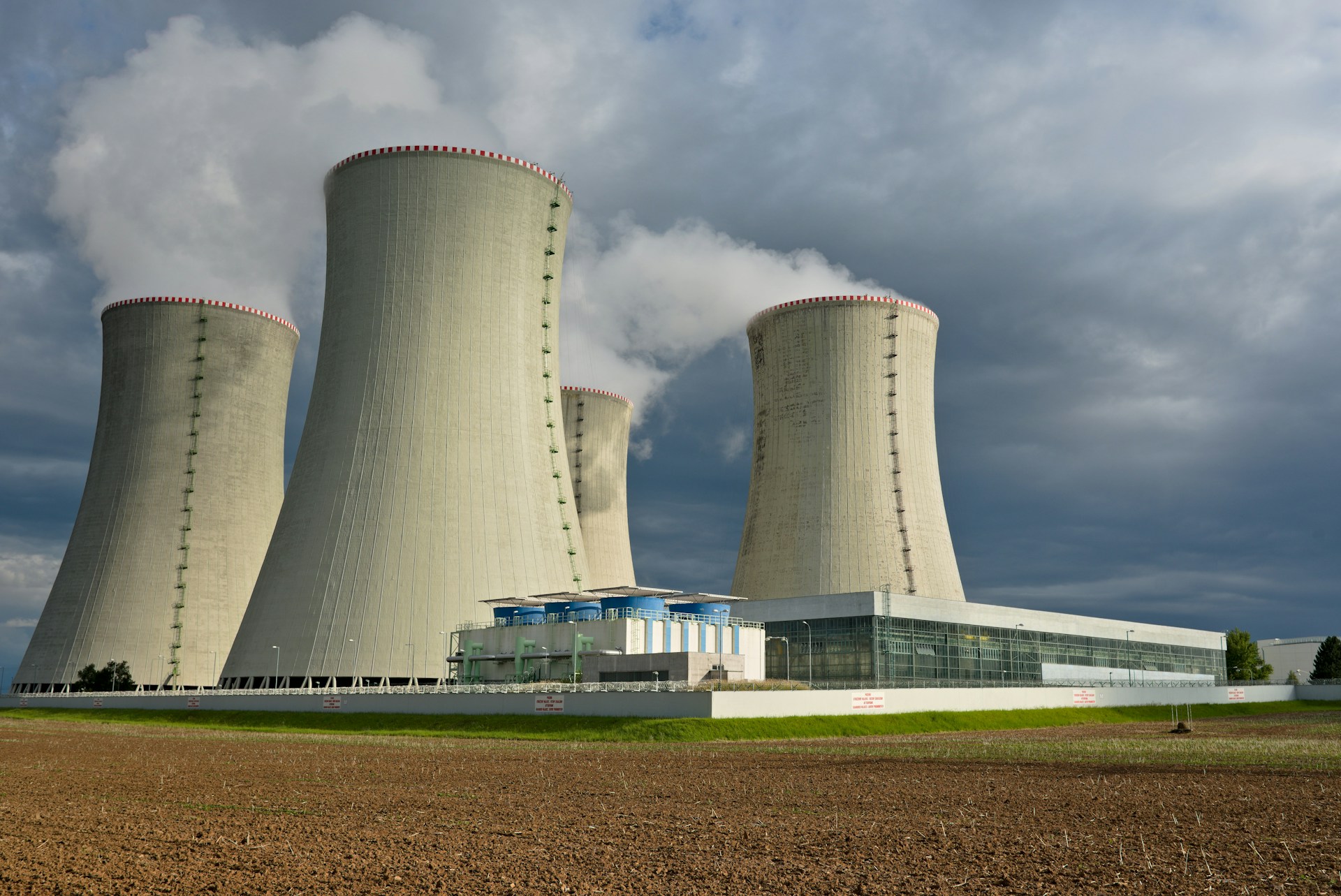
Walk into a nuclear power plant control room or turbine hall, and you will find an obsession with hardware redundancy. Every primary safety system has a physical backup. Every critical valve and cooling loop is cross-checked against multiple failsafes. Yet, hand a reactor operator or maintenance technician a 400-page operating procedure written in bloated corporate prose, and that entire safety margin evaporates.

Nuclear engineering documentation compliance relies on more than just ticking regulatory boxes; it requires absolute clarity. When an ambiguous sentence in a shutdown manual or testing protocol triggers a misinterpretation, the resulting delay or operational error can compromise safety. This is why achieving strict documentation compliance requires moving away from loose prose and adopting controlled language standards like ASD-STE100.

In aerospace and nuclear engineering documentation compliance, an ambiguous sentence in a troubleshooting guide causes mistakes, delays, and costly rework. Despite that, most organisations treat technical documentation like a compliance afterthought—something tossed over to whoever has free time before a deadline.

To solve this, industries rely on Simplified Technical English (STE)—an international writing specification designed to remove guesswork from technical documents. Originally developed for the aerospace sector and formally maintained under the specification known as ASD-STE100, this standard restricts writers to a controlled vocabulary and strict grammar rules.

It is not about running text through a basic spell-checker or satisfying a bureaucratic audit. It is a practical engineering control designed to make complex instructions unambiguous.

The Cost of Ambiguity in Nuclear and Aerospace

Traditional technical writing often suffers from unnecessary literary variation. Writers swap out verbs, bury actions inside passive voice, and write long, multi-clause sentences that require multiple passes to parse.

When an aerospace technician works on flight control systems under tight turnaround times, or a nuclear technician reviews shutdown procedures during an outage, they do not calmly analyse prose—they execute actions. If a step relies on loose modifiers or vague verbs, interpretation fractures.

The practical costs show up quickly:

  • Wasted Time: Engineers burn hours decoding poorly worded instructions or calling engineering support to clarify what a step actually means.
  • Workarounds: Frustrated technicians stop reading the manual, relying on tribal knowledge and shortcuts that bypass safety checks.
  • Operational Risk: Misinterpreting an action verb during turbine overhaul or valve calibration can damage expensive hardware or trigger unexpected shutdowns.

Surface-level calls for “clear communication” do not fix this. You need structural boundaries, which is why the ASD-STE100 specification enforces a controlled vocabulary where every word has one approved meaning.

Controlling Vocabulary and Syntax

ASD-STE100 restricts writers to roughly 500 approved general terms, paired exclusively with vetted technical nouns. Words like check, inspect, verify, and test are never allowed to bleed into one another. Each has a specific operational definition.

In a nuclear facility or an aerospace maintenance depot, that distinction is non-negotiable. If a procedure blurs the line between checking a pressure gauge and testing a system under load, an operator might glance at a dial instead of running a diagnostic sequence.

The standard enforces this through mechanical rules:

  • Fixed Verb Definitions: Synonyms are banned. An action verb means one precise physical action every time.
  • The Imperative Mandate: Instructions must start with the action verb, leaving no doubt about who does what.
  • Strict Word Limits: Procedural sentences are capped at 20 words. Descriptive text stops at 25.
  • No Gerunds or Noun Piles: Heavy noun clusters are broken down into clean subject-verb-object structures.

S1000D Integration

Large aerospace and nuclear projects involve multi-vendor ecosystems where suppliers, contractors, and regulators must share data seamlessly. That requires modular data standards like S1000D.

An XML container standard is only as good as the text inside it. S1000D provides the structure; ASD-STE100 provides the linguistic rules. Together, they deliver:

  • Cleaner Translation: Removing idioms and grammatical clutter makes source text easier for human translators and machine engines across international supply chains.
  • Lower Localization Costs: Standardised English yields higher translation memory matches, cutting endless rewrites.
  • Safe Content Reuse: Modular data modules move between aircraft platforms or reactor designs without losing semantic integrity.

Implementing STE

You cannot deploy ASD-STE100 by treating it as a software plugin or a final edit. Changing how engineers author documents requires a structured approach:

  1. Run a Baseline Audit: Pull a sample of current maintenance manuals to measure sentence lengths and unapproved terminology.
  2. Set Governance: Appoint STE champions and embed the rules into corporate style guides and authoring templates.
  3. Train the Writers: Run practical workshops for technical writers and subject matter experts focusing on controlled vocabulary and syntax.
  4. Automate Guardrails: Integrate checking tools into the authoring environment so writers catch non-compliant terms as they type.
  5. Measure Results: Track metrics like technical query tickets, translation costs, and procedural errors.

Practical Precision

In aerospace and nuclear engineering documentation compliance, documents are a functional tool, not a stylistic showcase. Treating manuals as a clerical afterthought invites operational friction. Proper ASD-STE100 compliance aligns documentation directly with engineering intent.

Ready to eliminate ambiguity in your manuals?

Shufrans TechDocs helps engineering teams in aerospace and nuclear sectors implement practical ASD-STE100 compliance through specialised training and governance consulting. Contact us today to discuss your documentation workflow.


The Multi-Jurisdiction Trap: Why Fragmented Technical Language Breaks Cross-Border Fleet Support

The Multi-Jurisdiction Trap: Why Fragmented Technical Language Breaks Cross-Border Fleet Support

When high-value, safety-critical assets—such as rolling stock, aerospace propulsion units, or defense launcher systems—are deployed across international markets, they rarely operate within a single linguistic bubble. A locomotive maintained in South Korea, an aircraft engine serviced in Azerbaijan, or a semiconductor subsystem installed in Europe relies on a complex web of local technicians, regional partners, and third-party contractors.

Yet, many global engineering enterprises commit a foundational operational error: they write their technical documentation for a single domestic audience, assuming that natural English will seamlessly translate across borders.

When maintenance manuals, standard work instructions (SWIs), and troubleshooting guides are packed with idioms, regional terminology, and unstructured phrasing, they become high-risk liabilities the moment they cross an international border.

The Cost of Multi-Site Misinterpretation

In global field operations, an ambiguous instruction is not merely a linguistic inconvenience; it is an operational hazard. When local technicians encounter unconstrained, complex technical literature, downtime multiplies.

  1. Inconsistent Service Execution: If two regional hubs interpret a complex component replacement procedure differently due to vague phrasing, maintenance quality fractures.

  2. Prolonged Mean Time to Repair (MTTR): Technicians spend critical minutes decoding convoluted prose rather than executing the repair, directly degrading fleet availability and customer uptime.

  3. Audit and Liability Exposure: Cross-border regulatory audits demand absolute procedural repeatability. If local service records reveal that maintenance actions deviated because the master manual was open to interpretation, the organisation faces severe compliance penalties.

Localisation agencies and automated translation tools cannot solve this structural flaw. If the source text is inherently ambiguous, translation tools merely scale that ambiguity into multiple languages, turning minor phrasing errors into widespread operational risks.


Establishing a Universal Operational Standard

Protecting global assets requires a single, ironclad rule: operational instructions must mean the exact same thing whether they are read in Singapore, Rotterdam, or Seoul.

This is why leading high-stakes sectors rely on ASD-STE100 Simplified Technical English (STE). By enforcing strict, standardized writing rules—such as restricting every approved word to a single meaning, enforcing the imperative voice for actions, and eliminating subjective modifiers—STE strips away semantic friction. It creates a controlled vocabulary that human technicians can execute instantly and automated translation systems can process without error.

Bridge the Gap with Shufrans TechDocs

Eliminating documentation ambiguity across international networks requires more than passive software checkers; it demands specialized, human-centric training that transforms how engineering teams author technical data at the source.

With twenty years of specialised experience delivering rigorous ASD-STE100 implementation and training programmes across aviation, rail, defense, and high-tech sectors, Shufrans TechDocs helps global engineering organisations secure total linguistic control over their operations.

Whether you are looking to streamline cross-border maintenance handoffs or future-proof your technical publications for global compliance, we provide the expert training and implementation framework your team needs.

🔗 Ready to eliminate operational ambiguity? Reserve a 30-min STE Feasibility Session with Shufrans TechDocs: https://calendly.com/shufranstechdocs/30min


The Quiet Risk: Why Uncontrolled English Undermines Engineering Compliance

The Quiet Risk: Why Uncontrolled English Undermines Engineering Compliance

Engineering organisations subject every physical component, software algorithm, and manufacturing process to rigorous validation. Yet, the instructions guiding how operators, technicians, and auditors interact with those systems are frequently left to individual writing styles.

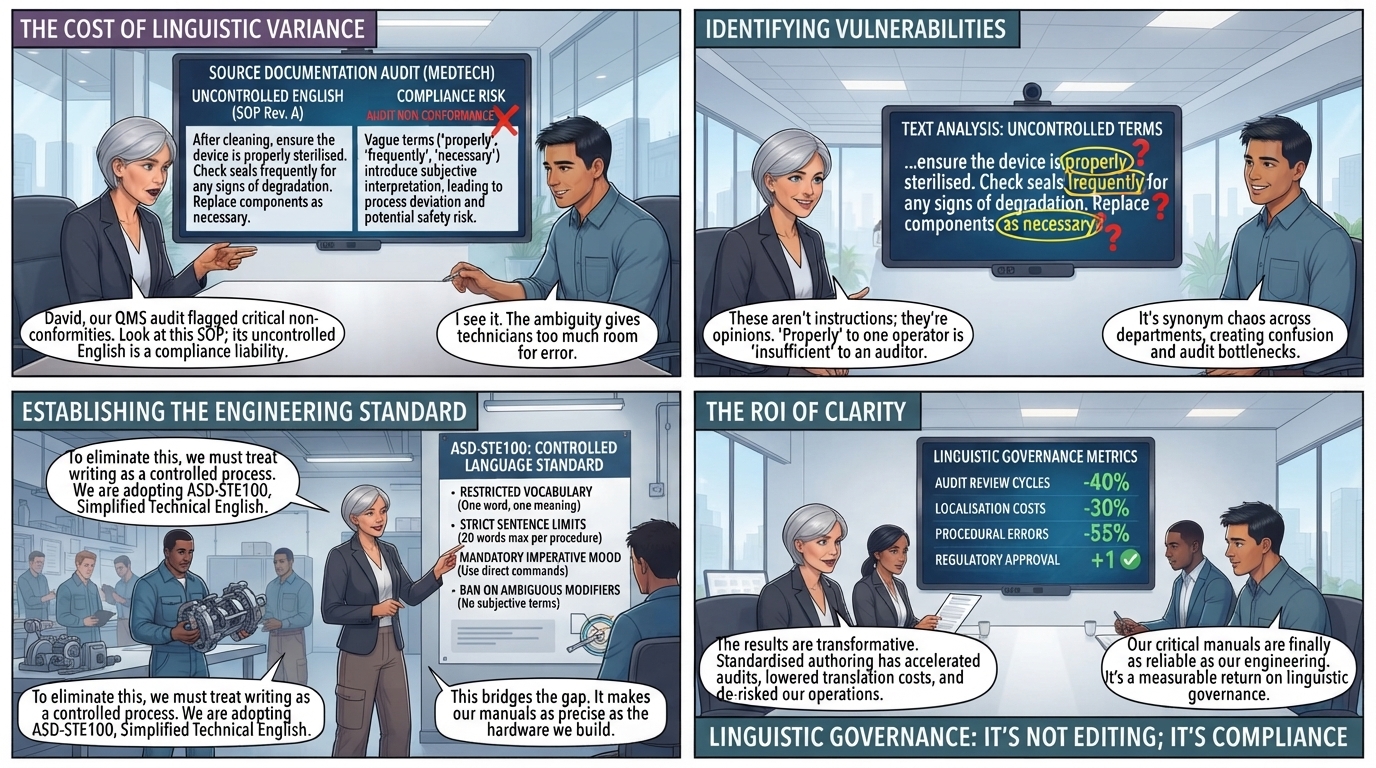
When standard operating procedures (SOPs), maintenance manuals, and regulatory dossiers rely on conversational phrasing, they introduce controlled variation into environments that demand absolute predictability. In high-consequence sectors like aerospace, medical devices, automotive, and heavy industry, that linguistic gap is a major operational liability.

The Structural Vulnerability of Natural Language

Technical writers and engineers are experts in their fields, but natural language is built for interpretation rather than precision. When drafting documentation without structural constraints, standard writing habits routinely introduce three specific vulnerabilities:

  • Lexical Inconsistency: Different authors use multiple terms for the same component or action. One section calls for disconnect, another for detach, and a third for unplug, creating confusion for readers and rendering translation memories inefficient.
  • Subjective Parameters: Words like appropriate, sufficient, frequent, or excessive introduce personal judgement into instructions that require measurable thresholds. A technician’s definition of “frequent maintenance” rarely matches an auditor’s interpretation.
  • Complex Syntax: Long, multi-clause sentences bury the primary action, increasing cognitive load under operational pressure and elevating the risk of procedural error.

During an audit or regulatory review, these inconsistencies translate directly into audit non-conformities, review bottlenecks, and prolonged approval cycles.

Bridging the Gap with ASD-STE100

To eliminate this friction, organisations must treat technical authoring as a controlled engineering process. This requires implementing ASD-STE100 (Simplified Technical English)—an international specification originally engineered for complex aerospace systems to remove linguistic uncertainty.

ASD-STE100 brings the same methodological discipline to text that engineers apply to hardware design:

  • A Standardised Vocabulary: A controlled dictionary limits each word to a single approved meaning and part of speech, eliminating unauthorised synonyms and ambiguity.
  • Strict Length Limits: Procedural sentences are restricted to a maximum of 20 words, while descriptive text is capped at 25 words, ensuring information is processed quickly and accurately.
  • Explicit Action-Oriented Phrasing: Writers must use the imperative mood for instructions, ensuring the required task is unmistakable and direct.

The Commercial Impact of Linguistic Governance

Adopting a controlled language standard transforms technical documentation from an administrative bottleneck into an asset for operational excellence. When source texts adhere to a predictable grammatical baseline:

  1. Review Cycles Accelerate: Quality assurance and regulatory teams spend less time untangling vague phrasing and more time evaluating core compliance.
  2. Localisation Costs Drop: Clean, standardised source text maximises translation memory reuse and optimises machine translation accuracy across global markets.
  3. Safety Risks Decrease: Operators in the field execute maintenance procedures without second-guessing ambiguous instructions.

Securing Your Documentation Pipeline

Investing in physical safety systems while ignoring the clarity of the instructions governing them leaves a critical vulnerability open. Standardising authoring output protects your compliance posture, safeguards your audit readiness, and ensures your documentation matches the quality of your engineering.

If your organisation is ready to eliminate documentation ambiguity and streamline compliance workflows, let us evaluate your technical text.

Reserve a 30-min STE Feasibility Session to discuss how linguistic governance can protect your engineering operations.


The Multi-Million-Dollar Machine Built With a Mystery Manual

The Multi-Million-Dollar Machine Built With a Mystery Manual

When you discuss modernising technical documentation with industry leads, the response is often a polite brush-off: a quiet note that they are simply not interested right now, followed by a swift exit.

It is a fascinating reaction.

You have engineered a marvel of industrial machinery. It weighs 20 tonnes, handles complex high-throughput processing, operates under punishing conditions, and represents years of precision mechanical and electrical design. It is shipped to a plant halfway across the world.

Then, an operator misinterprets a single, poorly translated safety instruction in the manual because the source text was written with loose, ambiguous phrasing instead of clear engineering data.

A component jams. Production stops. Equipment is damaged, or worse, someone gets hurt.

Whose fault is it? The engineers blame the manual. But the Technical Documentation Lead sitting back at headquarters—the person who dismissed text standardisation with a wave of the hand because “we’ve always written manuals this way”—sleeps soundly, completely blind to the fact that their department is an operational hazard.


The Industrial Delusion: The ISO Paperwork Tra

When you talk to documentation leads in heavy machinery and traditional manufacturing about linguistic governance or Simplified Technical English, you usually get a predictable defence:

  • “We have our ISO audit sorted, so our quality is covered.”
  • “Our translation agency handles the phrasing.”
  • “We don’t have the bandwidth to retrain our authors.”

It is a fascinating display of professional cognitive dissonance. These are the exact same enterprises that will happily throw a fortune at auditors to pass an ISO paperwork check, certifying that a bloated, chaotic authoring process has been officially documented and filed away. They cling to the ‘if it ain’t broke, don’t fix it’ mentality, entirely missing the point that their documentation is not only broken—it is an expensive, silent failure point.

Yet, when it comes to the actual words commanding how a multi-million-dollar machine is safely operated and maintained, it remains a free-for-all of ambiguous syntax, cultural idiom, and creative prose. An ISO certificate proves you have a process on paper. It does not prove your instructions make sense to a foreign technician at 3:00 AM.

The True Cost of Status-Quo Comfort

Refusing to standardise source text isn’t a neutral administrative choice. It is an active decision to burn capital and invite risk:

  1. The Translation Black Hole: Dumping unstandardised, verbose source text into translation memory or AI tools guarantees exponential costs. You are paying good money year after year to have translators untangle convoluted sentences that never should have been written that way in the first place.
  2. The Safety Liability: In heavy-duty industrial processing, ambiguity is a hazard. Words like appropriate, sufficient, or check periodically are legal and operational landmines. If an instruction can be interpreted in two ways, someone will eventually choose the wrong one.
  3. The AI Dead-End: Companies love talking about digital transformation and AI-driven service assistants. But if your underlying documentation is written like a novel, your downstream AI models will hallucinate, misinterpret procedures, and fail catastrophically.

Stop Managing a Printing Press

If your definition of technical documentation is simply filling pages until a CE-compliance box is checked, you aren’t managing an engineering asset. You are managing an expensive printing press for liability.

Trust in engineering arrives on foot and leaves on horseback. Decades of building rigorous, high-performance machinery can be undermined in a single afternoon by a legacy mindset that treats safety-critical documentation as an afterthought.

True linguistic governance isn’t about adding red tape. It is about removing friction, slashing localisation budgets, and ensuring that safety-critical instructions translate seamlessly into any language, anywhere in the world.

Your engineering is too precise to let your words be an afterthought.

If your technical documentation team is tired of fighting translation drag, inflated localisation budgets, and unclear source text, let’s talk. At Shufrans TechDocs, we implement Simplified Technical English and Linguistic Governance for high-compliance engineering sectors that take safety and clarity seriously.


The Unbearable Lightness of Ambiguity: Why Technical Documentation Needs Linguistic Governance

The Unbearable Lightness of Ambiguity: Why Technical Documentation Needs Linguistic Governance

By Shumin (Soumaiya) Chen

In his classic novel, Milan Kundera wrote about the “unbearable lightness of being”—a state where a total absence of rules and constraints causes life to lose its anchor, leaving everything floating in a void of insignificance. In the high-stakes engineering, manufacturing, and aerospace sectors, technical authors face a remarkably similar hazard.

We call it Linguistic Lightness.

When technical authors are given absolute freedom to write documentation, language becomes unanchored. Writers can choose any unapproved verb, stack complex noun clusters, or deploy vague descriptive phrases. On paper, it looks like creative freedom; in reality, it creates an unmanageable operational void.

The Hidden Operational Cost of Unstandardised Phrasing

Consider a typical instruction found in many industrial asset manuals:

“Tapping the ‘System Status’ icon navigates to the Event log page when an auxiliary system inspection is due.”

To a human author, that sentence feels perfectly natural. However, to an operator under pressure, a multinational engineering team, or a localization translator, unstandardised phrasing introduces immediate ambiguity.

  • What constitutes an abstract “event”?

  • Which exact sub-components are included in an “auxiliary system”?

  • What happens if a non-native speaker misinterprets when an inspection is “due”?

When technical text lacks standardization, clear communication breaks down. And when communication fails on a manufacturing floor, a defence asset, or an offshore platform, the consequences are measured in operational downtime, safety hazards, and regulatory non-compliance.


Mitigating Risk Through ASD-STE100 Implementation

To mitigate this risk, global industrial organizations must establish strict linguistic governance across their technical content. We achieve this by implementing ASD-STE100 (Simplified Technical English).

ASD-STE100 acts as a structural anchor. It strips away the “lightness” of subjective writing by enforcing a controlled vocabulary and a rigid set of writing rules. It leaves no room for creative interpretation because it ensures every word has exactly one approved meaning.

When you standardise technical data through a linguistic governance framework, you achieve three critical outcomes:

  1. Human Error Mitigation: Field technicians receive precise, actionable commands that eliminate guessing games.

  2. AI and RAG Accuracy: Clean, standardized documentation serves as high-fidelity training data for LLMs and enterprise AI search tools, preventing hallucination.

  3. Reduced Localization Costs: Eliminating linguistic variance slashes translation timelines and translation memory costs.

Establishing Linguistic Governance in 2026

Uncontrolled language is a hidden liability to asset integrity and operational safety. Technical documentation should never be “light” or open to interpretation—it requires absolute structural weight.

At Shufrans TechDocs, we bring 20 years of experience to helping enterprises implement ASD-STE100 training and workflows. We ensure your documentation standardisation complies with global aerospace, defence, and industrial requirements while de-risking your complex data lifecycles.

An earlier version of this thought leadership piece was shared by Shumin (Soumaiya) Chen on LinkedIn. Follow her profile real-time insights on linguistic standardization.

[/row

Asia Pacific (APAC) Online | Precision & Proofing: Mastering ASD-STE100 Simplified Technical English for High-Stakes Documentation & AI-Ready Inputs

Asia Pacific (APAC) Online | Precision & Proofing: Mastering ASD-STE100 Simplified Technical English for High-Stakes Documentation & AI-Ready Inputs


Write effective user manuals & instructions with Simplified Technical English

APAC | Online Certified ASD-STE100 Training Workshop Programme

Dates: 9 & 10 November 2026 (Alternative slot: 23 & 24 November 2026)

Time: 09:00 to 16:00 UTC/GMT+8:00 [APAC]

Length of training: 2 days

Group Size: Strictly capped at 5 participants for tailored, hands-on feedback

Course registration ends one week before training commences.

What’s Included: Course materials, practical exercises, learning aids, a certificate of completion, and 120 days of post-training support.

Group Discount: Save up to €500 when two or more colleagues register for the same cohort.

Bundle Offer: Receive a €210 discount when you also register for 🆕 Certified STE Masterclass | Asia Pacific (APAC) Online.

Why upstream standardisation matters

Simplified Technical English (ASD-STE100) is the internationally recognised controlled language specification designed to make complex technical manuals clear, unambiguous, and easily understood by a global audience. In today’s environment—where automated translation engines and generative tools can rapidly scale output but also multiply linguistic errors—upstream standardisation is more critical than ever. Consequently, by eliminating ambiguity and enforcing strict syntactic control, STE protects your documentation pipeline, cuts translation costs, and prevents operational risks.

Applicable across aerospace, defence, engineering, and high-compliance industries, this foundational training is led by Shumin Chen. Designed for technical managers, directors, and senior writers, the programme ensures participants learn how to correctly and effectively apply STE rules in practice, navigate common writing pitfalls, and avoid frequent misinterpretations. Furthermore, you will learn how to correct guidelines that undermine technical quality.

Applicable across aerospace, defence, engineering, and high-compliance industries, this foundational training is led by Shumin Chen. Designed for technical managers, directors, and senior writers, the programme ensures participants learn how to correctly and effectively apply STE rules in practice, navigate common writing pitfalls, and correct the frequent misinterpretations of core guidelines that undermine technical quality.

What customers are saying..

I am giving this training a 10/10. There was a good introductory and explanation to describe the 2-day training seminar. Rule 1.1 0 lets me use words that are: approved in the dictionary / technical names / technical verbs and is one rule I like very much because of its flexibility.

I think rule 1.1 is the most critical and important for STE dictionary. Sometimes I have to use non-approved words as an exception, but I will try to keep this rule 1.1 in my documents for good measure.

Although some of the exercises were tricky, they remind me of each rule application at that time. So they were practical for my role as a technical writer.

I want to recommend this course to current technical writers in Korea or engineers who are interested in writing their own documents effectively. Seung Eun Lee, Technical Writer, DB HiTek

Online STE Workshop Outline*

We’re committed to providing the highest quality learning experience in all our online workshops. Therefore, we’ve made the decision to cap all our online workshop session sizes at just five participants, starting 5 May 2025.

This intimate virtual environment fosters richer discussions, more personalised feedback, and a greater overall impact on your understanding and application of key technical communication standards like Simplified Technical English. Learn better, communicate better, across all our courses. This two-day Online STE Workshop includes interactive training, exercises, and a 120-day post-training consultation.

Day 1: Classroom Training

  • Practical overview of Simplified Technical English (ASD-STE100) and why strict structural control is essential for modern technical documentation.
  • How STE ensures absolute clarity for both native and non-native speakers across global audiences.
  • The direct risk-mitigation and cost benefits of adopting the STE international writing standard in high-compliance environments.
  • Core writing rules and how to apply them systematically in daily practice.
  • Mastering the general vocabulary lexicon: Approved and unapproved words, and the strict structural rationale behind them.
  • Eliminating ambiguous phrasing, noun clusters, and syntactic drift that undermine technical accuracy.
  • Establishing a rigorous baseline for clear, human-readable documentation that withstands automated review and translation workflows.

Day 2: Application, Review, & Exercises

  • How to deal with industry-specific terminology and integrate specialized nouns safely into controlled writing.
  • How to apply STE across various documentation types (such as maintenance manuals, service bulletins, and operating procedures).
  • How to implement STE frameworks with minimal disruption to ongoing production and existing documentation archives.
  • Practical hands-on workshop session for applying strict STE rules directly to your own company documents.
  • Review, edit, and discuss participants’ own documents to reinforce learning through actual correction.
  • Collaborative review of common error patterns and alternative phrasing solutions.
  • Final classroom presentation and editorial breakdown of your documents to establish a repeatable, high-integrity quality standard for your team.

* Shufrans also offers customised ASD-STE100 training solutions tailored to meet your specific requirements. These courses are normally provided at the customer’s premises.

Why select a Simplified Technical English training with Shufrans?

Shumin is a very knowledgeable STE instructor. She kept the course interesting and was always open to our questions/feedback. The introduction to Simplified Technical English has been greatly beneficial for my understanding of what the specification entails. In terms of preferred rules, I cannot pinpoint a specific set of STE writing rules as they are all valuable. This was my favorite part of the course as I enjoyed analyzing how other writers went about using STE to best apply it to their line of work.

The rewriting workshop was my favorite part of the course as I enjoyed analyzing how other writers went about using STE to best apply it to their line of work. I would highly recommend this course to all technical writers. Shumin Chen takes the time to clearly explain the rules of STE. A very attentive instructor, indeed. If given the chance, I would really enjoy working along side her. Michael Palmieri, Documentation Specialist, AON3D | The Advanced Additive Manufacturing Platform

What technical writing outcomes to expect?

Our interactive training, exercises, and practical workshops will equip participants to standardise content and achieve measurable operational outcomes:

  1. Enhanced Communication & Global Efficiency: Authors will master the structural discipline required to create clear, consistent, and easily translatable technical documentation, facilitating seamless communication across international markets and streamlining the authoring process.

  2. Improved Operational Safety & Reduced Downtime: By applying rigorous STE principles, teams will eliminate ambiguity, minimise procedural misunderstandings, and directly safeguard operational safety while reducing costly equipment downtime and service delays.

  3. Optimised Lifecycle Support & Cost Reduction: Structured drafting enables modular writing and efficient content reuse, maximizing long-term consistency, optimizing product lifecycle support, and significantly reducing the overall cost of creating and maintaining technical publications.

Ready to eliminate ambiguity in your documentation?

Speak to us today or view the schedule for our upcoming Online STE Workshops here.

Certified STE workshops online

Browse our convenient line-up of Simplified Technical English workshops scheduled at different timezones.


ASD-STE100 Trainer’s qualifications


Ms Shumin Chen will show participants how to correctly and effectively use Simplified Technical English (STE) in practice. She will also address some of the mistakes commonly found in technical writing and the frequently incorrect use of common STE writing rules.

According to Ms Chen, the benefits of STE are manifold – audience engagement through high-quality content, improved product safety, lower life cycle cost and reduced logistics footprint. 

Learn more about how you can create sustainable STE content and reap substantial cost-saving benefits as a result here.

twitter linkedin

Europe | Future-Proof Your Documentation: Mastering Simplified Technical English (ASD-STE100) Compliance

Europe | Future-Proof Your Documentation: Mastering Simplified Technical English (ASD-STE100) Compliance

Write effective user manuals & instructions with Simplified Technical English

Simplified Technical English training Europe | Online Certified ASD-STE100 Training Workshop Programme

Dates: 5 & 6 November 2026 (Alternative cohort: 19 & 20 November 2026)

Time: 08:00 to 15:00 CET

Length of training: 2 days

Course registration ends one week before training commences.

*Course fee includes exercises, learning aids, certificate of completion, and 120-day post-training support.

⁺⁺A group discount of up to €500 is applicable when two or more participants sign up for the same event. Send us your questions: enquiry@shufrans-techdocs.com.

🏷️ A €210 fee discount is applicable when you also sign up for 🆕 Certified STE Masterclass | Europe Online.

What’s Included & Incentives

  • Inclusions: Course materials, practical exercises, learning aids, a certificate of completion, and 120 days of post-training support.

  • Group Discount: Save up to €500 when two or more colleagues register for the same cohort.

  • Bundle Offer: Receive a €210 fee discount when you also register for the upcoming Certified STE Masterclass | Europe Online.

  • Enquiries: Have questions or need a custom corporate booking? Send us a message at enquiry@asd-ste100.net.

Summary of Simplified Technical English (STE)

Simplified Technical English (ASD-STE100) is the internationally recognised controlled language specification designed to make complex technical manuals clear, unambiguous, and easily understood by a global audience. In today’s enterprise landscape—where automated translation engines and AI-assisted workflows rapidly scale content output but also multiply linguistic errors—upstream standardisation is more critical than ever.

By eliminating ambiguity and enforcing strict syntactic control, STE protects your documentation pipeline, acts as a reliable grounding layer for automated systems, drastically reduces translation costs, and prevents costly operational risks. While often a formal requirement for aerospace and defence maintenance documentation, STE is readily adapted across all high-compliance technical industries. Led by Shumin Chen, this foundational training teaches participants how to correctly and effectively apply STE rules in practice, navigate common writing pitfalls, and correct the frequent misinterpretations of core guidelines that undermine technical quality.

Why select a Simplified Technical English training with Shufrans?

Shumin is a very knowledgeable STE instructor. She kept the course interesting and was always open to our questions/feedback. The introduction to Simplified Technical English has been greatly beneficial for my understanding of what the specification entails. In terms of preferred rules, I cannot pinpoint a specific set of STE writing rules as they are all valuable. This was my favorite part of the course as I enjoyed analyzing how other writers went about using STE to best apply it to their line of work.

The rewriting workshop in Simplified Technical English training Europe was my favorite part of the course as I enjoyed analyzing how other writers went about using STE to best apply it to their line of work. I would highly recommend this course to all technical writers. Shumin Chen takes the time to clearly explain the rules of STE. A very attentive instructor, indeed. If given the chance, I would really enjoy working along side her. Michael Palmieri, Documentation Specialist, AON3D | The Advanced Additive Manufacturing Platform

STE Course Outline*

We’re committed to providing the highest quality learning experience in all our online workshops. Therefore, we’ve made the decision to cap all our online workshop session sizes at just five participants, starting 5 May 2025.

This intimate virtual environment fosters richer discussions, more personalised feedback, and a greater overall impact on your understanding and application of key technical communication standards like Simplified Technical English. Learn better, communicate better, across all our courses. This two-day Online STE Workshop includes interactive training, exercises, and a 120-day post-training consultation.

Day 1: Classroom Training & Foundations

  • Practical overview of Simplified Technical English (ASD-STE100) and why strict structural control is essential for modern technical documentation.

  • How STE ensures absolute clarity for both native and non-native speakers across global audiences.

  • The direct risk-mitigation and cost benefits of adopting the STE international writing standard in high-compliance environments.

  • Core writing rules and how to apply them systematically in daily practice.

  • Mastering the general vocabulary lexicon: Approved and unapproved words, and the strict structural rationale behind them.

  • Eliminating ambiguous phrasing, noun clusters, and syntactic drift that undermine technical accuracy.

  • Establishing a rigorous baseline for clear, human-readable documentation that withstands automated review and translation workflows.

Day 2: Practical Application, Review, & Exercises

  • How to deal with industry-specific terminology and integrate specialised nouns safely into controlled writing.

  • How to apply STE across various documentation types (such as maintenance manuals, service bulletins, and operating procedures).

  • How to implement STE frameworks with minimal disruption to ongoing production and existing documentation archives.

  • Practical hands-on workshop session for applying strict STE rules directly to your own company documents.

  • Systematic review, live editorial breakdown, and discussion of participants’ own documents to reinforce learning.

  • Collaborative review of common error patterns and alternative phrasing solutions.

  • Final classroom presentation of edited documents to establish a repeatable, high-integrity quality standard for your team, directly reducing the cost of creating and maintaining technical publications.

*Shufrans also offers customised ASD-STE100 training solutions tailored to meet your specific requirements. These courses are normally provided at the customer’s premises.

Who should attend this Simplified Technical English training?

  • Executive Leadership & Strategy: CIOs, CTOs, COOs, and Compliance Managers

  • Documentation & Editorial Leads: Documentation Managers, Editors, and Technical Writers

  • Engineering & Technical Specialists: Engineering Managers, SMEs, Software Research Engineers, Service Engineers, and AI Content Engineers

  • Operations & Support Teams: Maintenance, ILS, Operation, Product, and Project Managers, plus Customer Support

  • Training & Content Creation: Instructional Designers, Translators, Translation Managers, and Technical Illustrators.

What technical writing outcomes to expect?

Our interactive training, exercises, and workshop will equip participants to standardise content and achieve measurable operational outcomes:

  • Enhanced Communication & Efficiency: Authors will gain the structural discipline required to create clear, consistent, and easily translatable technical documentation—providing a reliable grounding layer for automated translation engines and AI-assisted workflows, facilitating seamless global communication, and streamlining the authoring process.

  • Improved Operational Safety & Reduced Downtime: By mastering STE principles, teams will produce unambiguous documentation that eliminates procedural misunderstandings, directly safeguarding operational safety and driving a measurable reduction in costly AOG/downtime and human error.

  • Optimised Lifecycle Support & Cost Reduction: Standardisation enables modular writing, semantic consistency, and efficient content reuse. This optimises product lifecycle support, future-proofs documentation against shifting publishing stacks, and significantly reduces the overall cost of creating and maintaining technical publications.

What customers are saying..

The introduction in Simplified Technical English training Europe was a good and concise way to familiarize yourself with STE basics. I’ve a background in plain language, so for example the rule on noun clusters makes perfect sense. I’m all about simplification, so substituting verbs like “eliminate” for verbs like “remove” or “stop” will be my new quest. The STE exercises were helpful in getting to grasp with STE during the training workshop. I’d very likely recommend this course to anyone planning to introduce STE as it’s got a great practical angle. Jenni Virtaluoto, PhD, Senior Lecturer, University of Jyväskylä, Finland

ASD-STE100 Trainer’s qualifications

Ms. Shumin Chen, principal trainer and consultant at Shufrans TechDocs, received her professional on-the-job training in the field of Simplified Technical English under the tutelage of Dr Frans Wijma, a renowned linguist and documentation expert. Together as an experienced global team, they combined their expertise to benefit enterprise clients worldwide, having delivered training and consultancy services to over 200 companies to date. Shufrans TechDocs stands as an industry leader with unmatched depth of experience in providing certified Simplified Technical English training in Europe.

Shumin has guided numerous organisations through their complex documentation and standardisation needs. Although STE was originally developed for the aerospace industry—specifically for aircraft maintenance manuals—she has successfully demonstrated that its foundational principles provide an essential governance framework across a wide range of technical sectors, including machinery, IT, automotive, energy, and medical equipment.

As enterprises increasingly deploy automated translation engines, LLMs, and AI-assisted content workflows, Shumin’s approach proves that strict linguistic control is more vital than ever. Because structural clarity and syntactic discipline are universally required, few, if any, changes to the specification are necessary to adapt STE as a reliable upstream grounding layer for modern digital and AI-driven publishing stacks.


Americas | Mastering Simplified Technical English: Ensuring Clarity and Compliance in Technical Documentation

Americas | Mastering Simplified Technical English: Ensuring Clarity and Compliance in Technical Documentation

Write effective user manuals & instructions with ASD-STE100 Simplified Technical English

Americas | Online Certified ASD-STE100 Simplified Technical English Workshops

Dates: 11 to 13 November 2026 (Alternative slot: 25 to 27 November 2026)

Time: 08:00 to 12:30 Eastern Time (ET) or 15:00 to 19:30 Pacific Time (PT)

Length of training: 3 days

Course registration ends one week before training commences.

*Course fee includes exercises, learning aids, certificate of completion, and 120-day post-training support.

⁺⁺A group discount of up to €500 is applicable when two or more participants sign up for the same event. Send us your questions: enquiry@asd-ste100.net.

🏷️ A €210 fee discount is applicable when you also sign up for 🆕 Certified STE Masterclass | US Canada Online.

Summary

Simplified Technical English (ASD-STE100) is a controlled language designed to make technical manuals clear, unambiguous, and easily understood by a global audience. Mandated or recommended by key military and commercial specifications, STE reduces translation costs and serves as a vital upstream grounding layer for automated translation engines and AI workflows.

Led by Ms. Shumin Chen (Shufrans TechDocs), this training guides participants through the correct and effective practical application of STE, addressing common writing errors and the frequent misapplication of core rules across all technical industries.

For enquiries and registration: enquiry@asd-ste100.net

Course outline*

We are committed to providing the highest quality learning experience across all our online workshops. To ensure richer discussions, deeper document reviews, and maximum individual impact, all online workshop sessions are strictly capped at just five participants.

This intimate virtual environment fosters precise feedback and mastery of key technical communication standards like Simplified Technical English. Each three-day online workshop includes interactive training, hands-on exercises, and a dedicated 120-day post-training consultation period.

Day 1: Classroom Training & Foundations

  • Practical overview of Simplified Technical English (ASD-STE100)

  • How STE ensures absolute clarity for both native and non-native speakers across global networks

  • Strategic risk-mitigation and cost benefits of adopting the STE standard

  • Core writing rules and systematic daily application

Day 2: Application & Vocabulary

  • Navigating the general vocabulary dictionary

  • Approved versus unapproved words and the structural rationale behind them

  • Handling industry-specific terminology and specialised nouns safely

  • Applying STE across diverse manuals, service bulletins, and operating procedures

Day 3: Review, Implementation, & Exercises

  • Hands-on workshop session applying strict rules to your own corporate materials

  • Live editorial review, breakdown, and discussion of participant texts

  • Implementing frameworks with minimal disruption to ongoing production and legacy documentation

  • Classroom presentation and restructuring of participant documents to reinforce mastery

*Shufrans also offers customised ASD-STE100 training solutions tailored to meet your specific corporate requirements, normally delivered on-site at customer premises.

What customers are saying..

I was looking forward to the training and was not disappointed. I think that the training was valuable and would recommend that my colleagues take the training either on line or in person. Being able to send a sample document and then working on it together using my new STE skills was very helpful and valuable. Shumin was extremely knowledgeable and gave many practical examples. I hope to be able to make use of the support period post-training. Deborah Tonkin, Technical Information Engineer, Komatsu

Why select a Simplified Technical English training with Shufrans?

The introduction to ASD-STE100 was good and informative for someone like me with zero knowledge of the STE standard before. Rule 6.3 in STE writing summarizes the best of what I can take with me. There was quite a lot from the STE exercises to consume regarding grammar. Nevertheless, the worksheets were very good and helpful. I gained quite a lot of knowledge from them and they were the best part of this training workshop. Shumin was very professional and sharp as a razor. The best takeaway for me from her workshop is to give more thought to how I build my sentences rather than focussing on specific ‘allowed’ or ‘approved’ words. Jeppe Friis, Technical Inspector, Maersk Drilling Maintenance Support

Who should attend this ASD-STE100 workshop?

  • Executive & Strategy: CIOs, CTOs, COOs, Compliance and Quality Managers
  • Documentation & Editorial: Documentation Managers, Editors, Technical Writers, Technical Illustrators, and Graphics Specialists
  • Engineering, AI & Technical: Engineering Managers, SMEs, Software Research Engineers, AI Integration Specialists, Prompt Engineers, and Engineers who create documentation
  • Operations & Support: Maintenance, ILS, Operation, Product, and Project Managers, plus Customer Support Managers
  • Training, Translation & Content: Translation Managers, Translators

What ASD-STE100 workshop training outcomes to expect?

Our interactive training, exercises and workshop, will teach participants to standardise content to:

  • Enhanced Communication & Efficiency: Authors will gain the skills to create clear, consistent, and easily translatable technical documentation, facilitating effective communication with a global audience and streamlining the writing process.
  • Improved Operational Safety & Reduced Downtime: By mastering STE principles, teams will produce unambiguous documentation that minimises misunderstandings, directly contributing to improved operational safety and a reduction in costly AOG/downtime.
  • Optimised Lifecycle Support & Cost Reduction: Training will enable modular writing and content reuse, leading to maximised consistency, optimised product lifecycle support, and a significant reduction in the overall cost of creating and maintaining technical publications.

ASD-STE100 Trainer’s qualifications

Ms. Shumin Chen, principal trainer & consultant at Shufrans TechDocs received her professional on-the-job training in the field of STE under the tutelage of Dr Frans Wijma, a linguist and documentation expert. Together as an experienced global team, they provided their combined knowledge and dedication to benefit customers worldwide. To date, they have provided training and consultancy services to over 180 companies. Shufrans TechDocs is the only company with such vast experience in providing certified STE training.

Shumin has supported various companies with their STE and other documentation needs, based on standards where possible. Although STE was developed for the aerospace industry, more specifically for aircraft maintenance documentation, Shumin found that it made a lot of sense to apply the same principles to other industries and types of documents as well. Few -if any- changes to the specification are necessary to adapt STE to industries ranging from machinery to IT, automotive to medical equipment.


Middle East & Africa | Practical ASD-STE100 Simplified Technical English Workshops: Ensuring Documentation Compliance

Middle East & Africa | Practical ASD-STE100 Simplified Technical English Workshops: Ensuring Documentation Compliance

Middle East & Africa Online ASD-STE100 Technical Writing Workshop

MEA | Online Certified ASD-STE100 Training Workshop Programme

Dates: 2 & 3 November 2026 (Alternative slot: 16 & 17 November 2026)

Time: 09:00 to 16:00 Gulf Standard Time (GST)

Length of training: 2 days

Course registration ends one week before training commences.

Course fee includes exercises, learning aids, certificate of completion, and 120 days of post-training support.

Group discounts of up to €500 are available when two or more participants register from the same company. An additional €210 fee discount applies when your team also registers for the 🆕 Certified STE Masterclass | Asia Pacific (APAC) Online..

For enquiries and registration, contact us at enquiry@asd-ste100.net.

Simplified Technical English (ASD-STE100) is a controlled language designed to make technical manuals clear, unambiguous, and easily understood by a global audience. Mandated or recommended by specifications like MIL-STD-3048, S1000D, and ATA iSpec 2200, STE makes translations cheaper and more accurate while ensuring structural completeness.

In today’s digital landscape, STE also serves as the essential upstream grounding layer for automated translation engines, LLMs, and RAG pipelines, preventing syntactic drift and hallucinations. While a formal requirement for aerospace and defence maintenance, its rigorous principles are easily adapted across all technical industries. Led by Shumin Chen, this training teaches participants how to apply STE rules correctly in practice, avoid common writing pitfalls, and eliminate hidden operational risks.

The ASD-STE100 workshop conducted by Shufrans TechDocs made for a very good introduction to STE for new as well as intermediate users of the STE writing standard. The presentation on rules was very clear and I liked the emphasis on the fact that the rules are weighted and how one can use them flexibly. The exercises completed during this training were good and provided real world examples in technical writing in a practical way. I’d very likely recommend this course to someone else. This course is a must for any new technical writers or technical publication employees. Neil Winson, Technical Writer, Airbus Helicopters

MEA Online STE Workshop Course Outline*

We are committed to providing the highest quality learning experience across all our online workshops. To ensure richer discussions, deeper document reviews, and maximum individual impact, all online workshop sessions are strictly capped at just five participants.

This intimate virtual environment fosters precise feedback and mastery of key technical communication standards like Simplified Technical English. Each two-day online workshop includes interactive training, hands-on exercises, and a dedicated 120-day post-training consultation period.

Day 1: Classroom Training & Foundations

  • Practical overview of Simplified Technical English (ASD-STE100)

  • How STE ensures absolute clarity for both native and non-native speakers across global networks

  • Strategic risk-mitigation and cost benefits of adopting the STE standard

  • Core writing rules and systematic daily application

  • Navigating the general vocabulary dictionary

  • Approved versus unapproved words and the structural rationale behind them

Day 2: Practical Application, Review, & Exercises

  • Handling industry-specific terminology and specialised nouns safely

  • Applying STE across diverse manuals, service bulletins, and operating procedures

  • Implementing frameworks with minimal disruption to ongoing production and legacy documentation

  • Hands-on workshop session applying strict rules to your own corporate materials

  • Live editorial review, breakdown, and discussion of participant texts

  • Classroom presentation and restructuring of participant documents to reinforce mastery

*Shufrans also offers customised ASD-STE100 training solutions tailored to meet your specific corporate requirements, normally delivered on-site at customer premises.

Who should attend this Simplified Technical English training?

  • Executive & Strategy: CIOs, CTOs, COOs, Compliance and Quality Managers

  • Documentation & Editorial: Documentation Managers, Editors, Technical Writers, Technical Illustrators, and Graphics Specialists

  • Engineering & Technical: Engineering Managers, SMEs, Software Research Engineers, and Engineers who create documentation

  • Operations & Support: Maintenance, ILS, Operation, Product, and Project Managers, plus Customer Support Managers

  • Training, Translation & Content: Translation Managers, Translators.

What training outcomes to expect?

Enhanced Communication & Efficiency: Authors will gain the structural discipline required to create clear, consistent, and easily translatable technical documentation—providing a reliable grounding layer for automated translation engines and AI-assisted workflows, facilitating seamless global communication, and streamlining the authoring process.

Improved Operational Safety & Reduced Downtime: By mastering STE principles, teams will produce unambiguous documentation that eliminates procedural misunderstandings, directly safeguarding operational safety and driving a measurable reduction in costly AOG/downtime and human error.

Optimised Lifecycle Support & Cost Reduction: Standardisation enables modular writing, semantic consistency, and efficient content reuse. This optimises product lifecycle support, future-proofs documentation against shifting publishing stacks, and significantly reduces the overall cost of creating and maintaining technical publications.

ASD-STE100 Trainer’s qualifications

Ms. Shumin Chen, Principal Trainer and Consultant at Shufrans TechDocs, received her professional on-the-job training in Simplified Technical English under the tutelage of Dr Frans Wijma, a renowned linguist and documentation expert. Together as an experienced global team, they have delivered training and consultancy services to over 200 companies worldwide. Shufrans TechDocs stands as an industry leader with unmatched depth of experience in providing certified STE training.

Shumin has guided numerous organisations through their complex documentation and standardisation needs. Although STE was originally developed for the aerospace industry—specifically for aircraft maintenance manuals—she has successfully demonstrated that its foundational principles provide an essential governance framework across a wide range of technical sectors, including machinery, IT, automotive, energy, and medical equipment.

As enterprises increasingly deploy automated translation engines, LLMs, and AI-assisted workflows, strict linguistic control is more vital than ever. Because structural clarity and syntactic discipline are universally required, few, if any, changes to the specification are necessary to adapt STE as a reliable upstream grounding layer for modern digital and AI-driven publishing stacks.