technical writing Archives | Page 4 of 4 | Shufrans TechDocs Home // technical writing Archives | Page 4 of 4 | Shufrans TechDocs

Standardisation as a cost reduction strategy

Standardisation as a cost reduction strategy

Why standardise?

Standardisation is widely practised in manufacturing to realise economy of scale at the product level. Why not apply standardisation to documentation?

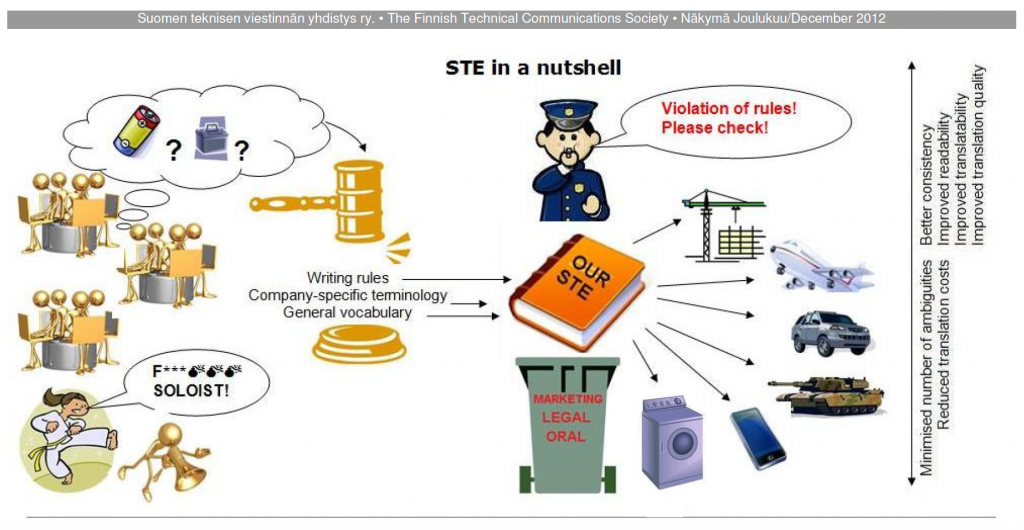
Data standardisation is cost saving by common sense. Injuries, losses and costly legal liabilities can occur as a result of unclear documentation and ambiguous translations. Just like the manufacturing industry makes use of standard components in their product assembly line, Simplified Technical English uses standard vocabulary in the ASD-STE100 specification and consistent industry-/product specific terminology to create documentation.

The borrowed concept of standardisation in the engineering world when translated into the technical documentation industry is based on standardised terminology and simple grammar rules.

The latter for instance, promotes the use of the active voice and simple present tense to clearly identify the doer of a particular action so as to avoid miscommunication and ambiguous translations during the localisation process. In a nutshell, we can draw a parallel between grammar rules and SOPs that both share a common purpose in streamlining processes in a straightforward and objective manner.

What is STE, and how does STE differ from Standard English and how do I know if this is right for my industry?

ASD-STE100 Simplified Technical English (STE) is an international standard that helps to make technical documentation easy to understand. Simplified Technical English standardises vocabulary, grammar and style, while letting users control their specific terminology. Although Simplified Technical English originates from the aerospace and defence industries, it can easily be customised and applied to any other industry, including machinery, automotive, electronics, IT and medical equipment. Major manufacturers and the S1000D standard require the use of ASD-STE100 Simplified Technical English.

Simplified Technical English pays for itself

Our customer is a manufacturer of mobile X-ray based imaging solutions. They created an operator manual and a service manual in Standard English. This manual is to be translated into 7 other languages.

Before using Simplified English, the manuals had a total word count of 67,300 words. The number of pages was 454. In Simplified English, the word count came down to 49,600 words. The page count was reduced to 406.

Simplified English case study

Text in Simplified Technical English is easier to understand and may not even require translation. Where translation is needed, Simplified Technical English helps to drastically reduce translation cost and time-to-market, as it effectively eliminates redundant words and improves consistency.

The company thus saves almost EUR 21,000 or 35% on the translation of these manuals. For subsequent manuals, the savings would increase further thanks to better re-use and yield from translation memory.

With the ever increasing number of languages that companies need to deal with, these savings add up quickly. As content in Simplified Technical English is easier to validate, technical writers will be more productive, and fewer iterations and less rework will be required.

For this reason, the time-to-market is reduced by a similar percentage.


Editorial note: Based on feedback from readers, we would like to clarify that the cost reduction above is based on statistics from standard commercial memory tools, i.e. re-use on the sentence (segment level). This is brought by a combination of consistent style, vocabulary and terminology.  

Copyright © 2016 Shufrans TechDocs. All rights reserved. No part of this article may be reproduced or transmitted in any form or by any means whatsoever without express written permission from the author, except in the case of brief quotations embodied in critical articles and reviews. 
Are you ready to make STE your strategic partner?

Explore our FAQ section below.
Simplified Technical English at the core of your documentation strategy

Simplified Technical English at the core of your documentation strategy

Why Simplified Technical English (STE)?

Whether you are looking to implement working standards such as DITA, S1000D, ATA iSpec 2200, RailDex, or ShipDex to standardise your information structure and facilitate content re-use, it is important to give due consideration to the quality of your source text when creating your technical content. Ambiguous or inconsistently worded documentation can result in non-compliant data deliveries, poor customer support, potential legal liabilities, equipment damage, as well as safety risks.

A well-written source text ensures the ease of downstream content management processes such as translations

Improved readability for your technical content

STE prescribes the use of grammar rules that are relatively more restrictive than the standard rules of the English language.

The general vocabulary has only 900 approved words while explicitly listing 1500 other non-approved words with alternative suggestions.

By introducing these grammar and vocabulary restrictions, technical authors can avoid writing overly long sentences and leave out unnecessary technical details where applicable, all of which are obstacles to the ease of readability and sound understanding.

Recommended by global documentation standards

Military defence standards (MIL-SPEC / MIL-STD) such as MIL-STD-3048, as well as technical documentation standards like S1000D and ATA iSpec 2200 recommend the use of ASD-STE100.

Although the S1000D standard was originally intended for the aerospace and defence industry, this widely successful specification has been customised for the shipping and train manufacturing and operations communities giving rise to both ShipDex and RailDex. Likewise, sound and consistent STE writing rules are highly applicable and practical for use across industries.

Simplifying or eliminating the need for translations?

STE is an international aerospace standard that helps to make technical documentation easy to understand. However, the benefits of STE have proven very highly applicable to all industries. That is why 60% of STE users today come from industries outside of aerospace & defence.

Understandably, STE was designed with non-native speakers of the English language in mind. By providing technical writers with a common set of standardised writing rules and general vocabulary, STE enables teams of writers to write technical manuals that are consistently accurate and require less proofreading and editing effort. Consequently, this does away with the need for translations altogether.

Besides the aerospace maintenance industry however, product exports are still subjected to much scrutiny in terms of their paperwork, documentation and associated product translations. Therefore, the use of STE to create technical content can support downstream translation processes in several ways:

  • A 900-word general vocabulary dictionary eliminates the need for other non-approved, and possibly uncommon synonyms. This reduces the likelihood of term-related clarifications and queries from translators, resulting in faster translation processes.
  • Enforcing STE rules strictly guarantees a high level of consistency at word-, phrase-, and sentence-levels.  This allows project managers to leverage on existing translation memories to substantially reduce translation costs.
  • With fewer technical terms to translate and a more uniform translation memory, translators can provide cheaper, faster and better translations thanks to STE.
  • Having STE content in place will result in exceptional translation quality with machine translations as well.


In a nutshell

For many years now, the use of STE as a controlled language authoring strategy has successfully taken off not just at large organisations, but also in small and medium enterprises.

With professional Simplified Technical English training that costs only a fraction of supposed “full implementation”, and yet achieves 75% – 85% of the benefits and results of an approach that includes checker software, getting started with STE is no longer the major and expensive investment it used to be.

Training technical writers and engineers to write in STE within two to three days may sound like a simple and straightforward undertaking. However, to change the way your technical authoring team works does require some managerial direction while the team transits to STE. Trained technical writers will experience on a more regular basis, the many benefits that STE as a controlled language writing strategy offers.


Shumin Chen

About the author

Since 2006, Ms Shumin Chen has been working as a consultant with customers in various industries worldwide: aerospace and defence, banking, consumer products, healthcare, IT, medical and fitness equipment. She has helped many companies with their documentation needs, based on standards where possible, and is widely regarded as a leading expert in ASD-STE100 Simplified Technical English training, aviation documentation and multilingual documentation.

Ms Chen now heads the ASD-STE100 training arm of Shufrans TechDocs. In her current role, Ms Chen continues to focus on the practical implementation of international standards to facilitate the efficient creation and management of multilingual documentation.

Copyright © 2015 Shufrans TechDocs. All rights reserved. No part of this article may be reproduced or transmitted in any form or by any means whatsoever without express written permission from the author, except in the case of brief quotations embodied in critical articles and reviews. 

Are you ready to make STE your strategic partner?

Attend a 2-day certified ASD-STE100 workshop at any of our worldwide locations
Tata Consultancy Services hired Shufra to maximise customer satisfaction in terms of compliance with ASD-STE100 Simplified Technical English.

Tata Consultancy Services hired Shufra to maximise customer satisfaction in terms of compliance with ASD-STE100 Simplified Technical English.

ASD-STE100 was originally developed to make maintenance documentation for aircraft and their components easier to understand for a global audience. Over time, use of the specification was increasingly required for other types of manuals in the electronics, automotive and IT industries. Amongst them is Tata Consultancy Services (TCS), a subsidiary of the Tata Group. By 2012 revenues, TCS is one of India’s most valuable companies, and the largest India-based IT services company.


Tata’s services include technical publications for major aircraft manufacturers and their suppliers, who require compliance with relevant standards such as ASD-STE100.

Airbus is widely known to have strict STE quality checks that are difficult to meet for outside suppliers. Head of Aerospace Vertical, Mr Sureshbabu says: “Amidst the financial turmoil of 2008, India continues to offer new business opportunities. At TCS, we constantly keep up with high quality standards and keep our customers happy. Learning how to optimally use a documentation standard like ASD-STE100 is a substantial boost to our technical writing team’s capabilities and significantly improved our compliance rating.”

Said Dr Frans Wijma, Shufra’s principal trainer: “To date, Shufra has trained 20 technical writers and SMEs at TCS and we expect many more companies in India to take this leap forward.”

Hear more from our satisfied customers.