
Engineering organisations subject every physical component, software algorithm, and manufacturing process to rigorous validation. Yet, the instructions guiding how operators, technicians, and auditors interact with those systems are frequently left to individual writing styles.
When standard operating procedures (SOPs), maintenance manuals, and regulatory dossiers rely on conversational phrasing, they introduce controlled variation into environments that demand absolute predictability. In high-consequence sectors like aerospace, medical devices, automotive, and heavy industry, that linguistic gap is a major operational liability.
The Structural Vulnerability of Natural Language
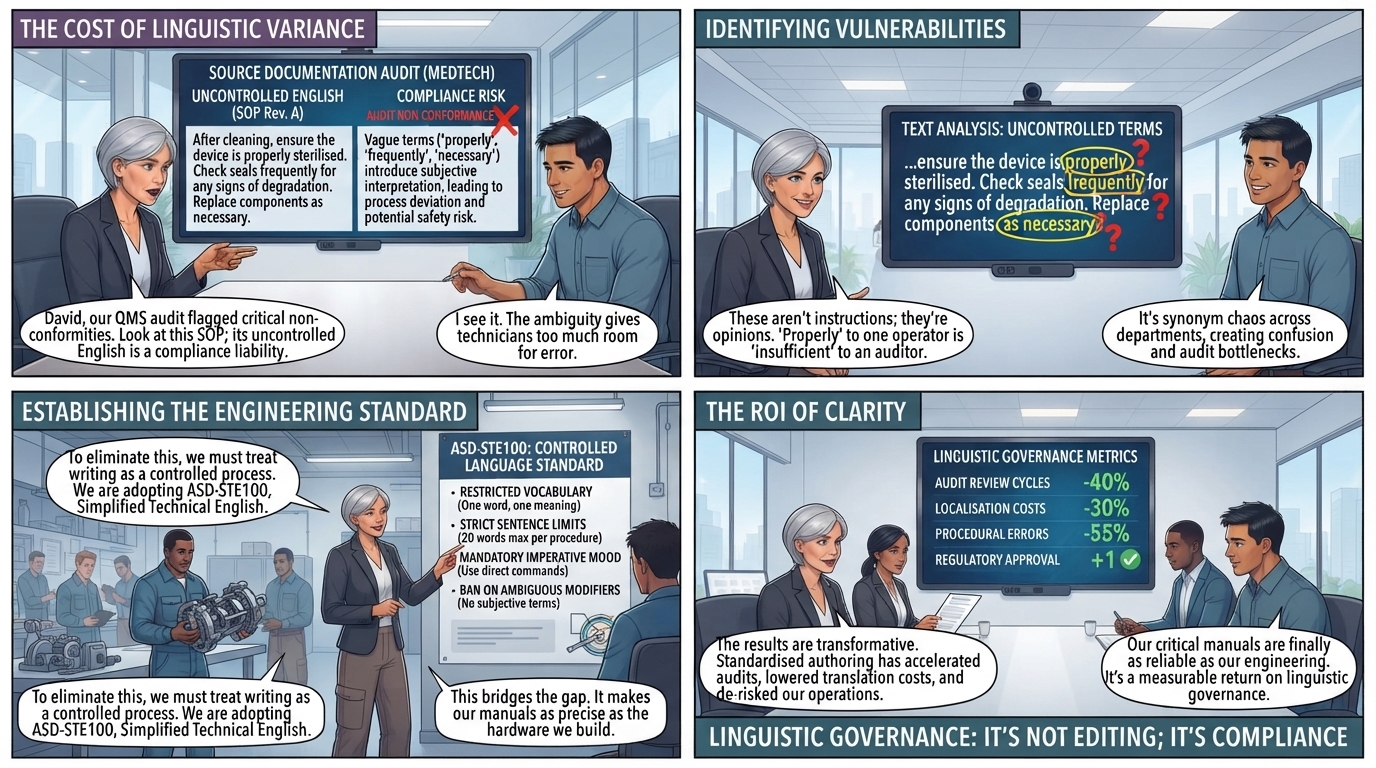
Technical writers and engineers are experts in their fields, but natural language is built for interpretation rather than precision. When drafting documentation without structural constraints, standard writing habits routinely introduce three specific vulnerabilities:
- Lexical Inconsistency: Different authors use multiple terms for the same component or action. One section calls for disconnect, another for detach, and a third for unplug, creating confusion for readers and rendering translation memories inefficient.
- Subjective Parameters: Words like appropriate, sufficient, frequent, or excessive introduce personal judgement into instructions that require measurable thresholds. A technician’s definition of “frequent maintenance” rarely matches an auditor’s interpretation.
- Complex Syntax: Long, multi-clause sentences bury the primary action, increasing cognitive load under operational pressure and elevating the risk of procedural error.
During an audit or regulatory review, these inconsistencies translate directly into audit non-conformities, review bottlenecks, and prolonged approval cycles.

Bridging the Gap with ASD-STE100
To eliminate this friction, organisations must treat technical authoring as a controlled engineering process. This requires implementing ASD-STE100 (Simplified Technical English)—an international specification originally engineered for complex aerospace systems to remove linguistic uncertainty.
ASD-STE100 brings the same methodological discipline to text that engineers apply to hardware design:
- A Standardised Vocabulary: A controlled dictionary limits each word to a single approved meaning and part of speech, eliminating unauthorised synonyms and ambiguity.
- Strict Length Limits: Procedural sentences are restricted to a maximum of 20 words, while descriptive text is capped at 25 words, ensuring information is processed quickly and accurately.
- Explicit Action-Oriented Phrasing: Writers must use the imperative mood for instructions, ensuring the required task is unmistakable and direct.
The Commercial Impact of Linguistic Governance
Adopting a controlled language standard transforms technical documentation from an administrative bottleneck into an asset for operational excellence. When source texts adhere to a predictable grammatical baseline:
- Review Cycles Accelerate: Quality assurance and regulatory teams spend less time untangling vague phrasing and more time evaluating core compliance.
- Localisation Costs Drop: Clean, standardised source text maximises translation memory reuse and optimises machine translation accuracy across global markets.
- Safety Risks Decrease: Operators in the field execute maintenance procedures without second-guessing ambiguous instructions.
Securing Your Documentation Pipeline
Investing in physical safety systems while ignoring the clarity of the instructions governing them leaves a critical vulnerability open. Standardising authoring output protects your compliance posture, safeguards your audit readiness, and ensures your documentation matches the quality of your engineering.
If your organisation is ready to eliminate documentation ambiguity and streamline compliance workflows, let us evaluate your technical text.
Reserve a 30-min STE Feasibility Session to discuss how linguistic governance can protect your engineering operations.


