
September 2026
When high-value, safety-critical assets—such as rolling stock, aerospace propulsion units, or defense launcher systems—are deployed across international markets, they rarely operate within a single linguistic bubble. A locomotive maintained in South Korea, an aircraft engine serviced in Azerbaijan, or a semiconductor subsystem installed in Europe relies on a complex web of local technicians, regional partners, and third-party contractors.
Yet, many global engineering enterprises commit a foundational operational error: they write their technical documentation for a single domestic audience, assuming that natural English will seamlessly translate across borders.
When maintenance manuals, standard work instructions (SWIs), and troubleshooting guides are packed with idioms, regional terminology, and unstructured phrasing, they become high-risk liabilities the moment they cross an international border.
The Cost of Multi-Site Misinterpretation
In global field operations, an ambiguous instruction is not merely a linguistic inconvenience; it is an operational hazard. When local technicians encounter unconstrained, complex technical literature, downtime multiplies.
-
Inconsistent Service Execution: If two regional hubs interpret a complex component replacement procedure differently due to vague phrasing, maintenance quality fractures.
-
Prolonged Mean Time to Repair (MTTR): Technicians spend critical minutes decoding convoluted prose rather than executing the repair, directly degrading fleet availability and customer uptime.
-
Audit and Liability Exposure: Cross-border regulatory audits demand absolute procedural repeatability. If local service records reveal that maintenance actions deviated because the master manual was open to interpretation, the organisation faces severe compliance penalties.
Localisation agencies and automated translation tools cannot solve this structural flaw. If the source text is inherently ambiguous, translation tools merely scale that ambiguity into multiple languages, turning minor phrasing errors into widespread operational risks.
Establishing a Universal Operational Standard
Protecting global assets requires a single, ironclad rule: operational instructions must mean the exact same thing whether they are read in Singapore, Rotterdam, or Seoul.
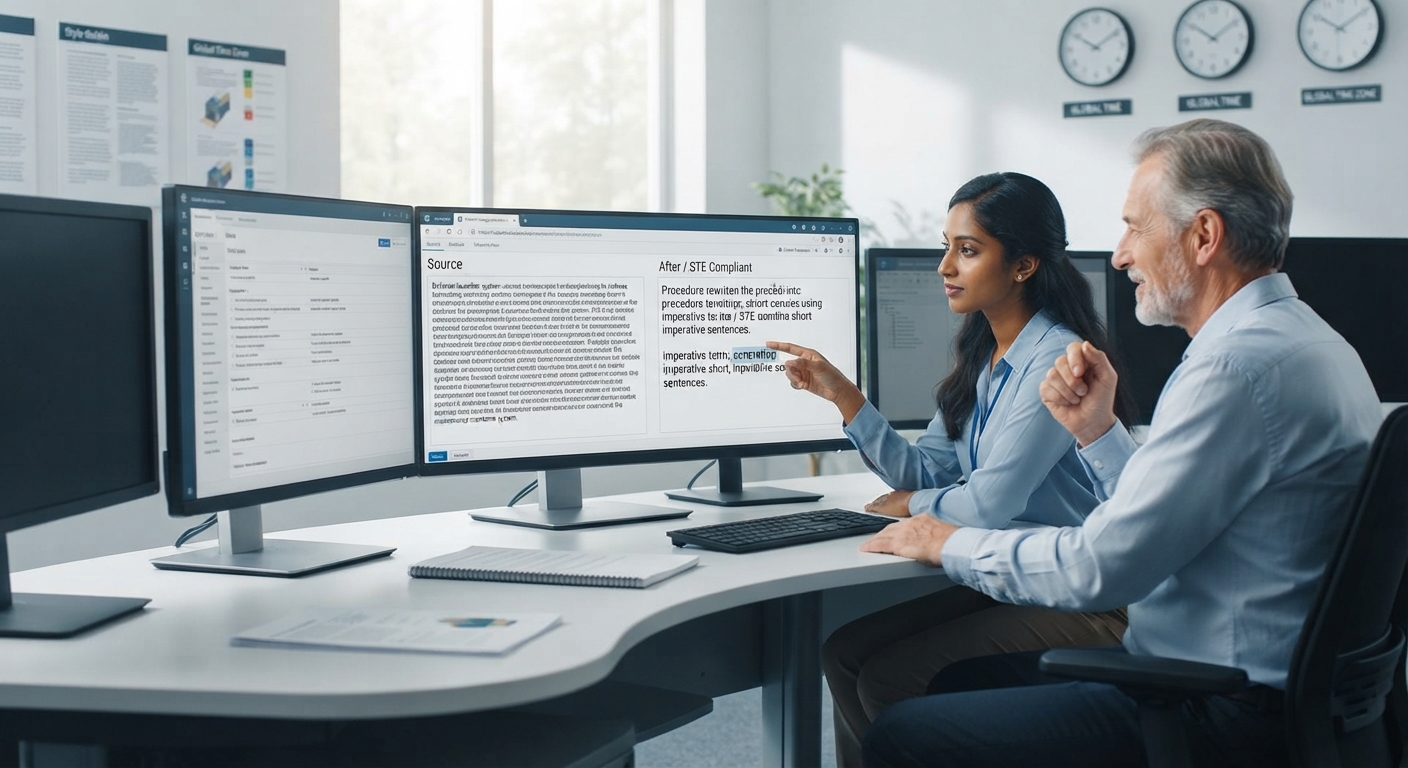
This is why leading high-stakes sectors rely on ASD-STE100 Simplified Technical English (STE). By enforcing strict, standardized writing rules—such as restricting every approved word to a single meaning, enforcing the imperative voice for actions, and eliminating subjective modifiers—STE strips away semantic friction. It creates a controlled vocabulary that human technicians can execute instantly and automated translation systems can process without error.
Bridge the Gap with Shufrans TechDocs
Eliminating documentation ambiguity across international networks requires more than passive software checkers; it demands specialized, human-centric training that transforms how engineering teams author technical data at the source.
With twenty years of specialised experience delivering rigorous ASD-STE100 implementation and training programmes across aviation, rail, defense, and high-tech sectors, Shufrans TechDocs helps global engineering organisations secure total linguistic control over their operations.
Whether you are looking to streamline cross-border maintenance handoffs or future-proof your technical publications for global compliance, we provide the expert training and implementation framework your team needs.
🔗 Ready to eliminate operational ambiguity? Reserve a 30-min STE Feasibility Session with Shufrans TechDocs: https://calendly.com/shufranstechdocs/30min


