News & Events | Page 2 of 8 | Shufrans TechDocs Home // News & Events | Page 2 of 8 | Shufrans TechDocs

Shufrans TechDocs Reinforces Commitment to Practical, Experience-Led Simplified Technical English (STE) Training

Shufrans TechDocs Reinforces Commitment to Practical, Experience-Led Simplified Technical English (STE) Training

FOR IMMEDIATE RELEASE

SINGAPORE – 10 June 2025 – Shufrans TechDocs today reaffirmed its position as a leading provider of expert-led training in ASD-STE100 Simplified Technical English, emphasising a profound commitment to practical, real-world application, honed over two decades of dedicated experience.

At the core of Shufrans TechDocs’ unique offering is the extensive, hands-on experience of its lead trainer, Ms. Shumin Chen, Head of ASD-STE100 Simplified Technical English training & implementation, whose journey in applying STE principles began in 2006. This foundational knowledge, cultivated directly within complex technical environments, significantly predates many contemporary certification frameworks, providing a depth of practical insight that is unparalleled.


“Our mission at Shufrans TechDocs has always been to empower technical communicators with truly actionable skills,” says Shumin. “My 20 years in the field have taught me that effective STE isn’t just about rules; it’s about practical application that makes a tangible difference in documentation clarity, efficiency, and global translatability. Our training programmes reflect this real-world perspective, moving beyond theoretical concepts to deliver immediate, impactful results for our clients.”

Shufrans TechDocs’ training methodology is distinguished by:

  • Decades of Practical Expertise: Leveraging over 20 years of direct, on-the-job experience in applying STE. This deep, real-world grounding ensures that our training is informed by actual industry challenges and effective solutions.
  • Focus on Actionable Skills: Ensuring participants gain concrete techniques they can implement immediately. Our programmes are designed to move beyond theory, providing practical methodologies that lead to instant improvements in documentation quality.
  • Enhanced Clarity and Readability: Enabling clients to produce documentation that is unambiguous and easy to understand. This commitment to precision helps prevent misinterpretation, reducing errors and improving user safety and efficiency.
  • Improved Global Communication: Facilitating more efficient and accurate translation processes. By simplifying the source language, we help organisations achieve consistent messaging and reduce translation costs significantly across diverse markets.

By focusing on battle-tested methodologies and genuine expertise, Shufrans TechDocs continues to be the trusted partner for organisations seeking to achieve superior technical communication standards.

About Shufrans TechDocs: Shufrans TechDocs is a specialist consultancy providing expert training and services in Simplified Technical English (ASD-STE100). With a focus on practical application and real-world results, Shufrans TechDocs empowers organisations to enhance the clarity, precision, and efficiency of their technical documentation.

The Unpopular Truth: ASD-STE100 Simplified Technical English (STE) is for Everyone, But Not Everyone is For STE

The Unpopular Truth: ASD-STE100 Simplified Technical English (STE) is for Everyone, But Not Everyone is For STE

Understanding the Disconnect Between Universal Benefit and Varied Adoption

In the world of technical communication, few standards offer the promise of clarity, precision, and efficiency quite like ASD-STE100 Simplified Technical English. It’s a meticulously crafted set of writing rules and a controlled vocabulary designed to eliminate ambiguity, streamline translation, and enhance comprehension across diverse audiences, especially in high-stakes, high-reliability sectors.

Logically, one would assume such a universally beneficial standard would be embraced by all. Yet, here’s an unpopular opinion that many in the field can quietly attest to: ASD-STE100 Simplified Technical English is for everyone, but not everyone is for STE.

The inherent benefits of STE for clear communication are undeniable. Its principles lead to documentation that is easier to read, quicker to write, and significantly more cost-effective to translate. These advantages are crucial in industries where a single misinterpretation can lead to operational errors, safety incidents, or costly rework.

So, if STE offers such clear advantages, why isn’t its adoption universal? This often stems from a fundamental disconnect: while the objective benefits are clear, the willingness or capacity of individuals and organisations to fully embrace and implement STE varies greatly. This reluctance speaks to several underlying factors:

The Comfort Zone of Existing Practices

For many, the current way of doing things, even if inefficient, is familiar and comfortable. Changing established writing habits and documentation workflows requires effort, time, and a shift in mindset. The perceived disruption of adopting a new standard can outweigh the perceived benefits, especially if the current inefficiencies are not explicitly measured or understood. “We’ve always done it this way” becomes a powerful barrier to change.

Underestimation of Hidden Costs

The true value of STE isn’t always immediately apparent. The costs of ambiguous documentation – including extended review cycles, frequent clarification requests, increased translation expenses due to low translation memory leverage, and errors stemming from misinterpretation – are often hidden. They’re absorbed across different departments and budgets, rarely aggregated into a single, alarming figure. Until a crisis hits or a deep dive into these inefficiencies is conducted, the compelling return on investment that STE offers remains largely unseen.

Natural Resistance to Change

Implementing STE requires discipline and a fundamental shift in writing habits. It’s not just about learning rules; it’s about unlearning old patterns and consistently applying new ones. This human element of change management is often underestimated. People may intellectually agree with the benefits but struggle with the practical, day-to-day application, especially without proper training and ongoing support.

Lack of Awareness Beyond the Superficial

For some, the understanding of STE extends only to a superficial “it’s simpler” or “it’s for non-native speakers.” They might not grasp the depth of its benefits in areas like risk mitigation, regulatory compliance, or the profound impact on automated translation and content reuse. Without a comprehensive understanding of its strategic value, STE can be dismissed as just another “technical writing fad” or an unnecessary layer of complexity.


Beyond the Crowd: Experience Personalised Simplified Technical English (STE) Training and Unrivalled Support

Beyond the Crowd: Experience Personalised Simplified Technical English (STE) Training and Unrivalled Support

In today’s globalised world, clear and concise technical documentation isn’t just a nice-to-have – it’s a necessity. That’s where Simplified Technical English (STE) comes in, providing a set of clear writing rules and a controlled vocabulary to ensure your message is understood by everyone, regardless of their native language or technical expertise.

While many training programmes adopt a broad, less individualised approach, potentially leaving participants to navigate the complexities of STE implementation in relative isolation, Shufrans TechDocs has, since 2006, championed a more refined educational experience. Our approach is rooted in the conviction that learning & mastery of the STE standard flourishes within intimate, small group settings, complemented by the assurance of comprehensive post-training support.

At Shufrans TechDocs, we believe there’s a better way. Since 2006, we’ve championed a more human-centred approach to STE training, built on the power of small group learning and unrivalled post-training support.

The Deliberate Distinction: Personalised Learning in Focused Groups

We consciously move away from the paradigm of expansive online cohorts, favouring instead online STE training limited to a carefully considered maximum of five participants. This deliberate selectivity cultivates an environment where learning becomes a more nuanced and interactive process. Within these focused groups, participants can expect:

  • Direct and Personalised Attention: With fewer participants, you’ll have ample opportunity to interact directly with the instructor and get your specific questions answered in detail.
  • Relevant Discussions: The smaller size fosters a more collaborative environment where we can delve into examples and scenarios that are directly relevant to your industry and needs.
  • A Supportive Learning Space: Feel comfortable asking questions, sharing challenges, and learning from your peers in a more relaxed and engaging atmosphere.
  • Tailored Insights: Where possible, the content and examples can be adapted to the specific backgrounds and requirements of the individuals within the group, ensuring the training is truly impactful.

We understand that the learning journey doesn’t end when the training session concludes. That’s why Shufrans TechDocs offers a unique and comprehensive 120 days of post-training support.

This isn’t just a cursory follow-up. It’s our commitment to your long-term success in applying STE. During this period, you’ll have access to:

  • Direct Email Consultation: Got a question about a specific rule or how to apply STE to a particular document? Reach out directly, and you’ll receive personalised guidance.
  • Feedback on Your Work: As you begin to implement STE, you can submit examples of your writing for constructive feedback to ensure you’re on the right track.
  • Clarification and Reinforcement: Need a refresher on a particular concept? We’re here to provide the clarification you need to solidify your understanding.

We believe that mastering STE is a skill that develops over time, and having expert support in those crucial initial months of application can make all the difference between simply knowing the rules and confidently implementing them.

Why Personalisation and Support Matter in STE Mastery

In a world often dominated by scale and automation, we believe in the power of the human touch. Learning is a personal journey, and having dedicated support can significantly enhance your understanding and application of STE.

If you’re looking for STE training that goes beyond the generic, that prioritises your individual learning needs and provides ongoing guidance to ensure your success, then Shufrans TechDocs offers a different approach.

The Shufrans TechDocs Approach

With two decades dedicated to Simplified Technical English training, our commitment is to empower individuals and organisations to communicate clearly and effectively. Our focus is on providing not just knowledge, but the practical skills and ongoing support needed to truly master STE.

Ready to experience the difference of personalised STE training with unrivalled support?

www.shufrans.com

The Perilous Afterthought: Why Product Documentation Cannot Be an After-the-Fact Endeavour

The Perilous Afterthought: Why Product Documentation Cannot Be an After-the-Fact Endeavour

In the fast-paced world of product development, especially within critical sectors like aerospace, defence, and manufacturing, the allure of rapid iteration and quick deployment can be overwhelming. However, this urgency often leads to a critical oversight: treating product documentation as an afterthought. This practice, while seemingly efficient in the short term, is a recipe for disaster, a potential malpractice that can have far-reaching consequences.

The Pitfalls of Post-Production Documentation:

  • Inaccurate and Incomplete Information: When documentation is created after the product is finalised, crucial details can be lost or misinterpreted. Developers, having moved on to new projects, may struggle to recall specific design decisions or implementation nuances. This leads to inaccurate or incomplete documentation that fails to serve its intended purpose.
  • Increased Risk of Errors and Accidents: In industries like aerospace and defence, where precision and safety are paramount, inadequate documentation can have catastrophic repercussions. Without clear and comprehensive instructions, operators and maintenance personnel are at a heightened risk of making errors, potentially leading to equipment malfunctions, accidents, and even loss of life.
  • Higher Maintenance and Support Costs: Troubleshooting and maintenance become significantly more complex when documentation is lacking. Support teams spend excessive time deciphering cryptic code or reverse-engineering design flaws, leading to increased costs and prolonged downtime.
  • Compliance and Regulatory Issues: Aerospace, defence, and manufacturing are heavily regulated industries. Comprehensive documentation is often a mandatory requirement for compliance. Failing to provide accurate and up-to-date documentation can result in hefty fines, legal penalties, and even product recalls.
  • Hindered Knowledge Transfer and Training: Effective documentation serves as a vital tool for knowledge transfer and training. When documentation is incomplete or inaccurate, it hinders the ability of new employees and operators to quickly grasp the intricacies of the product, leading to inefficiencies and potential errors.
  • Damage to Reputation and Trust: In industries where reliability and safety are paramount, inadequate documentation can severely damage a company’s reputation and erode customer trust. When customers encounter issues due to poor documentation, they are less likely to rely on the company’s products in the future.

Why This is Malpractice, Especially in Critical Industries:

In aerospace, defence, and manufacturing, the stakes are exceptionally high. Products are often complex, mission-critical, and subject to stringent safety standards. Treating documentation as an afterthought in these sectors is not merely an oversight; it’s a potential malpractice.

  • Safety-Critical Applications: In these industries, products are often used in safety-critical applications where human lives are at stake. Errors resulting from inadequate documentation can have dire consequences.

  • Long Product Lifecycles: Aerospace and defence products often have exceptionally long lifecycles. Proper documentation ensures that the product can be maintained and supported for decades.
  • Complex Regulatory Landscapes: These industries operate within complex regulatory landscapes that demand meticulous documentation. Failure to comply can lead to severe penalties.
  • High Cost of Failure: The cost of failure in these industries is exceptionally high, both in terms of financial losses and potential loss of life.


The Solution: Integrating Documentation into the Development Process:

The solution lies in integrating documentation into the product development process from the very beginning. By treating documentation as a core component of the product, companies can ensure accuracy, completeness, and consistency.

  • Early Planning and Collaboration: Documentation should be planned and initiated during the early stages of product development, with close collaboration between developers, technical writers, and subject matter experts.
  • Continuous Updates and Revisions: Documentation should be continuously updated and revised throughout the product lifecycle to reflect any changes or modifications.
  • Utilising Modern Documentation Tools: Leveraging modern documentation tools and technologies can streamline the documentation process and improve efficiency.

By prioritising product documentation and integrating it into the development process, companies can mitigate risks, enhance safety, and build trust, particularly in the demanding and critical sectors of aerospace, defence, and manufacturing.

🔗 Analyse your documentation needs and get recommendations and tailor-made solutions to help you establish and improve your documentation processes: https://www.shufrans-techdocs.com/services/consultancy/

ASD-STE100 Issue 9: Simplified Technical English Becomes a Global Standard

ASD-STE100 Issue 9: Simplified Technical English Becomes a Global Standard

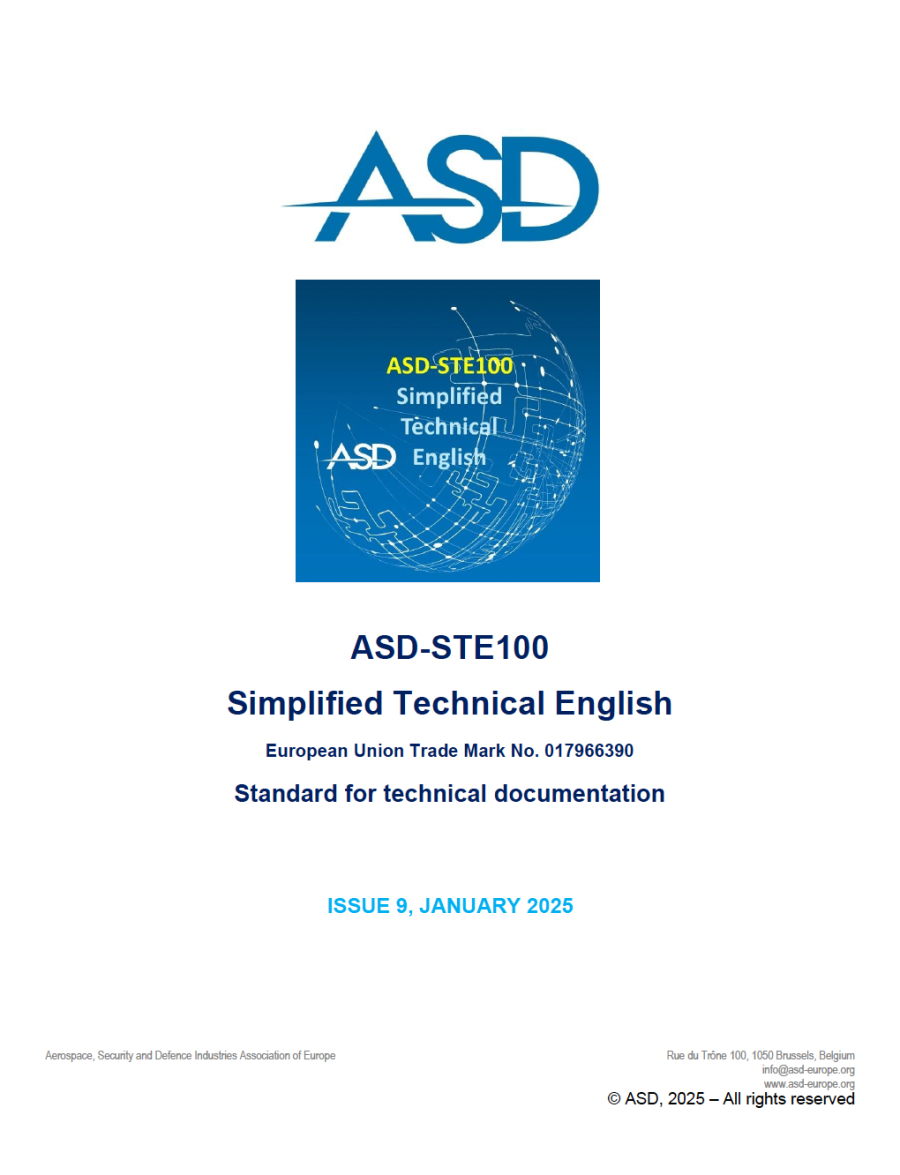
The latest version of Simplified Technical English (STE), Issue 9 of ASD-STE100, arrived on January 15, 2025. This update, three years in the making, signifies more than just a revision; it marks STE’s transition from a specification to a full-fledged international standard.

Developed by the ASD Simplified Technical English Maintenance Group (STEMG) with input from national and multi-country Support Teams (STEST), Issue 9 reflects a commitment to clarity, safety, and alignment with international standards. The STEMG, comprised of industry experts and linguists, meticulously reviewed 160 items and change forms, including 11 specifically related to meta-terminology. This collaborative process ensures the standard meets the needs of technical writers and, ultimately, the end-users of the documentation.


👩🏻‍💻 Find the right expert to support you with ASD-STE100 training and consultancy: www.asd-ste100.net

From Specification to Standard: A Key Shift

This isn’t just a name change. The move to “standard” reflects STE’s broader applicability. While a specification governs individual projects, a standard establishes universal rules. The official document title now reflects its registered trademark: “ASD-STE100 Simplified Technical English: Standard for Technical Documentation.”

Originally designed for aerospace and defense, STE is now used across various sectors, including rail, medical, automotive, and renewable energy. Its focus on clear, unambiguous language reduces human error, especially for non-native English speakers, leading to improved documentation quality, enhanced safety, and smoother global communication.

The Core of STE: Rules and Dictionary

ASD-STE100 is built on two pillars: writing rules and a controlled dictionary. The rules provide strict guidelines for grammar, style, and sentence structure, making content easily understandable for a global audience. The dictionary lists approved words, their definitions, and usage examples, along with a list of unapproved words and alternatives. This standardization of terminology ensures consistency and avoids confusion.

What’s New in Issue 9?

While no new rules were added, 31 of the 53 existing rules were clarified. The dictionary saw significant updates, with 555 entries revised for accuracy and relevance. A major focus was the meta-terminology review. In the context of ASD-STE100, terminology refers to the words and phrases used within the standard itself, such as “technical noun” and “technical verb.” Meta-terminology, on the other hand, refers to the terms used to describe and categorize those terms, such as “noun” and “verb.”

Essentially, meta-terminology is the language we use to talk about the language of the standard. It provides a framework for understanding the relationships between different types of terms and how they should be used.

The distinction between terminology and meta-terminology is important because it helps to ensure that the standard is clear, consistent, and easy to understand. By using precise meta-terminology, the ASD-STE100 Maintenance Group can avoid ambiguity and ensure that the standard is interpreted correctly by technical authors and translators.

Meta-Terminology Refresh: Aligning with International Standards

Issue 9 aligns with ISO 1087-1:2019, modernizing legacy classifications. “Technical name” and “technical verb” are now “technical noun” and “technical verb (term).” Subject field classifications have also been refined, with new categories added under Rules 1.5 and 1.12.

User-Centric Approach: Balancing Precision and Practicality

The STEMG prioritized usability for technical writers, recognizing that most aren’t linguists. Simplicity was key, even while maintaining terminological precision. For example, the dictionary retains the “word” column designation instead of more complex lexicographic terminology. Balancing correct meta-terminology with practical application was a key challenge. The goal was always to empower authors to create clear, accessible documentation. Defining technical verbs, in particular, required careful consideration to ensure both accuracy and ease of understanding.

The Future: AI and Collaboration

The STEMG and STEST are now exploring how AI can enhance STE compliance checks, provide real-time feedback, and automate terminology updates. Collaborations with universities are examining AI-driven tools to streamline technical documentation, improve accessibility, and ensure interoperability.

Issue 9 represents a significant step for ASD-STE100. Its evolution to a global standard, coupled with meta-terminology updates and alignment with international standards, ensures its continued relevance. With a focus on AI and digital transformation, STE is poised to evolve further in the age of smart documentation and Natural Language Processing.

Celebrating a milestone in Simplified Technical English: ASD-STE100 Issue 9

Celebrating a milestone in Simplified Technical English: ASD-STE100 Issue 9

The release of ASD-STE100 Issue 9 is a significant advancement in Simplified Technical English (STE). This latest issue reinforces STE’s position as the leading controlled language for creating clear, concise, and consistent technical documentation across diverse industries.

The Importance of Simplified Technical English

In today’s interconnected world, technical documentation must be readily understood by a global audience, regardless of language proficiency. STE addresses this challenge by providing a structured set of writing rules and a controlled vocabulary that minimizes ambiguity and maximizes comprehension. This results in improved safety, increased efficiency, and reduced translation costs. STE is widely adopted in sectors such as aerospace, defense, manufacturing, energy, and increasingly, in other technical fields.

Key Improvements in Issue 9

ASD-STE100 Issue 9, developed and maintained by the ASD Simplified Technical English Management Group (STEMG), builds upon previous versions with key improvements designed to meet the evolving needs of the technical communication landscape. A primary focus of this release has been the comprehensive review and modernization of legacy terminology. Terms established in the 1980s during the early development of AECMA Simplified English have been meticulously examined and updated, ensuring alignment with contemporary usage and international standards, including ISO 1087-1:2019. This terminological refinement included the reclassification of technical nouns and verbs, enhancing precision and consistency within specific subject domains.

Refining the STE Standard 

While Issue 9 does not introduce entirely new rules, it features important revisions to the wording of 31 of the existing 53 rules. These changes reflect current best practices in technical communication and ensure clarity and ease of application. Furthermore, 555 entries in the STE dictionary, comprising words, definitions, and illustrative examples, have been updated to reflect the latest linguistic and technical conventions.

A Collaborative and Rigorous Development Process

The development of ASD-STE100 Issue 9 exemplifies the collaborative nature of the STE community. STEMG worked closely with academic experts and STE users worldwide throughout the process. A two-month global feedback period allowed for extensive review and input from practitioners, ensuring that the final release is robust and validated by real-world application.

McLaren Receives First Official Copy

In a demonstration of STE’s broad applicability, the first official copy of ASD-STE100 Issue 9 was presented to McLaren, the 2024 Formula 1 Constructors’ World Champions. As a pinnacle of high-performance engineering, McLaren understands the critical importance of precise and unambiguous technical communication. This presentation highlights STE’s value in complex, technically demanding environments beyond the traditional aerospace and defense sectors.

STE is widely adopted in sectors such as aerospace, defense, manufacturing, and energy.

Veeam Software: Securing Clarity in Data Protection with Simplified Technical English

Veeam Software: Securing Clarity in Data Protection with Simplified Technical English

Securing Unambiguous Communication for Enhanced Data Protection and Global Operational Efficiency

Client: Veeam Software

Industry: Data Protection, Backup, Disaster Recovery, Cloud Solutions

Challenge: Ensuring consistent, unambiguous, and highly effective technical documentation for complex data management solutions, impacting clarity for a global customer base and efficiency for a diverse writing team.

Solution: Tailored ASD-STE100 (Issue 8) training delivered by Shufrans TechDocs to key documentation and data science professionals.

Results: Significant enhancement in documentation precision, improved efficiency in content creation, and strengthened comprehension of intricate data protection concepts for end-users.

The Challenge: Unifying Clarity in a Complex Digital Landscape

Veeam Software stands as a global leader in data protection, backup, and disaster recovery, operating at the forefront of virtual, physical, and cloud-based workloads. In an industry where precision is paramount, and a single misinterpretation can have significant consequences for data integrity and business continuity, the clarity of technical documentation is not just beneficial—it is fundamental.

Veeam faced the challenge of ensuring its comprehensive suite of solutions, from Veeam Backup & Replication to Veeam ONE, was explained with absolute consistency and unambiguous language across all documentation. This complexity was amplified by a rapidly evolving technological landscape and a diverse global customer base. Without a unified standard, there was a risk of:

  • Ambiguity in complex technical explanations, leading to user errors or support queries.
  • Inconsistency in terminology and style across different product manuals and guides.
  • Inefficiencies in the documentation workflow, impacting authoring and review cycles.
  • Potential for misinterpretation of critical recovery procedures, jeopardising data resilience.

Veeam sought a solution that could standardise its technical language, ensuring every instruction and explanation was understood unequivocally, regardless of the reader’s technical background or native language.

The Solution: Tailored STE Training for Enhanced Precision

Shufrans TechDocs partnered with Veeam to deliver a focused ASD-STE100 (Issue 8) training programme. Recognising the varied expertise within Veeam’s content creation ecosystem, the training was specifically tailored for nine key individuals, comprising mostly technical writers, senior technical writers, a crucial data scientist, a handful of Knowledge Managers, and a technical writing lead.

The programme focused on equipping these professionals with the practical rules and vocabulary of STE, enabling them to:

  • Apply STE Principles: Learn and consistently implement the core rules of ASD-STE100 for all their documentation.
  • Simplify Complex Concepts: Translate intricate data protection methodologies and software functionalities into clear, concise, and unambiguous language.
  • Leverage Personal Pronouns: Understand and effectively utilise “You” and “We” to create direct, actionable instructions, particularly vital for user guides and procedural documentation.
  • Standardise Terminology: Adopt a controlled vocabulary to ensure consistent use of terms across all documents, reducing confusion.

The inclusion of a data scientist and a Knowledge Manager in the training was particularly strategic, highlighting Veeam’s commitment to clarity even at the intersection of advanced analytics, information organisation, and practical application.


The Results: Elevated Documentation Quality and Operational Efficiency

By investing in ASD-STE100 training with Shufrans TechDocs, Veeam achieved significant, measurable improvements in its technical communication:

  • Enhanced Documentation Clarity and Precision: The application of STE principles led to documentation that was easier for Veeam’s global customers to understand, reducing the potential for misinterpretation of critical backup and recovery procedures. This directly contributes to higher operational reliability for their clients.
  • Streamlined Authoring Efficiency: Technical writers benefited from the structured approach of STE, leading to more efficient content creation, reduced rework, and greater consistency across their document portfolio.
  • Improved Comprehension of Complex Solutions: For the data scientist, STE provided a framework to articulate complex data models and analytical insights with greater clarity, ensuring that even highly specialised information was accessible and actionable for its intended audience.
  • Unified Documentation Standard: The technical writing lead gained a powerful tool for enforcing a consistent, high-quality standard across the team, facilitating better internal collaboration and a more cohesive documentation suite.

Veeam’s proactive investment in STE training with Shufrans TechDocs has transformed its technical documentation into a strategic asset, reinforcing its commitment to delivering clear, reliable, and high-quality data protection solutions worldwide. This success story underscores the power of targeted communication training in ensuring operational excellence and customer satisfaction in the rapidly evolving technology sector.

If your organisation faces similar challenges in achieving uncompromising clarity and operational excellence through precise communication, discover how Shufrans TechDocs can help. Learn more about our ASD-STE100 training and consulting services:

🗓️ View our training calendar.


Protecting Digital Experiences through Clear Communication for Global Efficiency

Protecting Digital Experiences through Clear Communication for Global Efficiency

Clarity for a Connected World: Driving Digital Security and Performance

Client: Akamai Technologies

Industry: Content Delivery Network (CDN), Cybersecurity, Cloud Services

Challenge: Ensuring consistent, unambiguous, and highly effective technical documentation for complex and rapidly evolving digital experiences, impacting clarity for a global user base and efficiency for documentation teams.

Solution: Tailored ASD-STE100 (Issue 8) training delivered by Shufrans TechDocs.

Results: Significant enhancement in documentation precision, improved efficiency in content creation, and strengthened comprehension of intricate digital security and delivery concepts for a global audience.

The Challenge: Precision in the Digital Edge

Akamai Technologies stands at the forefront of powering and protecting life online, delivering and securing digital experiences across its vast global network. In an environment where milliseconds matter for performance and a single vulnerability can have widespread impact, the clarity and precision of technical documentation are not just important—they are critical to operational integrity, security, and user adoption.

Akamai faced the challenge of ensuring its comprehensive suite of solutions—spanning content delivery, cybersecurity, and cloud services—was explained with absolute consistency and unambiguous language across all documentation. This complexity was magnified by the rapid pace of technological innovation and a diverse, global customer base ranging from developers to enterprise IT professionals. Without a unified standard, there was a risk of:

  • Ambiguity in complex technical explanations, potentially leading to misconfigurations or security vulnerabilities.
  • Inconsistency in terminology and style across various product guides, API documentation, and security advisories.
  • Inefficiencies in the documentation workflow, impacting authoring and review cycles for new product releases.
  • Challenges in effectively onboarding users and partners to Akamai’s advanced platforms.

Akamai sought a solution that could standardise its technical language, ensuring every instruction, explanation, and security guideline was understood unequivocally, regardless of the reader’s technical background or native language.

The Solution: Targeted STE Training for Digital Clarity

Shufrans TechDocs partnered with Akamai to deliver a focused ASD-STE100 (Issue 8) training programme in November 2022.

This was an online training delivered to colleagues in Chile, Poland, Germany, and India. Recognising the pivotal role of clear communication in Akamai’s operations, the training was specifically tailored for technical writers, technical enablement managers, and instructional designers.

The programme focused on equipping these professionals with the practical rules and vocabulary of STE, enabling them to:

  • Apply STE Principles: Consistently implement the core rules of ASD-STE100 across all their documentation.
  • Simplify Complex Concepts: Translate intricate network architectures, cybersecurity protocols, and cloud functionalities into clear, concise, and unambiguous language.
  • Leverage Personal Pronouns: Understand and effectively utilise “You” and “We” to create direct, actionable instructions, particularly vital for user guides and procedural documentation.
  • Standardise Terminology: Adopt a controlled vocabulary to ensure consistent use of terms across all documents, reducing confusion and enhancing searchability.

Documentation Types and Job Roles That Benefited:

The STE training had a direct and positive impact on several critical documentation types and enhanced the capabilities of the participating job roles:

Documentation Types That Benefited:

  • Product Documentation: User manuals, installation guides, and configuration guides for Akamai’s CDN, security, and cloud computing products became significantly clearer and easier to follow.
  • API Documentation: For developers integrating with Akamai’s vast array of services, STE ensured that API calls, parameters, and responses were described with unparalleled precision, reducing integration errors and accelerating development.
  • Security Advisories and Bulletins: Unambiguous language in these high-stakes documents became vital for conveying security threats, vulnerabilities, and precise mitigation steps, directly impacting customer security posture.
  • Training Materials: Instructional designers applied STE principles to create highly effective and unambiguous training content, crucial for onboarding users and partners to Akamai’s complex platforms and solutions.
  • Solution Briefs and White Papers: Explaining intricate technical solutions to a broad audience, from technical experts to business stakeholders, became more concise and impactful.

Job Roles That Learnt a Lot:

  • Technical Writers: Gained mastery in crafting consistent, clear, and concise documentation for all of Akamai’s product lines, from web performance to advanced security.
  • Instructional Designers: Elevated their ability to design and develop highly effective and unambiguous training content, ensuring that users could quickly and accurately learn to utilise Akamai’s complex digital experience platforms.

The Results: Elevated Clarity, Enhanced Security, and Streamlined Global Operations

By investing in ASD-STE100 training with Shufrans TechDocs, Akamai Technologies achieved significant, measurable improvements in its technical communication:

  • Enhanced Clarity for Global Users: The application of STE principles led to documentation that was easier for Akamai’s global customers to understand, directly improving the reliability of their CDN services, the effectiveness of their cybersecurity defences, and the usability of their cloud solutions.
  • Improved Efficiency in Content Creation: Technical writers and instructional designers benefited from the structured approach of STE, leading to more efficient content creation, reduced rework, and greater consistency across their documentation portfolio.
  • Strengthened Security Posture: Unambiguous security documentation meant that critical security advisories and mitigation steps were understood precisely, enhancing Akamai’s and its customers’ ability to defend against sophisticated cyber threats.
  • Optimised Content for Translation: The inherent consistency and reduced ambiguity of STE-compliant source text facilitated faster, more accurate, and more cost-effective translations, crucial for Akamai’s global reach.

Testimonial

Kasia Lelonek, Technical Enablement Manager at Akamai Technologies, shared:

“The STE training was a truly eye-opening experience that definitely met my expectations. The trainer’s delivery was exceptionally professional, respectful, and flexible, adapting seamlessly to our specific needs. I particularly valued Rule 4.1, which focuses on writing short and clear sentences, as this is incredibly helpful when considering our diverse audience and their language proficiency. What stood out most was the trainer’s professionalism and readiness to tweak the material on-the-go, making the learning experience highly effective and engaging.”

Conclusion

Akamai’s proactive investment in STE training with Shufrans TechDocs has transformed its technical documentation into a strategic asset, reinforcing its commitment to delivering clear, reliable, and high-quality digital experiences worldwide. This success story underscores the power of targeted communication training in ensuring operational excellence and customer satisfaction in the rapidly evolving technology sector.

If your organisation faces similar challenges in achieving uncompromising clarity and operational excellence through precise communication, explore how Shufrans TechDocs can help. Learn more about our ASD-STE100 training and consulting services:

🗓️ View our training calendar.

www.shufrans.com


Green, safe, and reliable power | DEIF

Green, safe, and reliable power | DEIF

STE as part of your global content strategy

The role of technical authors and technical documentation managers

Technical writers are the go-between for subject-matter-experts (SMEs), engineers, designers and the end-users of documentation. Consequently, the responsibility of creating effective documentation falls on technical authors who endeavour to send out a clear, unambiguous, and user-friendly message about their products and line of services.

At the level of global information management, technical writing professionals should consider short-term tactics and longer-term strategies to overcome the following:

  • An ever-increasing volume of words to write and translate
  • Snowballing translation and documentation management costs
  • Overlapping information across different versions of similar document types
  • Low comprehension levels for the English language jargon.

Simplified Technical English as part of your content strategy

Established in Denmark in 1933, today the DEIF Group is a global market leader in green, safe and reliable control solutions for decentralised power production on land or at sea. In simple terms, DEIF makes sure that power is always available.

ASD-STE100 Simplified Technical English (STE) is a controlled language that is used to write technical manuals in such a way that they can be more easily understood by an international audience. To put it across plainly, STE is a form of controlled language that is guided by 53 technical writing rules that were put together by a committee of linguists, engineers, and manufacturers who established over the years that these writing rules made sense and allowed them to re-write any of their existing documentation based on these rules, making their documentation easier to understand, while maintaining accuracy, safety, and validity.

Develop, deploy, and deliver documentation with STE

STE Quick facts

Background: With the widespread dissemination of user documentation published in various delivery formats across several language translations, the relevance of global information management has become greater in an attempt to stem terminology inconsistencies, mistranslations, and the disproportionate escalation of costs associated with the maintenance, reuse, and consumption of technical content.

Year: In use since 1986

Current Version: Issue 8, May 2021.

Technical writing rules: 53

Dictionary word entries: approx. 2400 terms.

The STE specification also includes a core vocabulary of around 930 approved words and 1500 non-approved words that let technical authors write just about everything that they need for for procedural and descriptive texts. Therefore, the use of approved words, compliance with the standard, and a language quality checker tool to complement your content strategy efforts is akin to pooling your most valuable resources where people, internal processes, and innovative technologies become more aligned.


STE in practice

If this is your first time hearing about STE, the example that follows will hopefully shed more light on the principles and best practices that govern good STE writing. Here is an original piece of text presented in standard English writing:

THE SYNTHETIC LUBRICATING OIL USED IN THIS ENGINE CONTAINS ADDITIVES WHICH, IF ALLOWED TO COME INTO CONTACT WITH THE SKIN FOR PROLONGED PERIODS, CAN BE TOXIC THROUGH ABSORPTION.

And here it is again in STE:

THE OIL IS POISONOUS. DO NOT GET THE ENGINE OIL ON YOUR SKIN.  IT CAN GO THROUGH YOUR SKIN AND INTO YOUR BODY.

Making the comparison between the two types of writing above, you will see that the original writing is rather cumbersome in expression. It is also very likely that the person reading this sentence will have difficulties following the writer’s line of thought because of the longer sentence length and unnecessary information included. In contrast, the text written in STE is much more to the point and simply distils what is pertinent to the person doing this work:

  1. The oil is poisonous.
  2. I must always be careful not to touch oil without protection.

From this example, STE shows us that warnings and cautions must always start with a simple and clear command that is usually substantiated by a reasoning that comes before or after.  


A command informs the user about the precautionary measures to take to avoid danger. Presenting information as if it were a general comment in the original writing obscures the importance of the message and is not specific enough.

Where can I learn more about STE?

Shufrans TechDocs regularly hosts online training workshops for technical writers, SMEs, and engineers at different time zones for your convenience. To learn more about our diverse course offerings and workshop customisations that we can do for you and your global technical documentation team, speak to us today!

What customers are saying.. | DEIF A/S

Helene Birkebaek, Technical Writer, DEIF | Power Efficiency “Shumin’s delivery was really good. The STE specification contains a lot of information and she managed to condense it into manageable chunks. This made it easier to grasp the different rules and concepts.

Complex verbs, noun clusters, “ing” words and using the active voice. These are my favourites, because our documents can benefit from using these rules, as these are some of the “common offenders” in terms of STE. I have realised reading through the documentation, that we tend to use complex verbs a great deal along with “ing” words.

The course was brilliant, but for me the biggest benefit was re-writing our own documentation, so I wish I could have spent a bit more time focusing on that. The workshop was managed really well, and this was my favourite part of the course. It was brilliant that Shumin had time to go through some of the re-written text and provide feedback.

Just wanted to say that you have been absolutely brilliant. Not only throughout the course, but also providing brilliant feedback afterwards. Thank you!”

Jeanine Shepstone, Senior Technical Writer, DEIF | Power Efficiency “I love and hate the list of Simplified Technical English (STE) approved and non-approved verbs list. IMHO it’s the strongest tool in STE to stop bad behaviour. The quizzes, worksheets, and exercises were good, but I’d like to have more of them.

With regards to the rewriting workshop, it was great to be able to work on our own content, and to get Shumin’s input as we did so. Thank you! Overall a good course which I’d most likely recommend. Some rework of the way the exercises are done would push the course to be among the very best! Once again, thank you.”

An innovative approach to consider for your global documentation landscape

Over the last three decades, STE has emerged as a rather important and universal standard for technical English. Predictably, as a result of language standardisation, STE helps us to achieve a number of benefits. Technical writers become more consistent on a word level. This starts with the simple fact that we are going to use the same word whenever we refer to the same thing, so that means an improved level of consistency and consequently quality improvements.

Precision motion control & automation | Aerotech Inc.

Precision motion control & automation | Aerotech Inc.

STE as part of your global content strategy

The role of technical authors and technical documentation managers

Technical writers are the go-between for subject-matter-experts (SMEs), engineers, designers and the end-users of documentation. Consequently, the responsibility of creating effective documentation falls on technical authors who endeavour to send out a clear, unambiguous, and user-friendly message about their products and line of services.

At the level of global information management, technical writing professionals should consider short-term tactics and longer-term strategies to overcome the following:

  • An ever-increasing volume of words to write and translate
  • Snowballing translation and documentation management costs
  • Overlapping information across different versions of similar document types
  • Low comprehension levels for the English language jargon.


Simplified Technical English as part of your content strategy

Since 1970, Aerotech has been solving motion control and automation challenges for the most complex applications in the world’s most demanding industries. Aerotech’s depth and breadth of experience reduces technical and business risk and total cost of ownership. Aerotech is the global precision motion control and automation industry leader. Aerotech’s solutions enable manufacturing, testing, and inspection processes on a micrometer and nanometer scale. Aerotech is the only company offering solutions for every motion challenge.

As your precision motion partner, Aerotech works closely with your team to improve your processes, products and productivity. The depth and breadth of their experience means they’ve likely seen your motion challenge before – and they’ve probably already solved it.

ASD-STE100 Simplified Technical English (STE) is a controlled language that is used to write technical manuals in such a way that they can be more easily understood by an international audience. To put it across plainly, STE is a form of controlled language that is guided by 53 technical writing rules that were put together by a committee of linguists, engineers, and manufacturers who established over the years that these writing rules made sense and allowed them to re-write any of their existing documentation based on these rules, making their documentation easier to understand, while maintaining accuracy, safety, and validity.


Develop, deploy, and deliver documentation with STE

STE Quick facts

Background: With the widespread dissemination of user documentation published in various delivery formats across several language translations, the relevance of global information management has become greater in an attempt to stem terminology inconsistencies, mistranslations, and the disproportionate escalation of costs associated with the maintenance, reuse, and consumption of technical content.

Year: In use since 1986

Current Version: Issue 8, May 2021.

Technical writing rules: 53

Dictionary word entries: approx. 2400 terms.

The STE specification also includes a core vocabulary of around 930 approved words and 1500 non-approved words that let technical authors write just about everything that they need for for procedural and descriptive texts. Therefore, the use of approved words, compliance with the standard, and a language quality checker tool to complement your content strategy efforts is akin to pooling your most valuable resources where people, internal processes, and innovative technologies become more aligned.

STE in practice

If this is your first time hearing about STE, the example that follows will hopefully shed more light on the principles and best practices that govern good STE writing. Here is an original piece of text presented in standard English writing:

THE SYNTHETIC LUBRICATING OIL USED IN THIS ENGINE CONTAINS ADDITIVES WHICH, IF ALLOWED TO COME INTO CONTACT WITH THE SKIN FOR PROLONGED PERIODS, CAN BE TOXIC THROUGH ABSORPTION.

And here it is again in STE:

THE OIL IS POISONOUS. DO NOT GET THE ENGINE OIL ON YOUR SKIN.  IT CAN GO THROUGH YOUR SKIN AND INTO YOUR BODY.

Making the comparison between the two types of writing above, you will see that the original writing is rather cumbersome in expression. It is also very likely that the person reading this sentence will have difficulties following the writer’s line of thought because of the longer sentence length and unnecessary information included. In contrast, the text written in STE is much more to the point and simply distils what is pertinent to the person doing this work:

  1. The oil is poisonous.
  2. I must always be careful not to touch oil without protection.

From this example, STE shows us that warnings and cautions must always start with a simple and clear command that is usually substantiated by a reasoning that comes before or after.  A command informs the user about the precautionary measures to take to avoid danger. Presenting information as if it were a general comment in the original writing obscures the importance of the message and is not specific enough.

Where can I learn more about STE?

Shufrans TechDocs regularly hosts online training workshops for technical writers, SMEs, and engineers at different time zones for your convenience. To learn more about our diverse course offerings and workshop customisations that we can do for you and your global technical documentation team, speak to us today!

What customers are saying.. | Aerotech Inc.

Senior Technical Writer, Aerotech Inc. “The presentation on rules clarified a lot of things of which I was unaware. I have a much better understanding of how to format lists with colons, when to use obey vs. comply, and the differences between notes, cautions, and warnings. Moving forward, I will be able to utilize the ASD-STE rules more effectively to write better documents.
I appreciated the exercises because they helped me immediately practice and enforce the ASD-STE rules. I like the fact that they were timed. Writing under time constraints forced me to think quickly and fully concentrate on my writing.
I will definitely recommend this training to writers of many fields, especially technical fields. The material, presentation, and instructor are fantastic. I learned a lot about ASD-STE. Even though I’ve been using this writing convention for almost eight years, formal training brought much clarity and comprehension that I had not previously realized. I now know that an aptitude for writing and a copy of the STE rules is a good start, but not enough. This course takes your understanding to a professional level.”

Lauren Gelli, Senior Technical Writer, Aerotech Inc. “The introduction provided a well-rounded history of ASD-STE, the types of industries that use it, and how they use it. I now have a better understanding of what ASD-STE is and how our company should be using it.

My favourite writing rule is Rule 1.3 (Use approved words only with their approved meanings.) This rule is the heart of STE. It makes consistency, clarity, and comprehension ubiquitous across all documents regardless of who writes them. It is the main rule that unifies writers with one voice.

My favourite STE verbs are Apply, Attach, Make Sure, and Show. The verb Apply has multiple use cases for our documents. The verb Attach is a great utility verb because common alternatives like “mount” are not approved. The verb “make sure” is extremely helpful in cautions and warnings, also in some procedural steps. Finally, the verb “show” is extremely helpful when I write about background processes and how things work in general.”


Kelly Walsh, Technical Writer, Aerotech Inc. “The course intro was helpful. Shumin used examples, videos, and asked us questions to introduce the material. Knowing that the subject matter could be dry, she tried to counteract that by varying the presentation. The information itself was useful for what we did later in the course.

My favourite rules are the word count rules. That sounds lame, but I tend to write too long of sentences that don’t get to the point. The exercises were really helpful in demonstrating the rules that we had talked about / gone over. I got the most out of doing the exercises and working on the examples that we submitted.

I would definitely recommend the course to someone considering or currently using STE. Shumin catered the course to our needs and familiarity level. She was very knowledgeable and was happy to help us through trouble spots and answer our questions.”

An innovative approach to consider for your global documentation landscape

Over the last three decades, STE has emerged as a rather important and universal standard for technical English. Predictably, as a result of language standardisation, STE helps us to achieve a number of benefits. Technical writers become more consistent on a word level. This starts with the simple fact that we are going to use the same word whenever we refer to the same thing, so that means an improved level of consistency and consequently quality improvements.