Blog | Page 7 of 9 | Shufrans TechDocs Home // Blog | Page 7 of 9 | Shufrans TechDocs

NIMR (EDGE Group): Enhancing Operational Readiness through On-Site STE Training

NIMR (EDGE Group): Enhancing Operational Readiness through On-Site STE Training

Clarity and Multilingual Efficiency in Critical Defence Documentation

Client: NIMR (A subsidiary of EDGE Group)

Industry: Defence Manufacturing & Technology

Location: Abu Dhabi, UAE (On-site Training)

Challenge: Ensuring absolute clarity, consistency, and a unified communication standard in critical technical and support documentation, vital for operational readiness, effective customer support, and seamless English-Arabic translation in the defence sector.

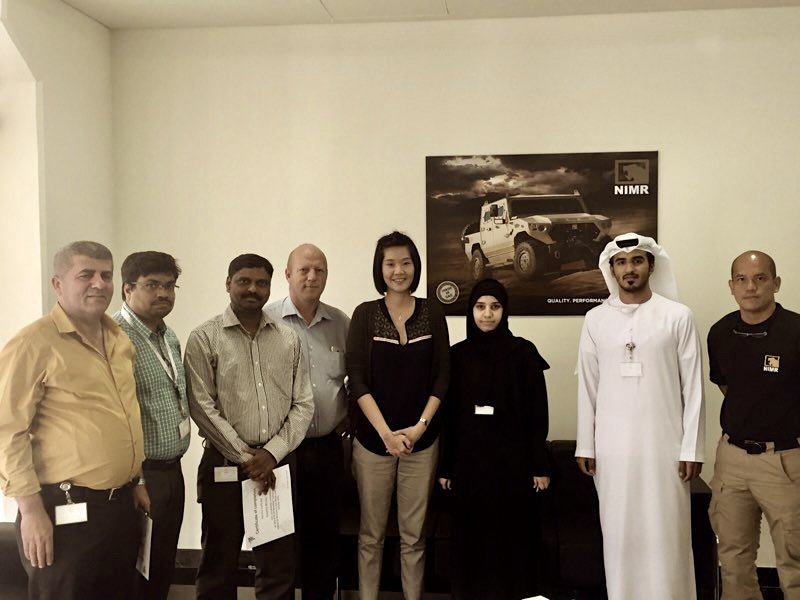
Solution: A bespoke, three-day on-site ASD-STE100 training programme delivered by Shufrans TechDocs to key personnel including Customer Support Officers, Field Engineers, Technical Writers, and Documentation Experts.

Results: Significant uplift in documentation precision, improved efficiency in field and customer support interactions, enhanced cross-functional communication, optimised translation processes, and accelerated professional development, directly contributing to NIMR’s mission of delivering mission-ready solutions.


The Challenge: Uncompromising Clarity in Defence Communications

NIMR, a leading manufacturer of wheeled military vehicles and a pivotal subsidiary within the UAE’s advanced technology and defence group, EDGE, operates in an environment where clarity is not merely beneficial—it is critical. The precision of technical documentation directly impacts the operational readiness, safety, and effectiveness of defence assets in demanding environments.

NIMR faced the challenge of ensuring that all its technical and support communications, from maintenance manuals to field service reports and customer interactions, adhered to an uncompromising standard of clarity and consistency. This was particularly complex given the diverse roles involved in creating and delivering this information, and the crucial requirement to translate documents accurately between English and Arabic for various customers and end-users:

  • Customer Support Officers: Needing to convey precise solutions and guidance efficiently to end-users, often in both English and Arabic.
  • Field Engineers & Technicians: Requiring unambiguous instructions for maintenance, troubleshooting, and on-site support of complex military vehicles, with the knowledge that these would be translated.
  • Technical Writers & Documentation Experts (from various backgrounds): Tasked with authoring and managing a vast array of critical technical content, with a direct impact on the quality of subsequent translations.

Any ambiguity could lead to misinterpretations in critical operational contexts, potentially compromising safety, delaying field repairs, impacting training effectiveness, or introducing errors during the English-Arabic translation process. NIMR sought a solution that would embed a culture of precise communication directly within their operational teams, with a clear benefit to their multilingual documentation needs.


The Results: A New Standard for Operational Clarity and Multilingual Efficiency

By investing in on-site ASD-STE100 training with Shufrans TechDocs, NIMR achieved significant, measurable improvements in its technical and support communications:

  • Enhanced Operational Clarity: A unified approach to language drastically minimised ambiguities in all forms of documentation, directly improving the understanding and execution of critical procedures by both internal teams and external customers.
  • Improved Field Efficiency: Field Engineers could more effectively diagnose issues and follow maintenance protocols, reducing downtime and ensuring rapid response in operational scenarios.
  • Streamlined Customer Support: Customer Support Officers provided clearer, more concise guidance, leading to reduced resolution times and enhanced customer satisfaction.
  • Boosted Documentation Quality: Technical Writers and Documentation Experts consistently produced high-quality, compliant content, streamlining workflows and reducing rework.
  • Optimised Translation Processes: With a consistent and unambiguous English source text, the translation of documents into Arabic became faster, more accurate, and more cost-effective, ensuring seamless communication with diverse customer bases.
  • Accelerated Professional Growth: The hands-on training significantly upskilled personnel across critical roles, fostering a collective commitment to precision communication and supporting their long-term professional development within the defence sector.
  • Strengthened Communication Chain: A common language standard facilitated seamless information exchange between engineering, documentation, field support, and translation teams, underpinning NIMR’s commitment to delivering superior defence solutions globally.

NIMR’s proactive investment in on-site STE training with Shufrans TechDocs has transformed its communication landscape, reinforcing its position as a leader in defence manufacturing through unparalleled clarity, operational excellence, and enhanced multilingual capabilities. This success story underscores the vital role of targeted communication training in ensuring readiness and reliability for critical industries operating on a global scale.

If your organisation faces similar challenges in achieving uncompromising clarity and operational readiness through precise communication, especially when translation between English and Arabic is a key requirement, discover how Shufrans TechDocs can help. Learn more about our ASD-STE100 training and consulting services:

🗓️ View our training calendar.

www.shufrans.com

Why everyone should consider writing in STE, and how to implement STE-based writing at work

Why everyone should consider writing in STE, and how to implement STE-based writing at work

When? 15 – 16 July 2018

Location: Shanghai, China

Length of training: 2 days

Deadline for registration: 2 July 2018

We offer you more than just a training service

  1. Are you a manager who constantly worries about the varying technical English proficiency levels of your staff?
  2. If you are an engineer, are you having a difficult time explaining your concepts to your technical writing team?
  3. If you work as a technical communicator, do you often struggle to convert complex ideas into brilliant content?

If you answered yes to any of the above, join us at the next certified Simplified Technical English workshop session in Shanghai, and be pleasantly surprised.


STE stands for Simplified Technical English. It offers native & non-native English speakers alike an efficient platform to improve your technical English language competency when writing for a global audience.

  1. For technical writers: simplified wording and grammar will improve readability and safety compliance of your documentation and product respectively.
  2. For engineers and programmers: Breeze through writing of test cases, technical documents, and business emails in a highly standardised and regulated manner. STE opens up effective communication channels, hence avoiding potential miscommunication issues at work while improving the overall professional impression that you portray.
  3. For translators, translation PMs, and localisation engineers: With STE working for your team in the background, you can streamline your preparation of translation memory/terminology based on leaner documentation, lowered translation & localisation costs, and faster delivery.
  4. For LSPs and technical writing services companies: Diversify your business portfolio with an in-depth knowledge of STE as an international controlled English language standard.


The Organisers

Shufrans Techdocs

Shufrans TechDocs is a full-service technical documentation provider and the global leader in ASD-STE100 Simplified Technical English training and consultancy. Together with our partner network, we can help you implement a future-proof information management environment that lets you work more efficiently and accurately.

https://www.shufrans-techdocs.com/


TC互联

Talent of Content is a Shanghai-based technical communication platform that is designed especially for the technical writing community. Talent of Content (ToC) strives to provide technical communicators with a platform for their professional development, communication, and cooperation. Now, we extend our services to all content-related professionals.


Act fast and register now! We have limited seat availability.

15 (Sun) to 16 (Mon) July 2018

Shanghai • China

This event is a collaborative effort brought to you by the dedicated teams at Shufrans Techdocs × TC互联. The first ever co-certified STE training program in China.


Programme Highlights

  1. Highly efficient: We will cover all 400 pages of the ASD-STE100 Specification in 2 days’ training for immediate implementation.
  2. Practicality: cross-industry cases sharing by trainers with excellent pragmatic approach
  3. Follow-up: 3-month post-training consulting period follows immediately after the training to ensure a seamless transition into STE writing at work
  4. Experienced trainer: Ms Shumin Chen, Co-founder & Head of ASD-STE100 training & implementation of Shufrans TechDocs. Linkedin: https://www.linkedin.com/in/shuminchen/

Introductory offer 2999 RMB from 5999 RMB | Service Package includes:

  1. 2-day classroom training
  2. 90-day post-training support by Shufrans TechDocs
  3. 90-day professional consulting by STE experts
  4. Reduce your content development time and efforts
  5. Significantly lowers post-processing (e.g. translation) cost
  6. One-stop content quality solution
  7. Overall quality improvement.

More case studies & industry samples:https://www.shufrans-techdocs.com/simplified-technical-english-case-study/


To learn more:


The common denominator for credible & concise documentation across industries

The common denominator for credible & concise documentation across industries

TCLoc Master article on The common denominator for credible & concise documentation across industries by Ms. Shumin Chen, Principal ASD-STE100 Trainer & Consultant.

First published on TCLoc Master Blog • University of Strasbourg • 4 December 2017

Safety, efficiency, and readability are the main considerations for the use of ASD-STE100 Simplified Technical English (STE) in the aerospace and defense industries. For many other industries, such as machinery, automotive, electronics, IT, and medical equipment, another important consideration is to save on translation costs without compromising on translation quality. As technical communicators, navigating the tricky terrains of cost, quality, and efficiency in project management can be an extremely delicate equilibrium to maintain.

Standards

To technical communication professionals, it makes a lot of sense to use standards whenever possible to achieve similar results. However, standards in the documentation field are often disregarded. Documentation always kicks in when the product is already behind schedule, and over budget for the product life-cycle. However, we still want to stand behind what we do and make sure we provide a quality product. How does a written language standard potentially help us to achieve this and why do we need a controlled language such as STE to begin with?

Consider the following example:

Standard English:

Follow these instructions to prevent potential failures and damage and to ensure as safe and trouble-free functioning of the product as possible. Read this manual before starting to work with the filter system, familiarize yourself with the functionality and operation of the product and follow the instructions.

STE:

FOR SAFE OPERATION, OBEY THESE INSTRUCTIONS TO PREVENT POSSIBLE FAILURES.
READ THIS MANUAL BEFORE YOU START TO DO WORK WITH THE FILTER SYSTEM. KNOW THE PRODUCT FUNCTION AND OPERATION, AND OBEY ALL INSTRUCTIONS.

Which set of instructions lets you understand and complete the procedure with greater ease?


Case Study: Achieving Clarity and Consistency in Technical Documentation for Schindler Elevators

Case Study: Achieving Clarity and Consistency in Technical Documentation for Schindler Elevators

A Strategic Approach to Unambiguous Communication and Operational Excellence

Industry: Urban Mobility (Elevators, Escalators, Moving Walks)

Client: Schindler Group

Training Locations: Ebikon, Switzerland (on-site) & Shanghai, China (online)

Service Provided: Simplified Technical English (STE) Training & Documentation Rewriting

Introduction

Clear, unambiguous, and consistent technical documentation is paramount in the complex and safety-critical world of urban mobility. This case study highlights a successful engagement with Schindler Group, a global leader in elevators, escalators, and related services, focused on achieving their technical communication through comprehensive Simplified Technical English (STE) implementation.

Client Background

Schindler Group, headquartered in Ebikon, Switzerland, is renowned for its innovative and sustainable mobility solutions. With a vast international presence and a diverse workforce, ensuring that technical manuals, maintenance procedures, and product documentation are universally understood is a strategic imperative, particularly for safety and operational efficiency.

The Challenge

Prior to the engagement, Schindler, like many multinational corporations, faced the inherent challenges of technical documentation:

  • Ambiguity: Standard English, with its rich vocabulary and complex grammatical structures, can lead to misinterpretations, especially among non-native English speakers.
  • Inconsistency: Multiple authors and external vendors, potentially across different regions, could result in varied writing styles and terminology, hindering clarity and increasing translation costs.
  • Translation Efficiency: Complex source texts often led to higher translation costs and potential errors in localised versions, impacting global operations.
  • Safety Criticality: In the elevator and escalator industry, any misunderstanding in technical instructions can have severe safety implications.

Schindler recognised the need for a standardised approach to technical English to mitigate these risks and improve the overall quality and efficiency of their documentation.

Phase 2: Document Rewriting and Refinement Following the initial training, a direct engagement commenced with key personnel to apply STE principles to existing documentation. This involved close collaboration with:

  • Principal Corporate Technical Author: To ensure the practical application of STE rules and to establish internal champions for the standard.
  • Head of Corporate Technical Documentation: To oversee the strategic implementation and integration of STE into Schindler’s documentation workflows.

This hands-on rewriting process ensured that the theoretical knowledge gained during training was immediately put into practice, demonstrating tangible improvements in clarity and consistency.

Phase 3: Global Expansion of Training Recognising the success and the need for global consistency, the training was extended to other critical regions. A dedicated online training session was conducted for:

  • Corporate Technical Documentation colleagues in Shanghai, China: This expanded the reach of STE adoption, ensuring that documentation produced in a key international hub also conformed to the new global standard.

www.shufrans.com

Key Stakeholders and Organisational Impact

The success of this initiative was a testament to the collaborative effort across various departments and external partners, demonstrating how STE benefits different parts of the organisation:

  • Leadership and Management: Gained strategic alignment and understanding of STE’s business value in achieving safety, efficiency, and global reach.
  • Engineering and Product Development Teams (including Subject Matter Experts): Benefited from improved clarity in technical specifications, design documents, and maintenance requirements, ensuring precise input and reduced ambiguity from the source.
  • Technical Documentation Teams (in-house and external partners): Acquired practical skills in applying STE rules, leading to more consistent, unambiguous, and efficient content creation for manuals, procedures, and other technical assets.
  • Terminology and Language Specialists: Enhanced their ability to manage and control technical vocabulary, ensuring consistency across all documentation and facilitating improved translation quality.
  • Translation Teams: Experienced streamlined translation processes due to the reduced ambiguity and increased consistency of STE-compliant source texts.

Results and Impact

The implementation of STE at Schindler Group yielded significant benefits:

  • Achieved Clarity and Readability: Documents became easier to understand for a global audience, including non-native English speakers, reducing the risk of misinterpretation.
  • Improved Consistency: A unified writing style and controlled vocabulary ensured consistency across all technical documentation, regardless of the author or origin.
  • Increased Efficiency: Streamlined writing processes and clearer source texts led to more efficient documentation creation and review cycles.
  • Reduced Translation Costs: The unambiguous nature of STE significantly lowered translation costs and improved the quality of translated materials.
  • Strengthened Safety: By eliminating ambiguity in critical instructions, the overall safety of operations and maintenance procedures was achieved.


Testimonials

This impact was echoed by participants:

Roland Kiser, Terminology Coordinator at Schindler, noted: “This course shares a good overview of structure, purpose, history, and contextual information about STE. The limited vocabulary and restricted list of words, short sentence constructions, active voice, and imperative verb usage are valuable takeaways messages to act upon in Simplified English. The examples used in this training are quite realistic and it is very likely that I will recommend this STE training to someone else.”

Cécile Roos, Corporate Translation Manager, added: “Entertaining, short, and clear presentation of the STE specification and rule sets. Overall, a good mix of rules, examples, and exercises. The course was very much on point and encouraged me to write in a more structured way. This will help the readers to properly understand my message even in business writing. Shumin had a very calm way of leading all of us through the training. Her style of teaching is rather empathetic and she keeps the group working effectively with timely breaks in between. Thanks Shumin for an enjoyable course with the perfect score of 10/10 in terms of trainer evaluation.”

Marco Valtangoli, Senior Corporate Technical Author at Schindler, also provided valuable feedback: “A very important and highlighted point during the introduction is that STE is an English language specification that is not only applicable for companies in the aerospace & defence industry. Rule 5.2 where you only have one instruction per sentence is important to us. Not being able to use the verb “CHECK’ that is only used as an approved STE noun poses a challenge to me all the time. I really appreciate the STE writing rules that give us the possibility to improve the consistency of our documents. The workshop exercises were of high interest value and drive home the point that it is important to learn by doing. Although a time-consuming process, the writing workshop impressed on me that the need to prioritise the analysis of our internal documents. Shumin is a competent trainer who does not only focus on explaining and enforcing the “writing rules”, but is always available to understand and empathise with the training needs of the class.”

Conclusion

The comprehensive STE training and document rewriting initiative with Schindler Group stands as a strong example of how strategic investment in technical communication can drive operational excellence, improve safety, and foster global consistency within a leading industrial enterprise. By empowering their diverse teams with the tools and knowledge of Simplified Technical English, Schindler reinforced its commitment to delivering clear, reliable, and high-quality documentation worldwide.

If your organisation faces similar challenges in achieving uncompromising clarity and operational readiness through precise communication, discover how Shufrans TechDocs can help. Learn more about our ASD-STE100 training and consulting services:

🗓️ View our training calendar.


New name, new beginnings: Thoughts on my first STE training workshop using Issue 7

New name, new beginnings: Thoughts on my first STE training workshop using Issue 7

Not just a standard for maintenance documentation only

On 25 January 2017, Issue 7 of the ASD-STE100 was renamed ‘International specification for the preparation of maintenance technical documentation in a controlled language’. Now, given the success and adaptability of Simplified Technical English (STE) across industries, this long overdue name change is a very much welcomed move. Indeed, STE writing principles are very valid for all technical documentation purposes.

On 20 and 21 February 2017 Shufrans TechDocs & FOXIZ became the first companies worldwide to jointly offer a certified ASD-STE100 training workshop using Issue 7.

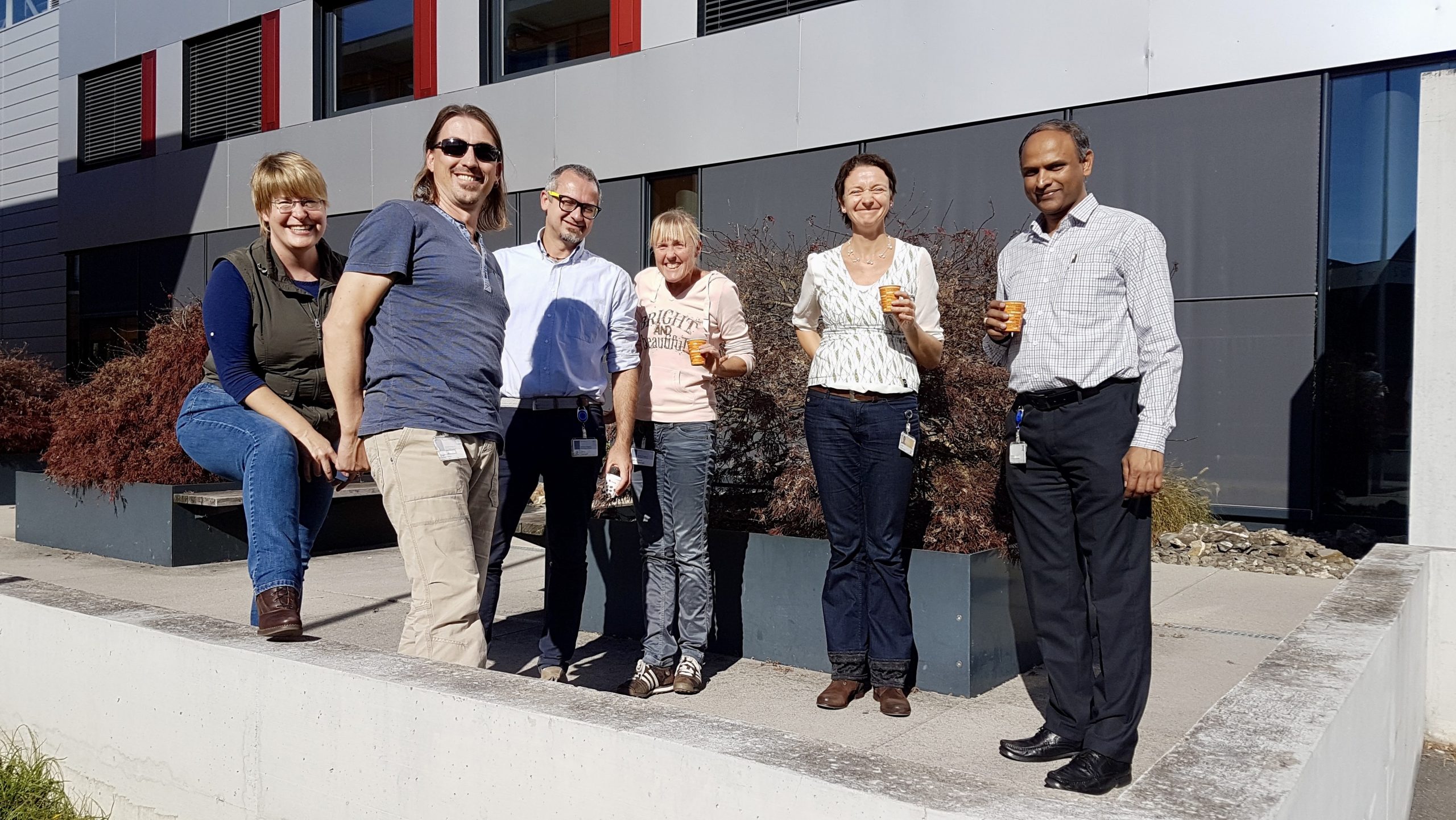
Naturally, a cake celebration was called for after writers worked so very hard on their STE rewriting assignments. 2017 coincides with my 11th year of using the ASD-STE100 Specification, although I had hoped for an earlier release date in 2016 to mark a decade of my technical writing career 😉

Followed this course last February and truly learned a lot. Shumin is very experienced and really knows what she is talking / teaching about. Recommended for all manual writers!

– Hans Harlé, Entecst Technical Communication

20% fewer rules in Issue 7!

Here are some of my observations: Seemingly overlapping writing rules were either removed or combined with others.  The results?  A 20% decrease in the number of writing rules from 65 to 53. Before you get the wrong idea, the message of STE did not change, it only crystallised. What transpired during those four years since the older issue in 2013 was a major overhaul where rules were succinctly rephrased and cleverly reorganised.

Every rule now includes a comprehensive description and explanation. Sentence examples were revised to facilitate a more progressive and concise understanding, coupled with an accurate use of this technical English writing standard.

A reduced learning curve

As a controlled language, STE writing rules and its core vocabulary (or general dictionary) of words work hand in hand to facilitate your authoring process. While the rules regulate the words and which parts of speech you can use, the dictionary provides you with a generous resource of technical words. This core vocabulary of around 930 approved words lets you write just about everything that you need for technical documentation, even for procedural information in general. However, this isn’t quite the end of my story yet.

Every dictionary entry is marked either as an approved or non-approved term. In the case of a non-approved word, one or more possible synonyms are provided to help the writer transition from Standard English to Simplified English. Approved synonyms and associated sentence examples will provide him with the ideas that will be difficult to think of all by himself. The revised layout and formatting in Issue 7 also makes it a lot easier to locate keywords and identify relevant examples speedily.

In recent versions of the ASD-STE100 specification issues 5, 6, and 7, we find that between 95 to 99% of the words in the STE general dictionary can be easily adapted even for technology companies, like the technical aspects of data protection solutions. And the concept of the STE specification is such that you can very easily adapt the specification to suit and cover your specific needs. It mainly entails additions to the dictionary which are customarily made, even for aerospace customers.


Enslaved to only 1,000 words or less? No way!

STE encompasses three main categories of words that technical writers can avail themselves of:

  1. Approved words from the general dictionary
  2. Technical names
  3. Technical verbs.

Technical names and verbs are word categories where organisations and writers can enjoy a considerable degree of autonomy using STE guidelines for customer-specific terms, most of them are known as technical names. Technical names are mainly nouns that you need in order to write meaningful content about your specific product or services. They are not included in the dictionary because terminology differs from one industry to the other. To manage this unpredictability, STE provides lists of 19 categories for nouns (Rule 1.5 of Issue 7), and four categories for verbs (Rule 1.12 of Issue 7). I am happy to report that the STE Maintenance Group has since reviewed and enriched those lists in Issue 7. You will not do away with most of your product-specific terminology. However, STE principles will help you regulate and filter it. I strongly encourage technical communicator in any field to hold onto this specification as a highly valuable resource!


Shumin Chen

About the trainer

Since 2006, Ms Shumin Chen has been working as a consultant with customers in various industries worldwide: aerospace and defence, banking, consumer products, healthcare, IT, medical and fitness equipment. She has helped many companies with their documentation needs, based on standards where possible, and is widely regarded as a leading expert in ASD-STE100 Simplified Technical English training, aviation documentation, and multilingual documentation.

Ms Chen now heads the ASD-STE100 training arm of Shufrans TechDocs. In her current role, Ms Chen continues to focus on the practical implementation of international standards to facilitate the efficient creation and management of multilingual documentation.

Copyright © 2017 Shufrans TechDocs. All rights reserved. No part of this article may be reproduced or transmitted in any form or by any means whatsoever without express written permission from the author, except in the case of brief quotations embodied in critical articles and reviews. 

Are you ready to make STE your strategic partner?

Attend a 2-day certified ASD-STE100 workshop at any of our worldwide locations
TCTrainNet offers new e-learning training course module on Simplified Technical English

TCTrainNet offers new e-learning training course module on Simplified Technical English

Training & e-learning

TCTrainNet is the first company worldwide to launch a Simplified Technical English (STE) e-learning course by Shumin CHEN to train technical writers and subject matter experts in the use and effective implementation of Simplified Technical English (STE). STE is the international standard for writing clear and accurate content and STE training is now made available to technical writers, engineers, and documentation teams.

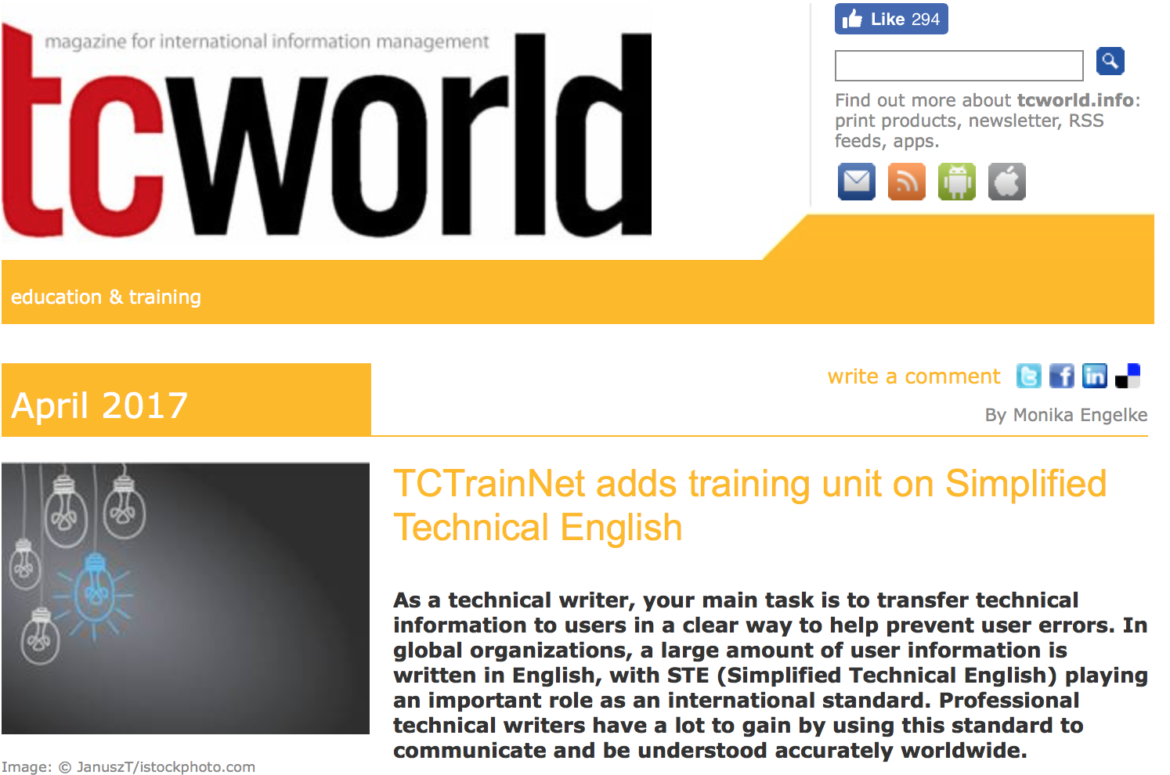
This article was first published on tcworld magazine for information management by Monika Engelke • April 2017

As a technical writer, your main task is to transfer technical information to users in a clear way to help prevent user errors. In global organizations, a large amount of user information is written in English, with STE (Simplified Technical English) playing an important role as an international standard. Professional technical writers have a lot to gain by using this standard to communicate and be understood accurately worldwide.

That is why TCTrainNet has added a new training unit on STE that has been developed by our experts! In this new unit, you will get an overview of more than 60 rules that will help improve your writing skills.

The STE learning unit serves as a basic introduction to the concept and working principles of STE.

ASD-STE100 Simplified Technical English (STE) is the international standard for accurate and efficient documentation. STE helps to make technical documentation easy to understand by standardizing vocabulary, grammar and style while letting users control their specific terminology.

It includes:

  • A set of technical English writing rules
  • A basic general vocabulary dictionary for writing technical documentation.

Language for all industries

STE addresses difficulties in understanding the English language. Problems related to complex sentence structures, confusing word forms, and unclear vocabulary are identified and resolved using STE technical writing rules. In George Orwell’s words, “If you simplify your English, you are freed from the worst follies of orthodoxy.”

The learning unit is intended to help you:

  1. Use words from the STE dictionary to replace ambiguous, confusing technical terms in your technical documentation.
  2. Apply STE writing rules in practice.
  3. Gain practical working knowledge of ASD-STE100 Simplified Technical English.

Get certified in STE

Besides the STE e-learning module, Shufrans TechDocs’ online certified Simplified English workshops are live training sessions organised on a monthly basis for technical writers, information architects, and engineers based in Asia, the Middle East, Africa, Europe, the US, and Canada.

Participants can engage one another in constructive discussions that include suggestions on how to improve text readability and user-friendliness while being accurate and concise in your technical writing content at the same time. All exchanges are moderated by a well qualified Simplified Technical English trainer who will ensure quality and depth of discussion for every workshop participant.


Shumin Chen

About the trainer

Since 2006, Ms Shumin Chen has been working as a consultant with customers in various industries worldwide: aerospace and defence, banking, consumer products, healthcare, IT, medical and fitness equipment. She has helped many companies with their documentation needs, based on standards where possible, and is widely regarded as a leading expert in ASD-STE100 Simplified Technical English training, aviation documentation, and multilingual documentation.

Ms Chen now heads the ASD-STE100 training arm of Shufrans TechDocs. In her current role, Ms Chen continues to focus on the practical implementation of international standards to facilitate the efficient creation and management of multilingual documentation.

TCTrainNet adds training unit on Simplified Technical English

TCTrainNet adds training unit on Simplified Technical English

First published in tcworld Magazine for international information management, April 2017

“As a technical writer, your main task is to transfer technical information to users in a clear way to help prevent user errors. In global organizations, a large amount of user information is written in English, with STE (Simplified Technical English) playing an important role as an international standard. Professional technical writers have a lot to gain by using this standard to communicate and be understood accurately worldwide.

That is why TCTrainNet has added a new training unit on STE that has been developed by our experts! In this new unit, you will get an overview of more than 60 rules that will help improve your writing skills.”

Dozuki Workshop Series – Optimize your technical content (Part 3 of 3)

Dozuki Workshop Series – Optimize your technical content (Part 3 of 3)

Read Part 1 & 2 of our blog series here:

Dozuki Workshop Series – Optimize your technical content (Part 1 of 3)

Dozuki Workshop Series – Optimize your technical content (Part 2 of 3)

In this final installment of our three-part text analysis, we highlight areas for improvement, then provide the same information based on Simplified Technical English (STE) writing rules.

RULE: 5.1 Keep procedural sentences as short as possible (20 words maximum).

RULE: 9.2 When you combine words to make a phrase, make sure that each word continues to obey the meanings given to them in the Dictionary.

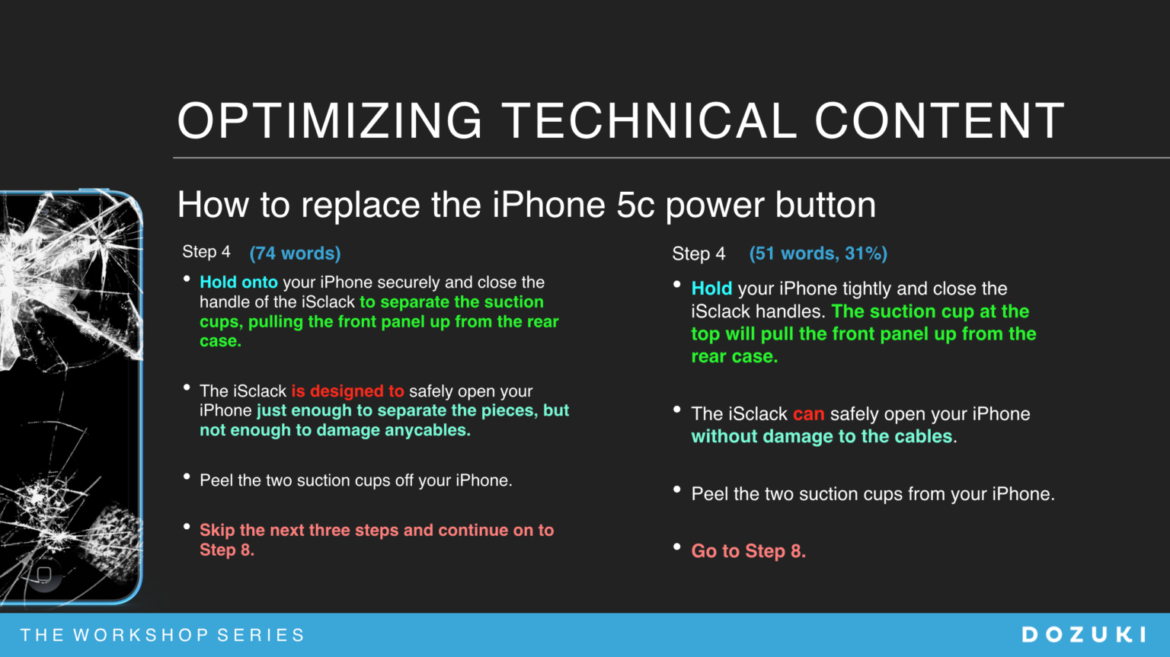
1a) Standard English:

Hold onto your iPhone securely and close the handle of the iSclack to separate the suction cups, pulling the front panel up from the rear case.

1b) STE:

Hold your iPhone tightly and close the iSclack handles. The suction cup at the top will pull the front panel up from the rear case.

Analysis:

In this rewrite, it is not necessary to create a phrasal verb such as ‘hold onto‘ to add emphasis to the verb ‘hold‘. Also, the objective of this step is to remove the front panel from the rear case. For this reason, we rephrased the sentence to clearly show which components need to be removed, using which tools. It is also recommended to write short, simple to understand sentences in procedural-type instructions.


RULE: 1.17  Make your instructions as specific as possible.

2a) Standard English:

The iSclack is designed to safely open your iPhone just enough to separate the pieces, but not enough to damage any cables.

2b) STE:

The iSclack can safely open your iPhone without damage to the cables.

Analysis:

In this rewrite, we reduced the number of words from 21 to 12. The Standard English sentence above seems  rather excessive in trying to explain the use of the iSclack, when it is sufficient to say that the iSclack tool is safe to use, without going into unnecessary details, such as design.


RULE: 1.1 Only use approved words in the dictionary

3a) Standard English:

Skip the next three steps and continue on to Step 8.

3b) STE:

Go to Step 8.

Analysis:

‘Skip’ is an unapproved word in STE, and not quite useful in this context. Simply tell your reader which steps they need to complete next.


Missed this session? The on-demand presentation is now available below.


Shumin Chen

About the speaker

Since 2006, Ms Shumin Chen has been working as a consultant with customers in various industries worldwide: aerospace and defence, banking, consumer products, healthcare, IT, medical and fitness equipment. She has helped many companies with their documentation needs, based on standards where possible, and is widely regarded as a leading expert in ASD-STE100 Simplified Technical English training, aviation documentation and multilingual documentation.

Ms Chen now heads the ASD-STE100 training arm of Shufrans TechDocs. In her current role, Ms Chen continues to focus on the practical implementation of international standards to facilitate the efficient creation and management of multilingual documentation.

Copyright © 2016 Shufrans TechDocs. All rights reserved. No part of this article may be reproduced or transmitted in any form or by any means whatsoever without express written permission from the author, except in the case of brief quotations embodied in critical articles and reviews. 

Ready to learn more?

Make STE your strategic partner today!

STE training & consultancy
Dozuki Workshop Series – Optimize your technical content (Part 2 of 3)

Dozuki Workshop Series – Optimize your technical content (Part 2 of 3)

Read Part 1 of our blog series here:

Dozuki Workshop Series – Optimize your technical content (Part 1 of 3)

A precise, coherent and audience-oriented technical content delivery is what every professional technical communicator should aim for, and standardising your terminology and documents at the word, phrase, and sentence levels is the first step to take.

In part two of our three-part text analysis, we will continue to share more examples of how you can prepare your content for optimum re-use, readability, and translatability. We will highlight areas for improvement, then provide the same information based on Simplified Technical English (STE) writing rules.


RULE: 5.1 Keep procedural sentences as short as possible.

1a) Standard English:

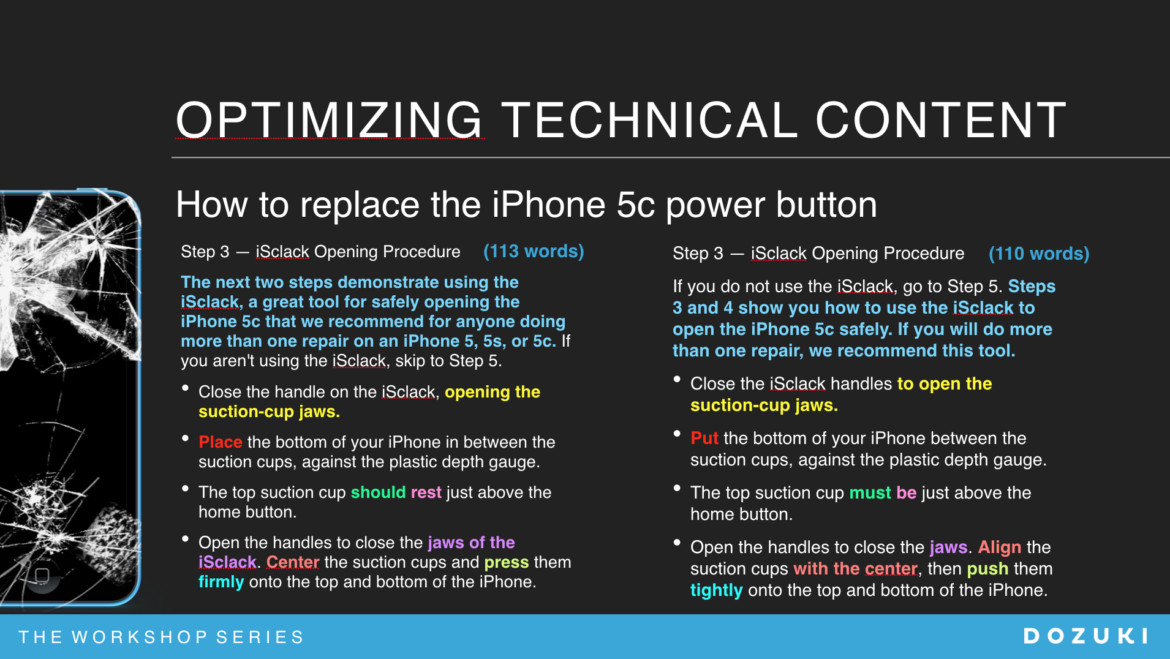
The next two steps demonstrate using the iSclack, a great tool for safely opening the iPhone 5c that we recommend for anyone doing more than one repair on an iPhone 5, 5s, or 5c. If you aren’t using the iSclack, skip to Step 5.

1b) STE:

If you do not use the iSclack, go to Step 5. Steps 3 and 4 show you how to use the iSclack to open the iPhone 5c safely. If you will do more than one repair, we recommend this tool.

Analysis:

In this rewrite, we advise users to skip the next two steps immediately if they do not use the iSclack. Also, shorter instructions that inform the user what specific actions to complete are easier to process. Procedural sentences in STE should ideally stay within the 20-word limit.


RULE: 3.3  Use the approved forms of the verb to make only:

  – The infinitive (to open..)

  – The imperative (Open the..)

 – The past participle as an adjective (the opened valve)

  – The simple present tense (it opens)

  – The simple past tense (it opened)

  – The future tense (you will open..).

2a) Standard English:

  • Close the handle on the iSclack, opening the suction-cup jaws.

2b) STE:

  • Close the iSclack handles to open the suction-cup jaws.

Analysis:

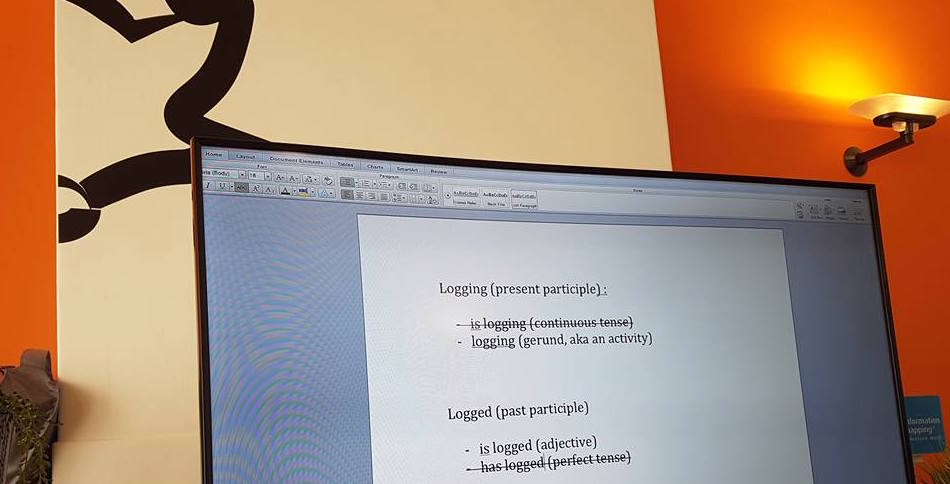
The present participle or verbs ending in -ing are not used in STE unless they are part of a technical name. Some examples include: during, lighting, missing, routing, and servicing.


RULE: 1.1 Only use approved words in the dictionary

3a) Standard English:

  • Place the bottom of your iPhone in between the suction cups, against the plastic depth gauge.
  • The top suction cup should rest just above the home button.
  • Open the handles to close the jaws of the iSclack. Center the suction cups and press them firmly onto the top and bottom of the iPhone.

3b) STE:

  • Put the bottom of your iPhone between the suction cups, against the plastic depth gauge.
  • The top suction cup must be just above the home button.
  • Open the handles to close the jaws. Align the suction cups with the center, then push them tightly onto the top and bottom of the iPhone.

Analysis:

Use ‘put‘ instead of ‘place’, ‘must‘ instead of ‘should’, ‘push‘ instead of ‘press’, and ‘tightly‘ instead of ‘firmly’. ‘Center‘ is an approved STE word, but only as a technical noun. Ergo, it is necessary to rewrite this clause to: ‘Align the suction cups with the centre,..’.

The STE general vocabulary or dictionary offers technical writers approved synonyms for non-approved words. This is going to be very helpful for the writer who is transitioning from Standard English to Simplified Technical English.

Further reading: Dozuki Workshop Series – Optimize your technical content (Part 3 of 3)


Missed this session? The on-demand presentation is now available below.


Shumin Chen

About the speaker

Since 2006, Ms Shumin Chen has been working as a consultant with customers in various industries worldwide: aerospace and defence, banking, consumer products, healthcare, IT, medical and fitness equipment. She has helped many companies with their documentation needs, based on standards where possible, and is widely regarded as a leading expert in ASD-STE100 Simplified Technical English training, aviation documentation and multilingual documentation.

Ms Chen now heads the ASD-STE100 training arm of Shufrans TechDocs. In her current role, Ms Chen continues to focus on the practical implementation of international standards to facilitate the efficient creation and management of multilingual documentation.

Copyright © 2016 Shufrans TechDocs. All rights reserved. No part of this article may be reproduced or transmitted in any form or by any means whatsoever without express written permission from the author, except in the case of brief quotations embodied in critical articles and reviews. 

Ready to learn more?

Make STE your strategic partner today!

STE training & consultancy
Dozuki Workshop Series – Optimize your technical content (Part 1 of 3)

Dozuki Workshop Series – Optimize your technical content (Part 1 of 3)

Your content matters

To follow-up with the audience on the webinar session on 26 July 2016, we will share in more detail some examples of how you can prepare your content for optimum re-use, readability, and translatability.

In the three-part text analysis that follows, we will highlight areas for improvement, then provide the same information based on Simplified Technical English (STE) writing rules.


Replace iphone 5c power button STE


RULE: 1.2 Use approved words from the Dictionary only as the part of speech given.

1a) Standard English:

If your display is cracked, keep further breakage contained and prevent bodily harm during your repair by taping the glass.

1b) STE:

If there are cracks in your display glass, use tape to prevent more damage and possible injuries.

Analysis:

‘Crack’ is only approved as an STE technical noun, not a verb. For this reason, we changed the past participle form ‘cracked’ to ‘cracks’.

It is also not advisable to use fake verbs or a passive construction such as ‘by taping’ in your sentence. This is a violation of rule 1.2 where ‘tape’ is used only as a noun, and also hides the doer of the action. Instead, write ‘use tape to prevent more damage..’ to sound more direct.

We also removed unnecessary phrasings like ‘keep further breakage contained’ and ‘bodily harm’, substituting them with the simple verb ‘to prevent’, and unambiguous words such as ‘more damage’ to the equipment, and ‘possible injuries’ to the user for a more concise sentence construction.


RULE: 1.6 Use a Technical Name only as a noun, not as a verb.

2a) Standard English:

Lay overlapping strips of clear packing tape over the iPhone’s display until the whole face is covered.

2b) STE:

Make a cover for the full display glass area with overlapping strips of clear tape.

Analysis:

‘Cover’ is a non-approved verb in STE. Instead, use ‘cover’ as a technical noun. In this sentence pair above, we removed redundant words like ‘lay’, ‘over’, and ‘until’. The result is a concise, more direct sentence for the reader to complete his task more quickly and efficiently.


RULE: 1.3 Keep to the approved meaning of a word in the Dictionary. Do not use the word with any other meaning.

3a) Standard English:

This will keep glass shards contained and provide structural integrity when prying and lifting the display.

3b) STE:

This will keep glass shards together and give structural integrity when you move the display.

Analysis:

The STE verb ‘contain’ is defined as to have in something or to hold in something. The approved STE adverb ‘together’ appears simpler in meaning and more accurately describes the situation.

‘Provide’ as an unapproved STE verb is replaced with ‘give’, a shorter and more direct alternative.

‘Prying’ and ‘lifting’ can easily be described as ‘to move’. We hardly need to go into detail yet about prying and lifting as we risk confusing the reader at this point in time. Also, the –ing form or present participle verb form is not used in STE unless it is part of a technical name. For instance: lighting, missing, servicing.


RULE: 1.3 Keep to the approved meaning of a word in the Dictionary. Do not use the word with any other meaning.

4a) Standard English:

Wear safety glasses to protect your eyes from any glass shaken free during the repair.

4b) STE:

Use safety glasses for eye protection during the repair. 

Analysis:

‘Wear’ is defined as the action of becoming damaged as a result of friction. For other possibly valid meanings of ‘wear’, STE prefers the verbs ‘use’ or ‘put on’ safety glasses.

Further reading: Dozuki Workshop Series – Optimize your technical content (Part 2 of 3)


Missed this session? The on-demand presentation is now available below.


Shumin Chen

About the speaker

Since 2006, Ms Shumin Chen has been working as a consultant with customers in various industries worldwide: aerospace and defence, banking, consumer products, healthcare, IT, medical and fitness equipment. She has helped many companies with their documentation needs, based on standards where possible, and is widely regarded as a leading expert in ASD-STE100 Simplified Technical English training, aviation documentation and multilingual documentation.

Ms Chen now heads the ASD-STE100 training arm of Shufrans TechDocs. In her current role, Ms Chen continues to focus on the practical implementation of international standards to facilitate the efficient creation and management of multilingual documentation.

Copyright © 2016 Shufrans TechDocs. All rights reserved. No part of this article may be reproduced or transmitted in any form or by any means whatsoever without express written permission from the author, except in the case of brief quotations embodied in critical articles and reviews. 

Sounds interesting?

For a list of STE approved and non-approved verbs, drop us a line!

Request for the STE verbs list