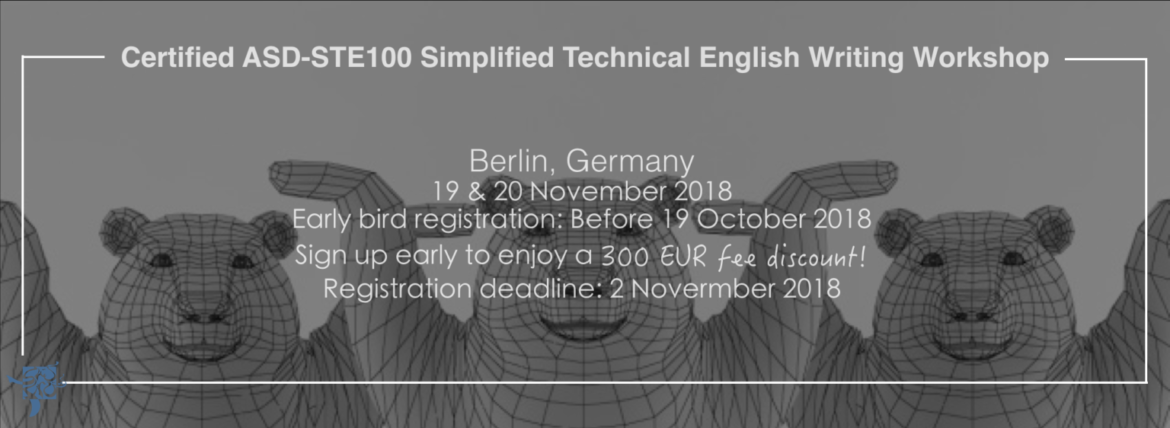
ASD-STE100 Simplified Technical English (STE) is a controlled language that is used to write technical manuals in such a way that they can be more easily understood by an international audience. STE helps to make translations cheaper and more accurate. Often a formal requirement for aircraft and defence maintenance documentation, STE can easily be adapted to all technical industries and beyond. Ms. Shumin Chen will teach participants how to correctly and effectively use STE in practice. She will also address some of the mistakes commonly found in technical writing and the frequently incorrect use of common STE writing rules.
All our training materials are updated according to the ASD-STE100 Specification Issue 7, January 2017.
Practical overview of ASD-STE100 Simplified Technical English
How STE helps both native & non-native speakers of English
Writing rules and how to apply them in practice
How to use the general vocabulary
How to deal with industry-specific terminology
How to use STE for various documentation types
How to implement STE with minimal disruption to on-going production and existing documentation
Hands-on STE editing and review
“The Simplified Technical English course content and requirements provided by Shumin Chen were an absolute good fit with the TCLoc Master’s program. A technical communicator has to know about the existing specifications for technical documentation. Furthermore, this course helps the students to acquire new skills in order to enhance the accuracy and clarity of contents.” TCLoc Master’s Student, University of Strasbourg.
Who should attend?
Compliance managers
CIO, COO, CTO
Customer support managers
Documentation managers
Editors
Engineering managers
Engineers and SMEs who create documentation
Graphics specialists
ILS managers
Maintenance managers
Operation managers
Product managers
Project managers
Quality managers
Software research engineers
Technical illustrators
Technical writers
Translation managers
Translators
What training outcomes to expect?
Our interactive training, exercises and workshop, will teach participants to standardise content to:
Author more efficiently
Communicate more effectively with a global audience
Improve operational safety
Reduce AOG / downtime
Facilitate modular writing and reuse
Facilitate teamwork
Facilitate translation
Maximise consistency
Optimise product lifecycle support
Reduce the cost of creating and maintaining technical publications
Trainer’s qualifications
Ms. Shumin Chen, principal trainer & consultant at Shufrans TechDocs received her professional on-the-job training in the field of STE under the tutelage of Dr Frans Wijma, a linguist and documentation expert. Together as an experienced global team, they provided their combined knowledge and dedication to benefit customers worldwide. To date, they have provided training and consultancy services to over 180 companies. Shufrans TechDocs is the only company with such vast experience in providing certified STE training.
Shumin has supported various companies with their STE and other documentation needs, based on standards where possible. Although STE was developed for the aerospace industry, more specifically for aircraft maintenance documentation, Shumin found that it made a lot of sense to apply the same principles to other industries and types of documents as well. Few -if any- changes to the specification are necessary to adapt STE to industries ranging from machinery to IT, automotive to medical equipment.
* Shufrans also offers customised ASD-STE100 training solutions tailored to meet your specific requirements. These courses are normally provided at the customer’s premises.
ASD-STE100 Simplified Technical English (STE) is a controlled language that is used to write technical manuals in such a way that they can be more easily understood by an international audience. STE helps to make translations cheaper and more accurate.
This three-day professional training course is intended for technical authors to familiarise themselves with the ASD-STE100 controlled language specification through a series of classroom- and workshop-type instruction and interaction.
STE improves quality, both in the aviation and defence industries, where it is often mandatory for safety & security reasons, and in any other technical industries.
We use the latest version of the ASD-STE100 specification: Issue 7, January 2017.
Course outline*
Practical overview of ASD-STE100 Simplified Technical English
How STE helps both native & non-native speakers of English
Writing rules and how to apply them in practice
How to use the general vocabulary
How to deal with industry-specific terminology
How to use STE for various documentation types
How to implement STE with minimal disruption to on-going production and existing documentation
Hands-on STE editing and review
* Shufrans also offers customised ASD-STE100 training solutions tailored to meet your specific requirements. These courses are normally provided at the customer’s premises.
“The introduction to the ASD-STE100 gave me a nice and clear overview of what to expect in the two training days that followed. Consistent language and spelling in STE are the rules I like best. The list of approved and unapproved verbs was a nice surprise for me. Shumin gave a highly practical STE training using relevant and pragmatic examples that relate closely to our field of work.” Maikel Kornuit, Technical Author, Triview.
This training workshop is organised in collaboration with Talent of Content our preferred training partner in mainland China.
Who should attend?
Compliance managers
CIO, COO, CTO
Customer support managers
Documentation managers
Editors
Engineering managers
Engineers and SMEs who create documentation
ILS managers
Maintenance managers
Operation managers
Product managers
Project managers
Quality managers
Technical writers
Translation managers
Translators
What will I learn?
Ms. Shumin Chen will teach participants how to correctly and effectively use STE in practice. She will also address some of the mistakes commonly found in technical writing and the frequently incorrect use of common STE writing rules.
Our interactive training, exercises and workshop, will teach participants to standardise content to:
Author more efficiently
Communicate more effectively with a global audience
Improve operational safety
Reduce AOG / downtime
Facilitate modular writing and reuse
Facilitate teamwork
Facilitate translation
Maximise consistency
Optimise product lifecycle support
Reduce the cost of creating and maintaining technical publications
Trainer’s qualifications
Ms. Shumin Chen, principal trainer & consultant at Shufrans TechDocs received her professional on-the-job training in the field of STE under the tutelage of Dr Frans Wijma, a linguist and documentation expert. Together as an experienced global team, they provided their combined knowledge and dedication to benefit customers worldwide. To date, they have provided training and consultancy services to over 180 companies. Shufrans TechDocs is the only company with such vast experience in providing certified STE training.
Shumin has supported various companies with their STE and other documentation needs, based on standards where possible. Although STE was developed for the aerospace industry, more specifically for aircraft maintenance documentation, Shumin found that it made a lot of sense to apply the same principles to other industries and types of documents as well. Few -if any- changes to the specification are necessary to adapt STE to industries ranging from machinery to IT, automotive to medical equipment.
ASD-STE100 Simplified Technical English (STE) is a controlled language that is used to write technical manuals in such a way that they can be more easily understood by an international audience. STE helps to make translations cheaper and more accurate. Often a formal requirement for aircraft and defence maintenance documentation, STE can easily be adapted to all technical industries and beyond. Ms. Shumin Chen will teach participants how to correctly and effectively use STE in practice. She will also address some of the mistakes commonly found in technical writing and the frequently incorrect use of common STE writing rules.
Practical overview of ASD-STE100 Simplified Technical English
How STE helps both native & non-native speakers of English
Writing rules and how to apply them in practice
How to use the general vocabulary
How to deal with industry-specific terminology
How to use STE for various documentation types
How to implement STE with minimal disruption to on-going production and existing documentation
Hands-on STE editing and review
* Shufrans also offers customised ASD-STE100 training solutions tailored to meet your specific requirements. These courses are normally provided at the customer’s premises.
“The Simplified Technical English course content and requirements provided by Shumin Chen were an absolute good fit with the TCLoc Master’s program. A technical communicator has to know about the existing specifications for technical documentation. Furthermore, this course helps the students to acquire new skills in order to enhance the accuracy and clarity of contents.” TCLoc Master’s Student, University of Strasbourg.
Who should attend?
Compliance managers
CIO, COO, CTO
Customer support managers
Documentation managers
Editors
Engineering managers
Engineers and SMEs who create documentation
Graphics specialists
ILS managers
Maintenance managers
Operation managers
Product managers
Project managers
Quality managers
Software research engineers
Technical illustrators
Technical writers
Translation managers
Translators
What training outcomes to expect?
Our interactive training, exercises and workshop, will teach participants to standardise content to:
Author more efficiently
Communicate more effectively with a global audience
Improve operational safety
Reduce AOG / downtime
Facilitate modular writing and reuse
Facilitate teamwork
Facilitate translation
Maximise consistency
Optimise product lifecycle support
Reduce the cost of creating and maintaining technical publications
Trainer’s qualifications
Ms. Shumin Chen, principal trainer & consultant at Shufrans TechDocs received her professional on-the-job training in the field of STE under the tutelage of Dr Frans Wijma, a linguist and documentation expert. Together as an experienced global team, they provided their combined knowledge and dedication to benefit customers worldwide. To date, they have provided training and consultancy services to over 180 companies. Shufrans TechDocs is the only company with such vast experience in providing certified STE training.
Shumin has supported various companies with their STE and other documentation needs, based on standards where possible. Although STE was developed for the aerospace industry, more specifically for aircraft maintenance documentation, Shumin found that it made a lot of sense to apply the same principles to other industries and types of documents as well. Few -if any- changes to the specification are necessary to adapt STE to industries ranging from machinery to IT, automotive to medical equipment.
by Shufrans Techdocsin BlogComments Off on The common denominator for credible & concise documentation across industries
TCLoc Master article on The common denominator for credible & concise documentation across industries by Ms. Shumin Chen, Principal ASD-STE100 Trainer & Consultant.
First published on TCLoc Master Blog • University of Strasbourg • 4 December 2017
Safety, efficiency, and readability are the main considerations for the use of ASD-STE100 Simplified Technical English (STE) in the aerospace and defense industries. For many other industries, such as machinery, automotive, electronics, IT, and medical equipment, another important consideration is to save on translation costs without compromising on translation quality. As technical communicators, navigating the tricky terrains of cost, quality, and efficiency in project management can be an extremely delicate equilibrium to maintain.
Standards
To technical communication professionals, it makes a lot of sense to use standards whenever possible to achieve similar results. However, standards in the documentation field are often disregarded. Documentation always kicks in when the product is already behind schedule, and over budget for the product life-cycle. However, we still want to stand behind what we do and make sure we provide a quality product. How does a written language standard potentially help us to achieve this and why do we need a controlled language such as STE to begin with?
Consider the following example:
Standard English:
Follow these instructions to prevent potential failures and damage and to ensure as safe and trouble-free functioning of the product as possible. Read this manual before starting to work with the filter system, familiarize yourself with the functionality and operation of the product and follow the instructions.
STE:
FOR SAFE OPERATION, OBEY THESE INSTRUCTIONS TO PREVENT POSSIBLE FAILURES.
READ THIS MANUAL BEFORE YOU START TO DO WORK WITH THE FILTER SYSTEM. KNOW THE PRODUCT FUNCTION AND OPERATION, AND OBEY ALL INSTRUCTIONS.
Which set of instructions lets you understand and complete the procedure with greater ease?
ASD-STE100 Simplified Technical English (STE) is a controlled language that is used to write technical manuals in such a way that they can be more easily understood by an international audience. STE helps to make translations cheaper and more accurate. Often a formal requirement for aircraft and defence maintenance documentation, STE can easily be adapted to all technical industries and beyond. Ms. Shumin Chen will teach participants how to correctly and effectively use STE in practice. She will also address some of the mistakes commonly found in technical writing and the frequently incorrect use of common STE writing rules.
Course outline*
Participants have the flexibility of attending a 1, 2, or 3-day training session with us.
Day 1: Classroom Training
Practical overview of ASD-STE100 Simplified Technical English
How STE helps both native & non-native speakers of English
Benefits of adopting the STE international writing standard
Writing rules and how to apply them in practice
How to use the general vocabulary.
Day 2: Application, Review, & Exercises
Approved and non-approved words discussion and the rationale behind.
How to deal with industry-specific terminology
How to use STE for various documentation types
How to implement STE with minimal disruption to on-going production and existing documentation
Day 3: Extended Writing Workshop
Practical workshop session for applying STE rules to your own documents
Review, edit, and discuss participants’ own documents to reinforce learning
Classroom presentation of own documents.
* Shufrans also offers customised ASD-STE100 training solutions tailored to meet your specific requirements. These courses are normally provided at the customer’s premises.
Learning how to optimally use a documentation standard like ASD-STE100 is a substantial boost to our technical writing team’s capabilities and significantly improved our compliance rating! Raja Sureshbabu, Global Head of Aerospace Vertical, Tata Consultancy Services.
Who should attend?
Compliance managers
CIO, COO, CTO
Customer support managers
Documentation managers
Editors
Engineering managers
Engineers and SMEs who create documentation
Graphics specialists
ILS managers
Maintenance managers
Operation managers
Product managers
Project managers
Quality managers
Software research engineers
Technical illustrators
Technical writers
Translation managers
Translators
What training outcomes to expect?
Our interactive training, exercises and workshop, will teach participants to standardise content to:
Author more efficiently
Communicate more effectively with a global audience
Improve operational safety
Reduce AOG / downtime
Facilitate modular writing and reuse
Facilitate teamwork
Facilitate translation
Maximise consistency
Optimise product lifecycle support
Reduce the cost of creating and maintaining technical publications
Trainer’s qualifications
Ms. Shumin Chen, principal trainer & consultant at Shufrans TechDocs received her professional on-the-job training in the field of STE under the tutelage of Dr Frans Wijma, a linguist and documentation expert. Together as an experienced global team, they provided their combined knowledge and dedication to benefit customers worldwide. To date, they have provided training and consultancy services to over 180 companies. Shufrans TechDocs is the only company with such vast experience in providing certified STE training.
Shumin has supported various companies with their STE and other documentation needs, based on standards where possible. Although STE was developed for the aerospace industry, more specifically for aircraft maintenance documentation, Shumin found that it made a lot of sense to apply the same principles to other industries and types of documents as well. Few -if any- changes to the specification are necessary to adapt STE to industries ranging from machinery to IT, automotive to medical equipment.
ASD-STE100 Simplified Technical English (STE) is a controlled language that is used to write technical manuals in such a way that they can be more easily understood by an international audience. STE helps to make translations cheaper and more accurate.
This two-day professional training course is intended for technical authors to familiarise themselves with the ASD-STE100 controlled language specification through a series of classroom- and workshop-type instruction and interaction.
STE improves quality, both in the aviation and defence industries, where it is often mandatory for safety & security reasons, and in any other technical industries.
We use the latest version of the ASD-STE100 specification: Issue 7, January 2017.
Course outline*
Practical overview of ASD-STE100 Simplified Technical English
How STE helps both native & non-native speakers of English
Writing rules and how to apply them in practice
How to use the general vocabulary
How to deal with industry-specific terminology
How to use STE for various documentation types
How to implement STE with minimal disruption to on-going production and existing documentation
Hands-on STE editing and review
* Shufrans also offers customised ASD-STE100 training solutions tailored to meet your specific requirements. These courses are normally provided at the customer’s premises.
“The introduction to the ASD-STE100 gave me a nice and clear overview of what to expect in the two training days that followed. Consistent language and spelling in STE are the rules I like best. The list of approved and unapproved verbs was a nice surprise for me. Shumin gave a highly practical STE training using relevant and pragmatic examples that relate closely to our field of work.” Maikel Kornuit, Technical Author, Triview.
This training workshop is organised in collaboration with Asia Technical Services Pte Ltd, our preferred training partner in the ASEAN region.
Who should attend?
Compliance managers
CIO, COO, CTO
Customer support managers
Documentation managers
Editors
Engineering managers
Engineers and SMEs who create documentation
ILS managers
Maintenance managers
Operation managers
Product managers
Project managers
Quality managers
Technical writers
Translation managers
Translators
What will I learn?
Ms. Shumin Chen will teach participants how to correctly and effectively use STE in practice. She will also address some of the mistakes commonly found in technical writing and the frequently incorrect use of common STE writing rules.
Our interactive training, exercises and workshop, will teach participants to standardise content to:
Author more efficiently
Communicate more effectively with a global audience
Improve operational safety
Reduce AOG / downtime
Facilitate modular writing and reuse
Facilitate teamwork
Facilitate translation
Maximise consistency
Optimise product lifecycle support
Reduce the cost of creating and maintaining technical publications
Trainer’s qualifications
Ms. Shumin Chen, principal trainer & consultant at Shufrans TechDocs received her professional on-the-job training in the field of STE under the tutelage of Dr Frans Wijma, a linguist and documentation expert. Together as an experienced global team, they provided their combined knowledge and dedication to benefit customers worldwide. To date, they have provided training and consultancy services to over 180 companies. Shufrans TechDocs is the only company with such vast experience in providing certified STE training.
Shumin has supported various companies with their STE and other documentation needs, based on standards where possible. Although STE was developed for the aerospace industry, more specifically for aircraft maintenance documentation, Shumin found that it made a lot of sense to apply the same principles to other industries and types of documents as well. Few -if any- changes to the specification are necessary to adapt STE to industries ranging from machinery to IT, automotive to medical equipment.
by Shufrans Techdocsin UncategorizedComments Off on Elevating cities of the future | Schindler Elevator Corporation
STE as part of your global content strategy
Simplified Technical English as part of your content strategy
Schindler’s success is driven by their commitment to traditional core values such as customer service, quality, and safety, combined with our key strengths of creativity and innovation to produce intelligent solutions in response to customer needs. More than 66,000 Schindler employees work around the clock to serve 1.5 billion people using our elevators and escalators every day. Safety for each one of our passengers and employees is foremost.
ASD-STE100 Simplified Technical English (STE) is a controlled language that is used to write technical manuals in such a way that they can be more easily understood by an international audience. To put it across plainly, STE is a form of controlled language that is guided by 53 technical writing rules that were put together by a committee of linguists, engineers, and manufacturers who established over the years that these writing rules made sense and allowed them to re-write any of their existing documentation based on these rules, making their documentation easier to understand, while maintaining accuracy, safety, and validity.
Develop, deploy, and deliver documentation with STE
STE Quick facts
Background: With the widespread dissemination of user documentation published in various delivery formats across several language translations, the relevance of global information management has become greater in an attempt to stem terminology inconsistencies, mistranslations, and the disproportionate escalation of costs associated with the maintenance, reuse, and consumption of technical content.
The STE specification also includes a core vocabulary of around 930 approved words and 1500 non-approved words that let technical authors write just about everything that they need for for procedural and descriptive texts. Therefore, the use of approved words, compliance with the standard, and a language quality checker toolto complement your content strategy efforts is akin to pooling your most valuable resources where people, internal processes, and innovative technologies become more aligned.
The role of technical authors and technical documentation managers
Technical writers are the go-between for subject-matter-experts (SMEs), engineers, designers and the end-users of documentation. Consequently, the responsibility of creating effective documentation falls on technical authors who will endeavour to send out a clear, unambiguous, and user-friendly message about their products and line of services.
At the level of global information management, technical writing professionals should consider short-term tactics and longer-term strategies to overcome the following:
An ever-increasing volume of words to write and translate
Snowballing translation and documentation management costs
Overlapping information across different versions of similar document types
Low comprehension levels for the English language jargon.
STE in practice
If this is your first time hearing about STE, the example that follows will hopefully shed more light on the principles and best practices that govern good STE writing. Here is an original piece of text presented in standard English writing:
THE SYNTHETIC LUBRICATING OIL USED IN THIS ENGINE CONTAINS ADDITIVES WHICH, IF ALLOWED TO COME INTO CONTACT WITH THE SKIN FOR PROLONGED PERIODS, CAN BE TOXIC THROUGH ABSORPTION.
And here it is again in STE:
THE OIL IS POISONOUS. DO NOT GET THE ENGINE OIL ON YOUR SKIN. IT CAN GO THROUGH YOUR SKIN AND INTO YOUR BODY.
Making the comparison between the two types of writing above, you will see that the original writing is rather cumbersome in expression. It is also very likely that the person reading this sentence will have difficulties following the writer’s line of thought because of the longer sentence length and unnecessary information included. In contrast, the text written in STE is much more to the point and simply distils what is pertinent to the person doing this work:
The oil is poisonous.
I must always be careful not to touch oil without protection.
From this example, STE shows us that warnings and cautions must always start with a simple and clear command that is usually substantiated by a reasoning that comes before or after. A command informs the user about the precautionary measures to take to avoid danger. Presenting information as if it were a general comment in the original writing obscures the importance of the message and is not specific enough.
Where can I learn more about STE?
Shufrans TechDocs regularly hosts online training workshops for technical writers, SMEs, and engineers at different time zones for your convenience. To learn more about our diverse course offerings and workshop customisations that we can do for you and your global technical documentation team, speak to us today!
What customers are saying.. | Schindler Elevator Corporation
Marco Valtangoli, Corporate Technical Author, Schindler Management
“A sometimes missed, yet very important point highlighted during the introduction is that STE is an English language specification that is not only applicable for companies in the aerospace & defence industry. Rule 5.2 where you only have one instruction per sentence is important to us. Not being able to use the verb “CHECK’ that is only used as an approved STE noun poses a challenge to me all the time. I really appreciate the STE writing rules that give us the possibility to improve the consistency of our documents.
The workshop exercises were of high-interest value and drive home the point that it is important to learn by doing. Although a time-consuming process, the writing workshop impressed on me that the need to prioritise the analysis of our internal documents.
Shumin is a competent trainer who does not only focus on explaining and enforcing the “writing rules”, but is always available to understand and empathise with the training needs of the class.”
Sylvia Helfenstein, Technical author, Proofreader “The information presented was clear and succinct. The exercises provided helped me understand and grasp the concept of Simplified English from the very beginning of the training. A 10/10 rating from me. When it comes to rules about Simplified English writing, I very much like the use of active voice, having a list of approved verbs as a useful resource, and the encouraged use of pronouns (you, we, it, them). To me, clear rules are the bedrock of consistent text and document creation.
I’ve found the STE exercises very useful since the examples in them are well focussed and cover issues we encounter in our daily work. Overall, I have found this training workshop to be well-structured, Shumin came well prepared, was well organised, clear & an easy speaker to follow. Thank you for the great training!”
Cécile Roos, Corporate Translation Manager, Schindler Management Ltd
“Entertaining, short, and clear presentation of the STE specification and rule sets. Overall, a good mix of rules, examples, and exercises. The course was very much on point and encouraged me to write in a more structured way. This will help the readers to properly understand my message even in business writing. Shumin had a very calm way of leading all of us through the training. Her style of teaching is rather empathetic and she keeps the group working effectively with timely breaks in between. Thanks Shumin for an enjoyable course with the perfect score of 10/10 in terms of trainer evaluation.”
An innovative approach to consider for your global documentation landscape
Over the last three decades, STE has emerged as a rather important and universal standard for technical English. Predictably, as a result of language standardisation, STE helps us to achieve a number of benefits. Technical writers become more consistent on a word level. This starts with the simple fact that we are going to use the same word whenever we refer to the same thing, so that means an improved level of consistency and consequently quality improvements.
by Shufrans Techdocsin Blog, News & EventsComments Off on Case Study: Achieving Clarity and Consistency in Technical Documentation for Schindler Elevators
A Strategic Approach to Unambiguous Communication and Operational Excellence
Training Locations: Ebikon, Switzerland (on-site) & Shanghai, China (online)
Service Provided: Simplified Technical English (STE) Training & Documentation Rewriting
Introduction
Clear, unambiguous, and consistent technical documentation is paramount in the complex and safety-critical world of urban mobility. This case study highlights a successful engagement with Schindler Group, a global leader in elevators, escalators, and related services, focused on achieving their technical communication through comprehensive Simplified Technical English (STE) implementation.
Client Background
Schindler Group, headquartered in Ebikon, Switzerland, is renowned for its innovative and sustainable mobility solutions. With a vast international presence and a diverse workforce, ensuring that technical manuals, maintenance procedures, and product documentation are universally understood is a strategic imperative, particularly for safety and operational efficiency.
The Challenge
Prior to the engagement, Schindler, like many multinational corporations, faced the inherent challenges of technical documentation:
Ambiguity: Standard English, with its rich vocabulary and complex grammatical structures, can lead to misinterpretations, especially among non-native English speakers.
Inconsistency: Multiple authors and external vendors, potentially across different regions, could result in varied writing styles and terminology, hindering clarity and increasing translation costs.
Translation Efficiency: Complex source texts often led to higher translation costs and potential errors in localised versions, impacting global operations.
Safety Criticality: In the elevator and escalator industry, any misunderstanding in technical instructions can have severe safety implications.
Schindler recognised the need for a standardised approach to technical English to mitigate these risks and improve the overall quality and efficiency of their documentation.
Phase 2: Document Rewriting and Refinement Following the initial training, a direct engagement commenced with key personnel to apply STE principles to existing documentation. This involved close collaboration with:
Principal Corporate Technical Author: To ensure the practical application of STE rules and to establish internal champions for the standard.
Head of Corporate Technical Documentation: To oversee the strategic implementation and integration of STE into Schindler’s documentation workflows.
This hands-on rewriting process ensured that the theoretical knowledge gained during training was immediately put into practice, demonstrating tangible improvements in clarity and consistency.
Phase 3: Global Expansion of Training Recognising the success and the need for global consistency, the training was extended to other critical regions. A dedicated online training session was conducted for:
Corporate Technical Documentation colleagues in Shanghai, China: This expanded the reach of STE adoption, ensuring that documentation produced in a key international hub also conformed to the new global standard.
The success of this initiative was a testament to the collaborative effort across various departments and external partners, demonstrating how STE benefits different parts of the organisation:
Leadership and Management: Gained strategic alignment and understanding of STE’s business value in achieving safety, efficiency, and global reach.
Engineering and Product Development Teams (including Subject Matter Experts): Benefited from improved clarity in technical specifications, design documents, and maintenance requirements, ensuring precise input and reduced ambiguity from the source.
Technical Documentation Teams (in-house and external partners): Acquired practical skills in applying STE rules, leading to more consistent, unambiguous, and efficient content creation for manuals, procedures, and other technical assets.
Terminology and Language Specialists: Enhanced their ability to manage and control technical vocabulary, ensuring consistency across all documentation and facilitating improved translation quality.
Translation Teams: Experienced streamlined translation processes due to the reduced ambiguity and increased consistency of STE-compliant source texts.
Results and Impact
The implementation of STE at Schindler Group yielded significant benefits:
Achieved Clarity and Readability: Documents became easier to understand for a global audience, including non-native English speakers, reducing the risk of misinterpretation.
Improved Consistency: A unified writing style and controlled vocabulary ensured consistency across all technical documentation, regardless of the author or origin.
Increased Efficiency: Streamlined writing processes and clearer source texts led to more efficient documentation creation and review cycles.
Reduced Translation Costs: The unambiguous nature of STE significantly lowered translation costs and improved the quality of translated materials.
Strengthened Safety: By eliminating ambiguity in critical instructions, the overall safety of operations and maintenance procedures was achieved.
Testimonials
This impact was echoed by participants:
Roland Kiser, Terminology Coordinator at Schindler, noted: “This course shares a good overview of structure, purpose, history, and contextual information about STE. The limited vocabulary and restricted list of words, short sentence constructions, active voice, and imperative verb usage are valuable takeaways messages to act upon in Simplified English. The examples used in this training are quite realistic and it is very likely that I will recommend this STE training to someone else.”
Cécile Roos, Corporate Translation Manager, added: “Entertaining, short, and clear presentation of the STE specification and rule sets. Overall, a good mix of rules, examples, and exercises. The course was very much on point and encouraged me to write in a more structured way. This will help the readers to properly understand my message even in business writing. Shumin had a very calm way of leading all of us through the training. Her style of teaching is rather empathetic and she keeps the group working effectively with timely breaks in between. Thanks Shumin for an enjoyable course with the perfect score of 10/10 in terms of trainer evaluation.”
Marco Valtangoli, Senior Corporate Technical Author at Schindler, also provided valuable feedback: “A very important and highlighted point during the introduction is that STE is an English language specification that is not only applicable for companies in the aerospace & defence industry. Rule 5.2 where you only have one instruction per sentence is important to us. Not being able to use the verb “CHECK’ that is only used as an approved STE noun poses a challenge to me all the time. I really appreciate the STE writing rules that give us the possibility to improve the consistency of our documents. The workshop exercises were of high interest value and drive home the point that it is important to learn by doing. Although a time-consuming process, the writing workshop impressed on me that the need to prioritise the analysis of our internal documents. Shumin is a competent trainer who does not only focus on explaining and enforcing the “writing rules”, but is always available to understand and empathise with the training needs of the class.”
Conclusion
The comprehensive STE training and document rewriting initiative with Schindler Group stands as a strong example of how strategic investment in technical communication can drive operational excellence, improve safety, and foster global consistency within a leading industrial enterprise. By empowering their diverse teams with the tools and knowledge of Simplified Technical English, Schindler reinforced its commitment to delivering clear, reliable, and high-quality documentation worldwide.
If your organisation faces similar challenges in achieving uncompromising clarity and operational readiness through precise communication, discover how Shufrans TechDocs can help. Learn more about our ASD-STE100 training and consulting services:
The Kaizen 改善 methodology is a business philosophy of continuous improvement of working practices where changes are made in incremental, continual steps. Successful ASD-STE100 implementation assisted by the correct tools and technologies is no different. ASD-STE100 Simplified Technical English (STE) is a controlled language that is used to write technical manuals in such a way that they can be more easily understood by an international audience. The core principle of ASD-STE100 lies in the process of analysing existing documentation to form an efficient feedback loop. Through this reflective process, redundant and non-optimal work steps can be identified, reduced, and, or eliminated altogether. The result is an ongoing evolution in the way technical communication professionals write content in an ongoing effort to improve product efficiency, safety, and reliability.
Course outline*
Ms. Shumin Chen will teach participants how to correctly and effectively use STE in practice. She will also address some of the mistakes commonly found in technical writing and the frequently incorrect use of common STE writing rules.
Introduction to ASD-STE100 & Related Technologies
Practical overview of ASD-STE100 Simplified Technical English
How STE helps both native & non-native speakers of English
Writing rules and how to apply them in practice
How to use the general vocabulary
How to deal with industry-specific terminology
How to use STE for various documentation types
How to implement STE with minimal disruption to ongoing production and existing documentation
* Shufrans also offers customised ASD-STE100 training solutions tailored to meet your specific requirements. These courses are normally provided at the customer’s premises.
“STE is a ‘way of life’ in the field of technical writing and documentation. The ASD-STE100 exercises covered a wide spectrum of topics from choosing between approved and non-approved words to recreating documentation in STE. Shumin expertly guides us from classroom learning mode to real-life practical application of STE rules. The materials that she presented were informative and very convincing.” Martin Broekhuis, Technical Editor, Webasto.
Who should attend?
Compliance managers
CIO, COO, CTO
Customer support managers
Documentation managers
Editors
Engineering managers
Engineers and SMEs who create documentation
Graphics specialists
ILS managers
Maintenance managers
Operation managers
Product managers
Project managers
Quality managers
Software research engineers
Technical illustrators
Technical writers
Translation managers
Translators
What training outcomes to expect?
Our interactive training, exercises and workshop, will teach participants to standardise content to:
Author more efficiently
Communicate more effectively with a global audience
Improve operational safety
Reduce AOG / downtime
Facilitate modular writing and reuse
Facilitate teamwork
Facilitate translation
Maximise consistency
Optimise product lifecycle support
Reduce the cost of creating and maintaining technical publications
Guest Speakers
Style Guide: Shigeko Takahashi, Heartiness Co.
UTX Terminology Management: Yuji Yamamoto, Cosmos House
XML Schematron rule check: Yasunori Kaneko
Machine Translation: Kozo Moriguchi, Kawamura International Co.
Trainer’s qualifications
Ms. Shumin Chen, principal trainer & consultant at Shufrans TechDocs, has supported various companies with their STE and other documentation needs, based on standards where possible. Although STE was developed for the aerospace industry, more specifically for aircraft maintenance documentation, Shumin found that it made a lot of sense to apply the same principles to other industries and types of documents as well. Few -if any- changes to the specification are necessary to adapt STE to industries ranging from machinery to IT, automotive to medical equipment. Shufrans TechDocs is the only company with such vast experience in providing certified STE training.
This training workshop is jointly organised in with InfoParse, our preferred training partner in Japan.
ASD-STE100 Simplified Technical English (STE) is a controlled language that is used to write technical manuals in such a way that they can be more easily understood by an international audience. STE helps to make translations cheaper and more accurate. Often a formal requirement for aircraft and defence maintenance documentation, STE can easily be adapted to all technical industries and beyond. Ms. Shumin Chen will teach participants how to correctly and effectively use STE in practice. She will also address some of the mistakes commonly found in technical writing and the frequently incorrect use of common STE writing rules.
Practical overview of ASD-STE100 Simplified Technical English
How STE helps both native & non-native speakers of English
Writing rules and how to apply them in practice
How to use the general vocabulary
How to deal with industry-specific terminology
How to use STE for various documentation types
How to implement STE with minimal disruption to on-going production and existing documentation
Hands-on STE editing and review
* Shufrans also offers customised ASD-STE100 training solutions tailored to meet your specific requirements. These courses are normally provided at the customer’s premises.
“The Simplified Technical English course content and requirements provided by Shumin Chen were an absolute good fit with the TCLoc Master’s program. A technical communicator has to know about the existing specifications for technical documentation. Furthermore, this course helps the students to acquire new skills in order to enhance the accuracy and clarity of contents.” TCLoc Master’s Student, University of Strasbourg.
Who should attend?
Compliance managers
CIO, COO, CTO
Customer support managers
Documentation managers
Editors
Engineering managers
Engineers and SMEs who create documentation
Graphics specialists
ILS managers
Maintenance managers
Operation managers
Product managers
Project managers
Quality managers
Software research engineers
Technical illustrators
Technical writers
Translation managers
Translators
What training outcomes to expect?
Our interactive training, exercises and workshop, will teach participants to standardise content to:
Author more efficiently
Communicate more effectively with a global audience
Improve operational safety
Reduce AOG / downtime
Facilitate modular writing and reuse
Facilitate teamwork
Facilitate translation
Maximise consistency
Optimise product lifecycle support
Reduce the cost of creating and maintaining technical publications
Trainer’s qualifications
Ms. Shumin Chen, principal trainer & consultant at Shufrans TechDocs received her professional on-the-job training in the field of STE under the tutelage of Dr Frans Wijma, a linguist and documentation expert. Together as an experienced global team, they provided their combined knowledge and dedication to benefit customers worldwide. To date, they have provided training and consultancy services to over 180 companies. Shufrans TechDocs is the only company with such vast experience in providing certified STE training.
Shumin has supported various companies with their STE and other documentation needs, based on standards where possible. Although STE was developed for the aerospace industry, more specifically for aircraft maintenance documentation, Shumin found that it made a lot of sense to apply the same principles to other industries and types of documents as well. Few -if any- changes to the specification are necessary to adapt STE to industries ranging from machinery to IT, automotive to medical equipment.