Blog | Page 10 of 12 | Shufrans TechDocs Home // Blog | Page 10 of 12 | Shufrans TechDocs

Open Simplified Technical English (STE) training workshop in Rabat, Morocco

Open Simplified Technical English (STE) training workshop in Rabat, Morocco

Quick facts

Dates: 14 – 15 February 2017

Location: Rabat, Morocco

Length of training: 2 days

Early bird registration: Before 16 January 2017

Sign up early to enjoy a 20% training discount

Deadline for registration: 26 January 2017

This two-day professional training course is intended for technical authors to familiarise themselves with the ASD-STE100 controlled language specification through a series of classroom- and workshop-type instruction and interaction.

Summary

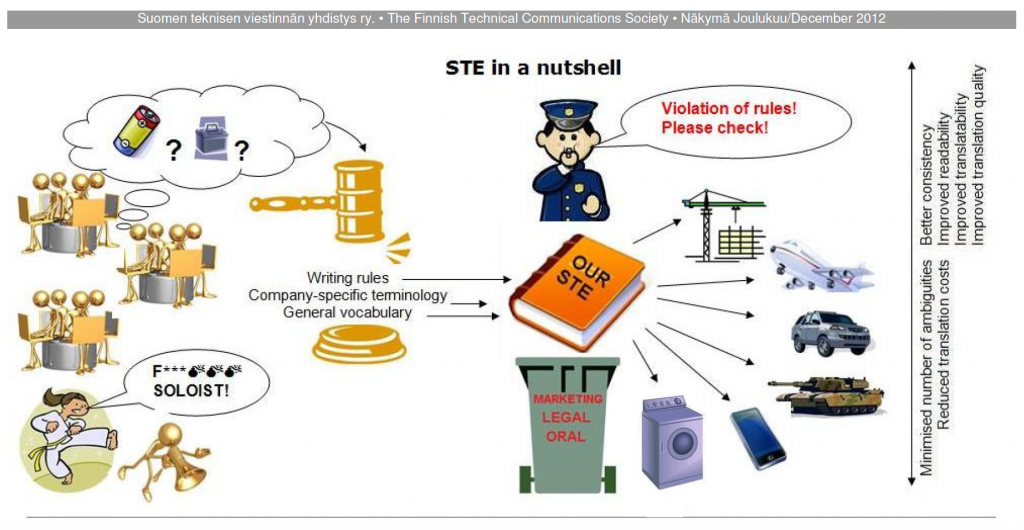
ASD-STE100 Simplified Technical English (STE) is a controlled language that is used to write technical manuals in such a way that they can be more easily understood by an international audience. STE helps to make translations cheaper and more accurate.

STE improves quality, both in the aviation and defence industries, where it is often mandatory for safety reasons, and in any other technical industries. 


Course outline*

  • Practical overview of ASD-STE100 Simplified Technical English
  • How STE helps both native & non-native speakers of English
  • Writing rules and how to apply them in practice
  • How to use the general vocabulary
  • How to deal with industry-specific terminology
  • How to use STE for various documentation types
  • How to implement STE with minimal disruption to on-going production and existing documentation
  • Hands-on STE editing and review

* Shufrans also offers customised ASD-STE100 training solutions tailored to meet your specific requirements. These courses are normally provided at the customer’s premises.

“STE is a ‘way of life’ in the field of technical writing and documentation. The ASD-STE100 exercises covered a wide spectrum of topics from choosing between approved and non-approved words to recreating documentation in STE. Shumin expertly guides us from classroom learning mode to real-life practical application of STE rules. The materials that she presented were informative and very convincing.” Martin Broekhuis, Technical Editor, Webasto.

Who should attend?

  • Compliance managers
  • CIO, COO, CTO
  • Customer support managers
  • Documentation managers
  • Editors
  • Engineering managers
  • Engineers and SMEs who create documentation
  • Graphics specialists
  • ILS managers
  • Maintenance managers
  • Operation managers
  • Product managers
  • Project managers
  • Quality managers
  • Software research engineers
  • Technical illustrators
  • Technical writers
  • Translation managers
  • Translators

What training outcomes to expect?

Ms. Shumin Chen will teach participants how to correctly and effectively use STE in practice. She will also address some of the mistakes commonly found in technical writing and the frequently incorrect use of common STE writing rules.

Our interactive training, exercises and workshop, will teach participants to standardise content to:

  • Author more efficiently
  • Communicate more effectively with a global audience
  • Improve operational safety
  • Reduce AOG / downtime
  • Facilitate modular writing and reuse
  • Facilitate teamwork
  • Facilitate translation
  • Maximise consistency
  • Optimise product lifecycle support
  • Reduce the cost of creating and maintaining technical publications

Trainer’s qualifications

Ms. Shumin Chen, principal trainer & consultant at Shufrans TechDocs received her professional on-the-job training in the field of STE under the tutelage of Dr Frans Wijma, a linguist and documentation expert. Together as an experienced global team, they provided their combined knowledge and dedication to benefit customers worldwide. To date, they have provided training and consultancy services to over 170 companies. Shufrans TechDocs is the only company with such vast experience in providing certified STE training.

Shumin has supported various companies with their STE and other documentation needs, based on standards where possible. Although STE was developed for the aerospace industry, more specifically for aircraft maintenance documentation, Shumin found that it made a lot of sense to apply the same principles to other industries and types of documents as well. Few -if any- changes to the specification are necessary to adapt STE to industries ranging from machinery to IT, automotive to medical equipment.
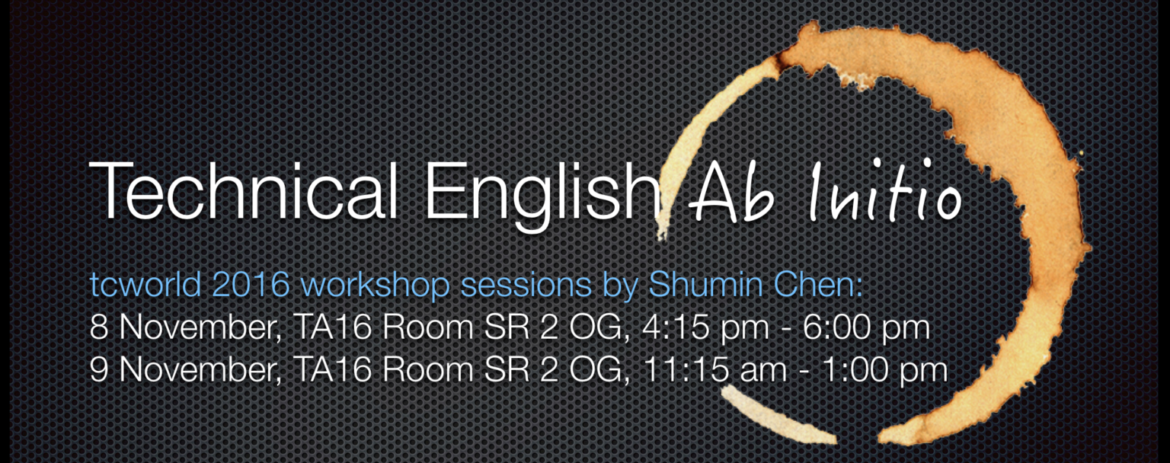


Technical English Ab Initio workshop at tcworld 2016 Stuttgart by Shumin Chen

Technical English Ab Initio workshop at tcworld 2016 Stuttgart by Shumin Chen

Consistent terminology is an important trademark of most well-written and user-friendly documentation. By removing uncommon technical terms, redundant synonyms and technical jargon, document readability will greatly improve.

Technical English ab initio (TEA) gets you started on compiling your own list of company-specific terms from first principles. TEA equips you with the most essential technical English words, and lets you write just about everything that you need for your product documentation in a clear, accurate and consistent manner.

In addition to common technical English terms, you will gain proficiency in cleverly selecting technical words that are specific to your industry, products, and services.


Workshop outline

This workshop will introduce the concept of TEA and its most practical application. We will present important criteria to consider before defining the scope of your corporate terminology. Participants will have the opportunity to apply what they have learnt in a highly interactive classroom environment.

  • The relevance of TEA for native & non-native speakers of English
  • TEA general vocabulary and how to apply them in practice
  • Mastering the general vocabulary of technical terms.
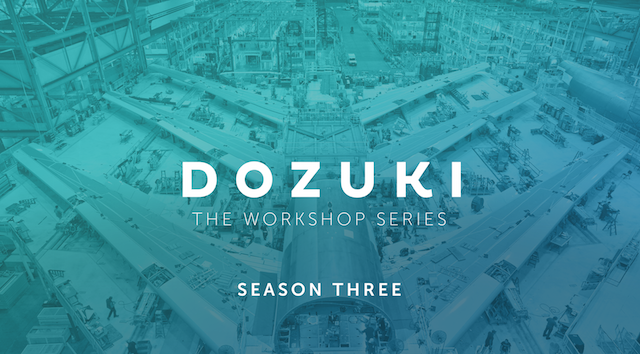
Dozuki Workshop Series – Optimize your technical content (Part 3 of 3)

Dozuki Workshop Series – Optimize your technical content (Part 3 of 3)

Read Part 1 & 2 of our blog series here:

Dozuki Workshop Series – Optimize your technical content (Part 1 of 3)

Dozuki Workshop Series – Optimize your technical content (Part 2 of 3)

In this final installment of our three-part text analysis, we highlight areas for improvement, then provide the same information based on Simplified Technical English (STE) writing rules.

RULE: 5.1 Keep procedural sentences as short as possible (20 words maximum).

RULE: 9.2 When you combine words to make a phrase, make sure that each word continues to obey the meanings given to them in the Dictionary.

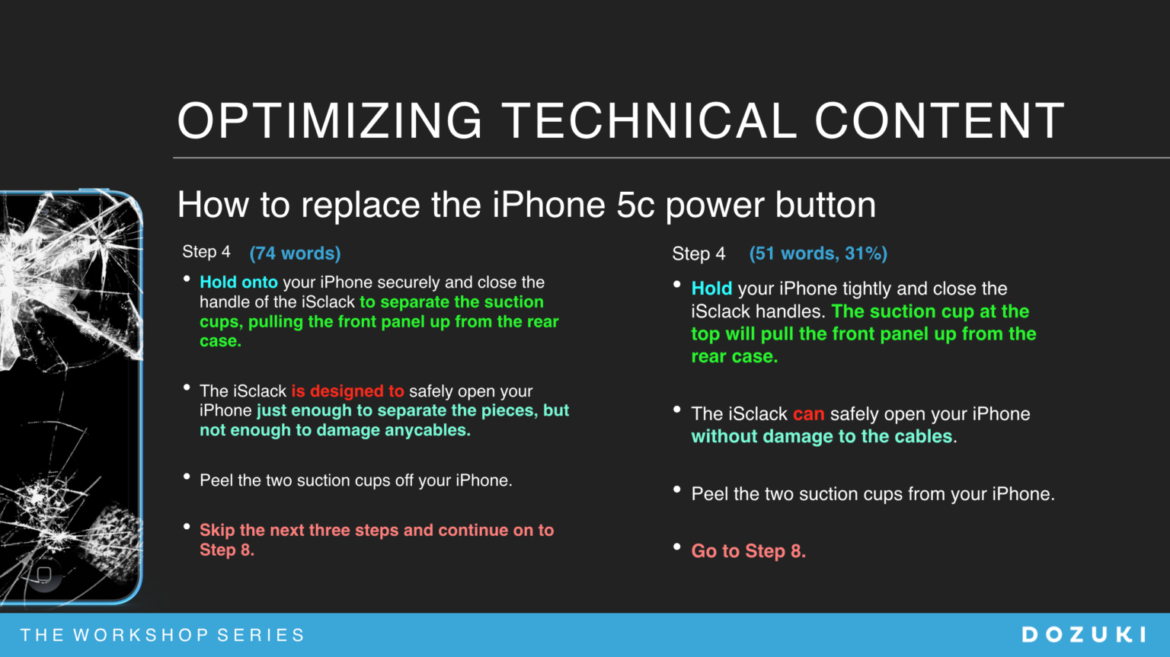
1a) Standard English:

Hold onto your iPhone securely and close the handle of the iSclack to separate the suction cups, pulling the front panel up from the rear case.

1b) STE:

Hold your iPhone tightly and close the iSclack handles. The suction cup at the top will pull the front panel up from the rear case.

Analysis:

In this rewrite, it is not necessary to create a phrasal verb such as ‘hold onto‘ to add emphasis to the verb ‘hold‘. Also, the objective of this step is to remove the front panel from the rear case. For this reason, we rephrased the sentence to clearly show which components need to be removed, using which tools. It is also recommended to write short, simple to understand sentences in procedural-type instructions.


RULE: 1.17  Make your instructions as specific as possible.

2a) Standard English:

The iSclack is designed to safely open your iPhone just enough to separate the pieces, but not enough to damage any cables.

2b) STE:

The iSclack can safely open your iPhone without damage to the cables.

Analysis:

In this rewrite, we reduced the number of words from 21 to 12. The Standard English sentence above seems  rather excessive in trying to explain the use of the iSclack, when it is sufficient to say that the iSclack tool is safe to use, without going into unnecessary details, such as design.


RULE: 1.1 Only use approved words in the dictionary

3a) Standard English:

Skip the next three steps and continue on to Step 8.

3b) STE:

Go to Step 8.

Analysis:

‘Skip’ is an unapproved word in STE, and not quite useful in this context. Simply tell your reader which steps they need to complete next.


Missed this session? The on-demand presentation is now available below.


Shumin Chen

About the speaker

Since 2006, Ms Shumin Chen has been working as a consultant with customers in various industries worldwide: aerospace and defence, banking, consumer products, healthcare, IT, medical and fitness equipment. She has helped many companies with their documentation needs, based on standards where possible, and is widely regarded as a leading expert in ASD-STE100 Simplified Technical English training, aviation documentation and multilingual documentation.

Ms Chen now heads the ASD-STE100 training arm of Shufrans TechDocs. In her current role, Ms Chen continues to focus on the practical implementation of international standards to facilitate the efficient creation and management of multilingual documentation.

Copyright © 2016 Shufrans TechDocs. All rights reserved. No part of this article may be reproduced or transmitted in any form or by any means whatsoever without express written permission from the author, except in the case of brief quotations embodied in critical articles and reviews. 

Ready to learn more?

Make STE your strategic partner today!

STE training & consultancy
Dozuki Workshop Series – Optimize your technical content (Part 2 of 3)

Dozuki Workshop Series – Optimize your technical content (Part 2 of 3)

Read Part 1 of our blog series here:

Dozuki Workshop Series – Optimize your technical content (Part 1 of 3)

A precise, coherent and audience-oriented technical content delivery is what every professional technical communicator should aim for, and standardising your terminology and documents at the word, phrase, and sentence levels is the first step to take.

In part two of our three-part text analysis, we will continue to share more examples of how you can prepare your content for optimum re-use, readability, and translatability. We will highlight areas for improvement, then provide the same information based on Simplified Technical English (STE) writing rules.


RULE: 5.1 Keep procedural sentences as short as possible.

1a) Standard English:

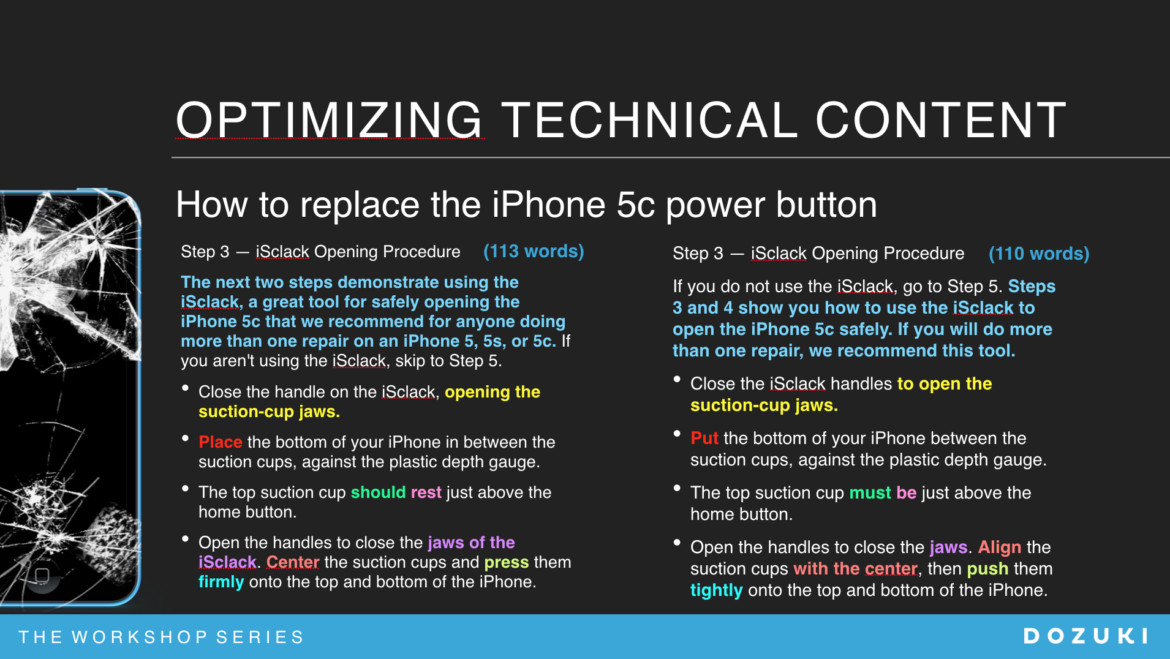
The next two steps demonstrate using the iSclack, a great tool for safely opening the iPhone 5c that we recommend for anyone doing more than one repair on an iPhone 5, 5s, or 5c. If you aren’t using the iSclack, skip to Step 5.

1b) STE:

If you do not use the iSclack, go to Step 5. Steps 3 and 4 show you how to use the iSclack to open the iPhone 5c safely. If you will do more than one repair, we recommend this tool.

Analysis:

In this rewrite, we advise users to skip the next two steps immediately if they do not use the iSclack. Also, shorter instructions that inform the user what specific actions to complete are easier to process. Procedural sentences in STE should ideally stay within the 20-word limit.


RULE: 3.3  Use the approved forms of the verb to make only:

  – The infinitive (to open..)

  – The imperative (Open the..)

 – The past participle as an adjective (the opened valve)

  – The simple present tense (it opens)

  – The simple past tense (it opened)

  – The future tense (you will open..).

2a) Standard English:

  • Close the handle on the iSclack, opening the suction-cup jaws.

2b) STE:

  • Close the iSclack handles to open the suction-cup jaws.

Analysis:

The present participle or verbs ending in -ing are not used in STE unless they are part of a technical name. Some examples include: during, lighting, missing, routing, and servicing.


RULE: 1.1 Only use approved words in the dictionary

3a) Standard English:

  • Place the bottom of your iPhone in between the suction cups, against the plastic depth gauge.
  • The top suction cup should rest just above the home button.
  • Open the handles to close the jaws of the iSclack. Center the suction cups and press them firmly onto the top and bottom of the iPhone.

3b) STE:

  • Put the bottom of your iPhone between the suction cups, against the plastic depth gauge.
  • The top suction cup must be just above the home button.
  • Open the handles to close the jaws. Align the suction cups with the center, then push them tightly onto the top and bottom of the iPhone.

Analysis:

Use ‘put‘ instead of ‘place’, ‘must‘ instead of ‘should’, ‘push‘ instead of ‘press’, and ‘tightly‘ instead of ‘firmly’. ‘Center‘ is an approved STE word, but only as a technical noun. Ergo, it is necessary to rewrite this clause to: ‘Align the suction cups with the centre,..’.

The STE general vocabulary or dictionary offers technical writers approved synonyms for non-approved words. This is going to be very helpful for the writer who is transitioning from Standard English to Simplified Technical English.

Further reading: Dozuki Workshop Series – Optimize your technical content (Part 3 of 3)


Missed this session? The on-demand presentation is now available below.


Shumin Chen

About the speaker

Since 2006, Ms Shumin Chen has been working as a consultant with customers in various industries worldwide: aerospace and defence, banking, consumer products, healthcare, IT, medical and fitness equipment. She has helped many companies with their documentation needs, based on standards where possible, and is widely regarded as a leading expert in ASD-STE100 Simplified Technical English training, aviation documentation and multilingual documentation.

Ms Chen now heads the ASD-STE100 training arm of Shufrans TechDocs. In her current role, Ms Chen continues to focus on the practical implementation of international standards to facilitate the efficient creation and management of multilingual documentation.

Copyright © 2016 Shufrans TechDocs. All rights reserved. No part of this article may be reproduced or transmitted in any form or by any means whatsoever without express written permission from the author, except in the case of brief quotations embodied in critical articles and reviews. 

Ready to learn more?

Make STE your strategic partner today!

STE training & consultancy
Dozuki Workshop Series – Optimize your technical content (Part 1 of 3)

Dozuki Workshop Series – Optimize your technical content (Part 1 of 3)

Your content matters

To follow-up with the audience on the webinar session on 26 July 2016, we will share in more detail some examples of how you can prepare your content for optimum re-use, readability, and translatability.

In the three-part text analysis that follows, we will highlight areas for improvement, then provide the same information based on Simplified Technical English (STE) writing rules.


Replace iphone 5c power button STE


RULE: 1.2 Use approved words from the Dictionary only as the part of speech given.

1a) Standard English:

If your display is cracked, keep further breakage contained and prevent bodily harm during your repair by taping the glass.

1b) STE:

If there are cracks in your display glass, use tape to prevent more damage and possible injuries.

Analysis:

‘Crack’ is only approved as an STE technical noun, not a verb. For this reason, we changed the past participle form ‘cracked’ to ‘cracks’.

It is also not advisable to use fake verbs or a passive construction such as ‘by taping’ in your sentence. This is a violation of rule 1.2 where ‘tape’ is used only as a noun, and also hides the doer of the action. Instead, write ‘use tape to prevent more damage..’ to sound more direct.

We also removed unnecessary phrasings like ‘keep further breakage contained’ and ‘bodily harm’, substituting them with the simple verb ‘to prevent’, and unambiguous words such as ‘more damage’ to the equipment, and ‘possible injuries’ to the user for a more concise sentence construction.


RULE: 1.6 Use a Technical Name only as a noun, not as a verb.

2a) Standard English:

Lay overlapping strips of clear packing tape over the iPhone’s display until the whole face is covered.

2b) STE:

Make a cover for the full display glass area with overlapping strips of clear tape.

Analysis:

‘Cover’ is a non-approved verb in STE. Instead, use ‘cover’ as a technical noun. In this sentence pair above, we removed redundant words like ‘lay’, ‘over’, and ‘until’. The result is a concise, more direct sentence for the reader to complete his task more quickly and efficiently.


RULE: 1.3 Keep to the approved meaning of a word in the Dictionary. Do not use the word with any other meaning.

3a) Standard English:

This will keep glass shards contained and provide structural integrity when prying and lifting the display.

3b) STE:

This will keep glass shards together and give structural integrity when you move the display.

Analysis:

The STE verb ‘contain’ is defined as to have in something or to hold in something. The approved STE adverb ‘together’ appears simpler in meaning and more accurately describes the situation.

‘Provide’ as an unapproved STE verb is replaced with ‘give’, a shorter and more direct alternative.

‘Prying’ and ‘lifting’ can easily be described as ‘to move’. We hardly need to go into detail yet about prying and lifting as we risk confusing the reader at this point in time. Also, the –ing form or present participle verb form is not used in STE unless it is part of a technical name. For instance: lighting, missing, servicing.


RULE: 1.3 Keep to the approved meaning of a word in the Dictionary. Do not use the word with any other meaning.

4a) Standard English:

Wear safety glasses to protect your eyes from any glass shaken free during the repair.

4b) STE:

Use safety glasses for eye protection during the repair. 

Analysis:

‘Wear’ is defined as the action of becoming damaged as a result of friction. For other possibly valid meanings of ‘wear’, STE prefers the verbs ‘use’ or ‘put on’ safety glasses.

Further reading: Dozuki Workshop Series – Optimize your technical content (Part 2 of 3)


Missed this session? The on-demand presentation is now available below.


Shumin Chen

About the speaker

Since 2006, Ms Shumin Chen has been working as a consultant with customers in various industries worldwide: aerospace and defence, banking, consumer products, healthcare, IT, medical and fitness equipment. She has helped many companies with their documentation needs, based on standards where possible, and is widely regarded as a leading expert in ASD-STE100 Simplified Technical English training, aviation documentation and multilingual documentation.

Ms Chen now heads the ASD-STE100 training arm of Shufrans TechDocs. In her current role, Ms Chen continues to focus on the practical implementation of international standards to facilitate the efficient creation and management of multilingual documentation.

Copyright © 2016 Shufrans TechDocs. All rights reserved. No part of this article may be reproduced or transmitted in any form or by any means whatsoever without express written permission from the author, except in the case of brief quotations embodied in critical articles and reviews. 

Sounds interesting?

For a list of STE approved and non-approved verbs, drop us a line!

Request for the STE verbs list


Why S1000D recommends the use of Simplified Technical English, or ASD-STE100?

Why S1000D recommends the use of Simplified Technical English, or ASD-STE100?

ASD-STE100 is mandated by several commercial and military specifications (MIL-SPEC) that control the style and content of maintenance documentation. Military defence standards (MIL-SPEC / MIL-STD) such as MIL-STD-3048, as well as technical documentation standards like S1000D and ATA iSpec 2200 recommend the use of ASD-STE100.

Join us for a live conversation with Shumin Chen, Head of Training and ASD-STE100 Implementation at Shufrans TechDocs, on Tuesday July 26th, 2016 at 11:00AM (PDT) to learn more about this controlled English standard, and the online resources that are made freely available to you!


Shufrans TechDocs and Literra expand Simplified Technical English writing workshop to Russia and the CIS region

Shufrans TechDocs and Literra expand Simplified Technical English writing workshop to Russia and the CIS region

Given a highly rated online Simplified Technical English (STE) writing workshop in May 2016, Shufrans TechDocs, the global leader in technical English writing consultancy, and Literra, a leading Russian language service provider will jointly offer their next technical English writing workshop sessions to customers from Russia and the CIS region.

Upcoming STE webinar sessions:

  1. September 8 – 9, 2016
  2. October 13 – 14, 2016
  3. November 29 – 30, 2016

These sessions will be conducted online in the form of highly interactive webinar sessions where course participants are offered the unique opportunity of analysing their documents according to tried-and-tested technical writing rules, and then apply what they have learnt in an online classroom environment. All sessions will be moderated by an experienced technical English trainer.

What delegates say about our technical English workshops

“I fully appreciate the advantages and benefits of implementing international language standards to our documentation. My favourite technical English writing rule is to only use company-approved terminology in addition to the general vocabulary that is offered by the Simplified Technical English specification.“

“The technical English writing rules were clearly presented during this webinar. Overall, I have found this webinar to be useful for my work and Shumin responded well to all my questions and clarified the doubts I had before taking this course.”

For more information about the online workshops please contact Mr Dmitriy Parfenov at d.parfenov@li-terra.ru


Open Simplified Technical English workshop in Tampere, Finland

Open Simplified Technical English workshop in Tampere, Finland

Quick facts

Dates: 27 – 28 October 2016

Location: Tampere, Finland

Length of training: 2 days

Early bird registration: Before 7 October 2016

Sign up early to enjoy a 20% training discount

Deadline for registration: 20 October 2016

Summary

ASD-STE100 Simplified Technical English (STE) is a controlled language that is used to write technical manuals in such a way that they can be more easily understood by an international audience. STE helps to make translations cheaper and more accurate. Often a formal requirement for aircraft and defence maintenance documentation, STE can easily be adapted to all technical industries and beyond. Ms. Shumin Chen will teach participants how to correctly and effectively use STE in practice. She will also address some of the mistakes commonly found in technical writing and the frequently incorrect use of common STE writing rules.

STE is a ‘way of life’ in the field of technical writing and documentation. The ASD-STE100 exercises covered a wide spectrum of topics from choosing between approved and non-approved words to recreating documentation in STE. Shumin expertly guides us from classroom learning mode to real-life practical application of STE rules. The materials that she presented were informative and very convincing.” Martin Broekhuis, Technical Editor, Webasto.

Course outline*

  • Practical overview of ASD-STE100 Simplified Technical English
  • How STE helps both native & non-native speakers of English
  • Writing rules and how to apply them in practice
  • How to use the general vocabulary
  • How to deal with industry-specific terminology
  • How to use STE for various documentation types
  • How to implement STE with minimal disruption to on-going production and existing documentation
  • Hands-on STE editing and review

* Shufrans also offers customised ASD-STE100 training solutions tailored to meet your specific requirements. These courses are normally provided at the customer’s premises.

Who should attend?

  • Compliance managers
  • CIO, COO, CTO
  • Customer support managers
  • Documentation managers
  • Editors
  • Engineering managers
  • Engineers and SMEs who create documentation
  • ILS managers
  • Maintenance managers
  • Operation managers
  • Product managers
  • Project managers
  • Quality managers
  • Technical writers
  • Translation managers
  • Translators

What training outcomes to expect?

Our interactive training, exercises and workshop, will teach participants to standardise content to:

  • Author more efficiently
  • Communicate more effectively with a global audience
  • Improve operational safety
  • Reduce AOG / downtime
  • Facilitate modular writing and reuse
  • Facilitate teamwork
  • Facilitate translation
  • Maximise consistency
  • Optimise product lifecycle support
  • Reduce the cost of creating and maintaining technical publications

Trainer’s qualifications

Ms. Shumin Chen, principal trainer & consultant at Shufrans TechDocs received her professional on-the-job training in the field of STE under the tutelage of Dr Frans Wijma, a linguist and documentation expert. Together as an experienced global team, they provided their combined knowledge and dedication to benefit customers worldwide. To date, they have provided training and consultancy services to over 180 companies. Shufrans TechDocs is the only company with such vast experience in providing certified STE training.

Shumin has supported various companies with their STE and other documentation needs, based on standards where possible. Although STE was developed for the aerospace industry, more specifically for aircraft maintenance documentation, Shumin found that it made a lot of sense to apply the same principles to other industries and types of documents as well. Few -if any- changes to the specification are necessary to adapt STE to industries ranging from machinery to IT, automotive to medical equipment.

This training workshop is hosted by Citec Finland, our preferred training partner in Finland.

STE workshop Tampere by Shufrans


Write effective user manuals & instructions with Simplified Technical English

Write effective user manuals & instructions with Simplified Technical English

Quick facts

Dates: 15 – 17 October 2018

Location: Seoul, South Korea

Length of training: 3 days

Early bird registration: Before 15 September 2018

Sign up early to enjoy a 20% training discount

Deadline for registration: 1 October 2018

Summary

Simplified Technical English (STE) stresses on the use of unambiguous terminology where one word only has one meaning. This reduces the likelihood of using synonymous terms that can result in confusion. Optimum re-usability of technical terms on the word, phrase, and sentence levels is to be expected. This will greatly improve any product life-cycle management process.

Technical documentation that is written in STE becomes easier for non-native speakers of the English language to understand. The resulting text is much easier to translate which is especially relevant when machine translation is part of your localization strategy. Preparing your technical content with ASD-STE100 ensures quality at the source and prepares you for future-proof translation processes.

Said Ms Shumin Chen, principal ASD-STE100 trainer: “The benefits of implementing and writing in Simplified Technical English (STE) are manifold – audience engagement through high-quality content, improved product safety, lower life cycle cost and reduced logistics footprint!”

“The ASD-STE100 course I attended by Shumin was very intensive yet enjoyable. Besides the standard format and company templates used when creating documentation, STE rules helped me understand that there is an alternative approach to technical writing. Top Qualities: Effective, versatile, high-quality training delivery.” Manufacturing Engineer, FNSS Defence Systems

Course outline*

  • Practical overview of ASD-STE100 Simplified Technical English
  • How STE helps both native & non-native speakers of English
  • Writing rules and how to apply them in practice
  • How to use the general vocabulary
  • How to deal with industry-specific terminology
  • How to use STE for various documentation types
  • How to implement STE with minimal disruption to on-going production and existing documentation
  • Hands-on STE editing and review

Who should attend?

  • Compliance managers
  • CIO, COO, CTO
  • Customer support managers
  • Documentation managers
  • Editors
  • Engineering managers
  • Engineers and SMEs who create documentation
  • ILS managers
  • Maintenance managers
  • Operation managers
  • Product managers
  • Project managers
  • Quality managers
  • Technical writers
  • Translation managers
  • Translators

What training outcomes to expect?

Ms. Shumin Chen will teach participants how to correctly and effectively use STE in practice. She will also address some of the mistakes commonly found in technical writing and the frequently incorrect use of common STE writing rules.

Our interactive training, exercises and workshop let participants standardise content to:

  • Author more efficiently
  • Communicate more effectively with a global audience
  • Improve operational safety
  • Reduce AOG / downtime
  • Facilitate modular writing and reuse
  • Facilitate teamwork
  • Facilitate translation
  • Maximise consistency
  • Optimise product lifecycle support
  • Reduce the cost of creating and maintaining technical publications

Trainer’s qualifications

Ms. Shumin Chen, principal trainer & consultant at Shufrans TechDocs received her professional on-the-job training in the field of STE under the tutelage of Dr Frans Wijma, a linguist and documentation expert. Together as an experienced global team, they provided their combined knowledge and dedication to benefit customers worldwide. To date, they have provided training and consultancy services to over 180 companies. Shufrans TechDocs is the only company with such vast experience in providing certified STE training.

Shumin has supported various companies with their STE and other documentation needs, based on standards where possible. Although STE was developed for the aerospace industry, more specifically for aircraft maintenance documentation, Shumin found that it made a lot of sense to apply the same principles to other industries and types of documents as well. Few -if any- changes to the specification are necessary to adapt STE to industries ranging from machinery to IT, automotive to medical equipment.
* Shufrans also offers customised ASD-STE100 training solutions tailored to meet your specific requirements. These courses are normally provided at the customer’s premises.


Attend a 2-day hands-on Simplified Technical English editing & review workshop in Vienna, Austria

Attend a 2-day hands-on Simplified Technical English editing & review workshop in Vienna, Austria

Quick facts

Dates: 19 – 20 September 2016

Location: Vienna, Austria

Length of training: 2 days

Early bird registration: Before 25 August 2016

Sign up early to enjoy a 20% training discount

Deadline for registration: 9 September 2016

Summary

ASD-STE100 Simplified Technical English (STE) is a controlled language that is used to write technical manuals in such a way that they can be more easily understood by an international audience. STE helps to make translations cheaper and more accurate.

ASD-STE100 is mandated by several commercial and military specifications (MIL-SPEC) that control the style and content of maintenance documentation. Military defence standards (MIL-SPEC / MIL-STD) such as MIL-STD-3048, as well as technical documentation standards like S1000D and ATA iSpec 2200 recommend the use of ASD-STE100.

Often a formal requirement for aircraft and defence maintenance documentation, STE can easily be adapted to all technical industries and beyond.

Course outline*

  • Practical overview of ASD-STE100 Simplified Technical English
  • How STE helps both native & non-native speakers of English
  • Writing rules and how to apply them in practice
  • How to use the general vocabulary
  • How to deal with industry-specific terminology
  • How to use STE for various documentation types
  • How to implement STE with minimal disruption to on-going production and existing documentation
  • Hands-on STE editing and review

* Shufrans also offers customised ASD-STE100 training solutions tailored to meet your specific requirements. These courses are normally provided at the customer’s premises.

“STE is a ‘way of life’ in the field of technical writing and documentation. The ASD-STE100 exercises covered a wide spectrum of topics from choosing between approved and non-approved words to recreating documentation in STE. Shumin expertly guides us from classroom learning mode to real-life practical application of STE rules. The materials that she presented were informative and very convincing.” Martin Broekhuis, Technical Editor, Webasto.

Who should attend?

  • Compliance managers
  • CIO, COO, CTO
  • Customer support managers
  • Documentation managers
  • Editors
  • Engineering managers
  • Engineers and SMEs who create documentation
  • Graphics specialists
  • ILS managers
  • Maintenance managers
  • Operation managers
  • Product managers
  • Project managers
  • Quality managers
  • Software research engineers
  • Technical illustrators
  • Technical writers
  • Translation managers
  • Translators

What training outcomes to expect?

Ms. Shumin Chen will teach participants how to correctly and effectively use STE in practice. She will also address some of the mistakes commonly found in technical writing and the frequently incorrect use of common STE writing rules.

Our interactive training, exercises and workshop, will teach participants to standardise content to:

  • Author more efficiently
  • Communicate more effectively with a global audience
  • Improve operational safety
  • Reduce AOG / downtime
  • Facilitate modular writing and reuse
  • Facilitate teamwork
  • Facilitate translation
  • Maximise consistency
  • Optimise product lifecycle support
  • Reduce the cost of creating and maintaining technical publications

Trainer’s qualifications

Ms. Shumin Chen, principal trainer & consultant at Shufrans TechDocs received her professional on-the-job training in the field of STE under the tutelage of Dr Frans Wijma, a linguist and documentation expert. Together as an experienced global team, they provided their combined knowledge and dedication to benefit customers worldwide. To date, they have provided training and consultancy services to over 180 companies. Shufrans TechDocs is the only company with such vast experience in providing certified STE training.

Shumin has supported various companies with their STE and other documentation needs, based on standards where possible. Although STE was developed for the aerospace industry, more specifically for aircraft maintenance documentation, Shumin found that it made a lot of sense to apply the same principles to other industries and types of documents as well. Few -if any- changes to the specification are necessary to adapt STE to industries ranging from machinery to IT, automotive to medical equipment.