
Operational Readiness Archives | Shufrans TechDocs Home // Operational Readiness Archives | Shufrans TechDocs

NIMR (EDGE Group): Enhancing Operational Readiness through On-Site STE Training

NIMR (EDGE Group): Enhancing Operational Readiness through On-Site STE Training

Clarity and Multilingual Efficiency in Critical Defence Documentation

Client: NIMR (A subsidiary of EDGE Group)

Industry: Defence Manufacturing & Technology

Location: Abu Dhabi, UAE (On-site Training)

Challenge: Ensuring absolute clarity, consistency, and a unified communication standard in critical technical and support documentation, vital for operational readiness, effective customer support, and seamless English-Arabic translation in the defence sector.

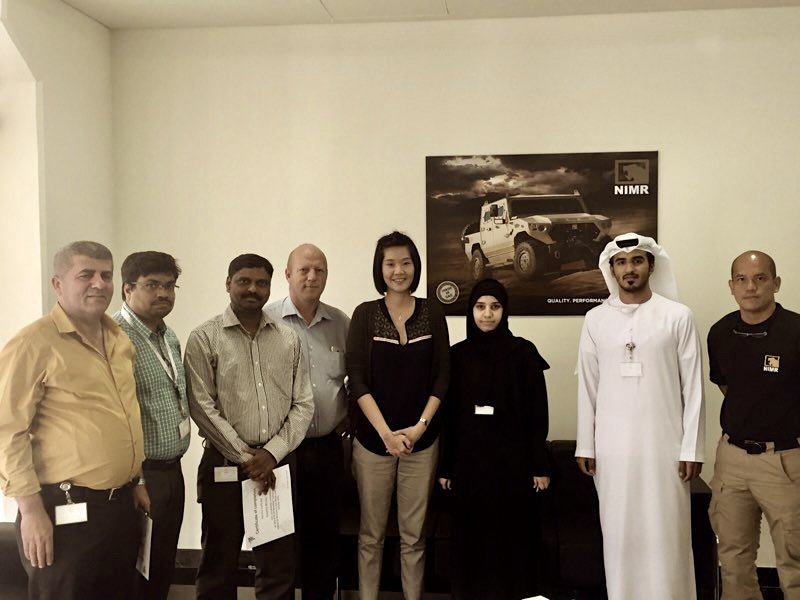
Solution: A bespoke, three-day on-site ASD-STE100 training programme delivered by Shufrans TechDocs to key personnel including Customer Support Officers, Field Engineers, Technical Writers, and Documentation Experts.

Results: Significant uplift in documentation precision, improved efficiency in field and customer support interactions, enhanced cross-functional communication, optimised translation processes, and accelerated professional development, directly contributing to NIMR’s mission of delivering mission-ready solutions.


The Challenge: Uncompromising Clarity in Defence Communications

NIMR, a leading manufacturer of wheeled military vehicles and a pivotal subsidiary within the UAE’s advanced technology and defence group, EDGE, operates in an environment where clarity is not merely beneficial—it is critical. The precision of technical documentation directly impacts the operational readiness, safety, and effectiveness of defence assets in demanding environments.

NIMR faced the challenge of ensuring that all its technical and support communications, from maintenance manuals to field service reports and customer interactions, adhered to an uncompromising standard of clarity and consistency. This was particularly complex given the diverse roles involved in creating and delivering this information, and the crucial requirement to translate documents accurately between English and Arabic for various customers and end-users:

  • Customer Support Officers: Needing to convey precise solutions and guidance efficiently to end-users, often in both English and Arabic.
  • Field Engineers & Technicians: Requiring unambiguous instructions for maintenance, troubleshooting, and on-site support of complex military vehicles, with the knowledge that these would be translated.
  • Technical Writers & Documentation Experts (from various backgrounds): Tasked with authoring and managing a vast array of critical technical content, with a direct impact on the quality of subsequent translations.

Any ambiguity could lead to misinterpretations in critical operational contexts, potentially compromising safety, delaying field repairs, impacting training effectiveness, or introducing errors during the English-Arabic translation process. NIMR sought a solution that would embed a culture of precise communication directly within their operational teams, with a clear benefit to their multilingual documentation needs.


The Results: A New Standard for Operational Clarity and Multilingual Efficiency

By investing in on-site ASD-STE100 training with Shufrans TechDocs, NIMR achieved significant, measurable improvements in its technical and support communications:

  • Enhanced Operational Clarity: A unified approach to language drastically minimised ambiguities in all forms of documentation, directly improving the understanding and execution of critical procedures by both internal teams and external customers.
  • Improved Field Efficiency: Field Engineers could more effectively diagnose issues and follow maintenance protocols, reducing downtime and ensuring rapid response in operational scenarios.
  • Streamlined Customer Support: Customer Support Officers provided clearer, more concise guidance, leading to reduced resolution times and enhanced customer satisfaction.
  • Boosted Documentation Quality: Technical Writers and Documentation Experts consistently produced high-quality, compliant content, streamlining workflows and reducing rework.
  • Optimised Translation Processes: With a consistent and unambiguous English source text, the translation of documents into Arabic became faster, more accurate, and more cost-effective, ensuring seamless communication with diverse customer bases.
  • Accelerated Professional Growth: The hands-on training significantly upskilled personnel across critical roles, fostering a collective commitment to precision communication and supporting their long-term professional development within the defence sector.
  • Strengthened Communication Chain: A common language standard facilitated seamless information exchange between engineering, documentation, field support, and translation teams, underpinning NIMR’s commitment to delivering superior defence solutions globally.

NIMR’s proactive investment in on-site STE training with Shufrans TechDocs has transformed its communication landscape, reinforcing its position as a leader in defence manufacturing through unparalleled clarity, operational excellence, and enhanced multilingual capabilities. This success story underscores the vital role of targeted communication training in ensuring readiness and reliability for critical industries operating on a global scale.

If your organisation faces similar challenges in achieving uncompromising clarity and operational readiness through precise communication, especially when translation between English and Arabic is a key requirement, discover how Shufrans TechDocs can help. Learn more about our ASD-STE100 training and consulting services:

🗓️ View our training calendar.

www.shufrans.com

Your Tactical Advantage | Emirates Defence Industries Company

Your Tactical Advantage | Emirates Defence Industries Company

STE as part of your global content strategy

Simplified Technical English as part of your content strategy

EDGE is creating opportunities in autonomous capabilities, directed energy, cyber-physical systems, advanced propulsion systems, robotics and smart materials, with artificial intelligence embedded across its products and services. Transforming how we live, and ensuring a more secure future, is what we do. Our mission is to bring innovative technologies and services to market with greater speed and efficiency.

ASD-STE100 Simplified Technical English (STE) is a controlled language that is used to write technical manuals in such a way that they can be more easily understood by an international audience. To put it across plainly, STE is a form of controlled language that is guided by 53 technical writing rules that were put together by a committee of linguists, engineers, and manufacturers who established over the years that these writing rules made sense and allowed them to re-write any of their existing documentation based on these rules, making their documentation easier to understand, while maintaining accuracy, safety, and validity.

Develop, deploy, and deliver documentation with STE

STE Quick facts

Background: With the widespread dissemination of user documentation published in various delivery formats across several language translations, the relevance of global information management has become greater in an attempt to stem terminology inconsistencies, mistranslations, and the disproportionate escalation of costs associated with the maintenance, reuse, and consumption of technical content.

Year: In use since 1986

Current Version: Issue 8, May 2021.

Technical writing rules: 53

Dictionary word entries: approx. 2400 terms.

The STE specification also includes a core vocabulary of around 930 approved words and 1500 non-approved words that let technical authors write just about everything that they need for for procedural and descriptive texts. Therefore, the use of approved words, compliance with the standard, and a language quality checker tool to complement your content strategy efforts is akin to pooling your most valuable resources where people, internal processes, and innovative technologies become more aligned.


The role of technical authors and technical documentation managers

Technical writers are the go-between for subject-matter-experts (SMEs), engineers, designers and the end-users of documentation. Consequently, the responsibility of creating effective documentation falls on technical authors who will then endeavour to send out a clear, unambiguous, and user-friendly message about their products and line of services.

At the level of global information management, technical writing professionals should consider short-term tactics and longer-term strategies to overcome the following:

  • An ever-increasing volume of words to write and translate
  • Snowballing translation and documentation management costs
  • Overlapping information across different versions of similar document types
  • Low comprehension levels for the English language jargon.

STE in practice

If this is your first time hearing about STE, the example that follows will hopefully shed more light on the principles and best practices that govern good STE writing. Here is an original piece of text presented in standard English writing:

THE SYNTHETIC LUBRICATING OIL USED IN THIS ENGINE CONTAINS ADDITIVES WHICH, IF ALLOWED TO COME INTO CONTACT WITH THE SKIN FOR PROLONGED PERIODS, CAN BE TOXIC THROUGH ABSORPTION.

And here it is again in STE:

THE OIL IS POISONOUS. DO NOT GET THE ENGINE OIL ON YOUR SKIN.  IT CAN GO THROUGH YOUR SKIN AND INTO YOUR BODY.

Making the comparison between the two types of writing above, you will see that the original writing is rather cumbersome in expression. It is also very likely that the person reading this sentence will have difficulties following the writer’s line of thought because of the longer sentence length and unnecessary information included. In contrast, the text written in STE is much more to the point and simply distils what is pertinent to the person doing this work:

  1. The oil is poisonous.
  2. I must always be careful not to touch oil without protection.

From this example, STE shows us that warnings and cautions must always start with a simple and clear command that is usually substantiated by a reasoning that comes before or after.  A command informs the user about the precautionary measures to take to avoid danger. Presenting information as if it were a general comment in the original writing obscures the importance of the message and is not specific enough.


What customers are saying.. | NIMR Automotive

Thuraya Al Mehrzi, Production Engineer, NIMR Automotive
“Shumin gave a good introduction to Simplified Technical English. Instead of writing long sentences that are difficult to read, I prefer the STE rule of presenting long sentences in a list that makes it much easier to understand the work that is required to be completed. The STE exercises were pretty engaging, and this is particularly so for day 2 of the rewriting workshop that gave the team a lot of insight into our documentation. Trainees also had the opportunity to replace many unapproved standard English words with STE ones that helped us better appreciate the application of STE rules in a real-world context. This is a training that I have rated 10/10 for.”

Nour Bazuhair, Engineer Trainee, NIMR Automotive “The introduction to Simplified Technical English (STE) was simple to follow and understand. Rule 1.4 to use only the approved forms of verbs and adjectives from the STE dictionary is something that I appreciate very much. Applying the rules faithfully was a challenging albeit enjoyable process. There is a lot of good writing rules to learn here. I’ve found the exercises to be very useful for learning reinforcement, and they have helped me to apply STE rules in a more efficient manner and I’ve gained a much better understanding of STE as a result. Shumin’s training methodology is easy to follow, and she offers us great technical writing advice and has simplified the process for us. Every aspect of this training is a 10/10 for me.”

Abdel Alazeem Arafah, Service Coordinator, NIMR Automotive “This was a great course with very useful and practical knowledge for my work. Simplified Technical English (STE) encourages users to always refer to the approved list of verbs and nouns in the STE dictionary before writing their technical documentation. The active voice is also a very useful and powerful tool in sending loud and clear instructions to our users. Starting a warning or caution with a simple and clear command is also very crucial in my line of work. Shumin’s delivery of the training is highly organised, and she has been most patient with our comments, questions, and feedback the whole time.”

An innovative approach to consider for your global documentation landscape

Over the last three decades, STE has emerged as a rather important and universal standard for technical English. Predictably, as a result of language standardisation, STE helps us to achieve a number of benefits. Technical writers become more consistent on a word level. This starts with the simple fact that we are going to use the same word whenever we refer to the same thing, so that means an improved level of consistency and consequently quality improvements.

Where can I learn more about STE?

Shufrans TechDocs regularly hosts online training workshops for technical writers, SMEs, and engineers at different time zones for your convenience. To learn more about our diverse course offerings and workshop customisations that we can do for you and your global technical documentation team, speak to us today!