
content strategy Archives | Page 2 of 2 | Shufrans TechDocs Home // content strategy Archives | Page 2 of 2 | Shufrans TechDocs

Dozuki Workshop Series – Optimize your technical content (Part 3 of 3)

Dozuki Workshop Series – Optimize your technical content (Part 3 of 3)

Read Part 1 & 2 of our blog series here:

Dozuki Workshop Series – Optimize your technical content (Part 1 of 3)

Dozuki Workshop Series – Optimize your technical content (Part 2 of 3)

In this final installment of our three-part text analysis, we highlight areas for improvement, then provide the same information based on Simplified Technical English (STE) writing rules.

RULE: 5.1 Keep procedural sentences as short as possible (20 words maximum).

RULE: 9.2 When you combine words to make a phrase, make sure that each word continues to obey the meanings given to them in the Dictionary.

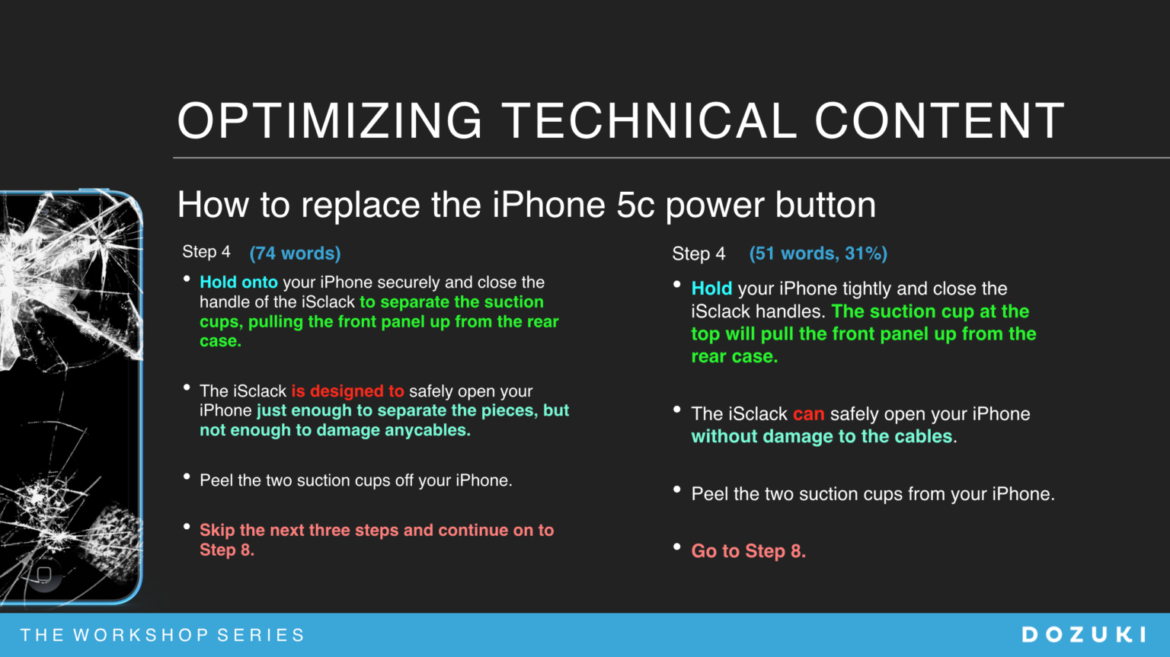
1a) Standard English:

Hold onto your iPhone securely and close the handle of the iSclack to separate the suction cups, pulling the front panel up from the rear case.

1b) STE:

Hold your iPhone tightly and close the iSclack handles. The suction cup at the top will pull the front panel up from the rear case.

Analysis:

In this rewrite, it is not necessary to create a phrasal verb such as ‘hold onto‘ to add emphasis to the verb ‘hold‘. Also, the objective of this step is to remove the front panel from the rear case. For this reason, we rephrased the sentence to clearly show which components need to be removed, using which tools. It is also recommended to write short, simple to understand sentences in procedural-type instructions.


RULE: 1.17  Make your instructions as specific as possible.

2a) Standard English:

The iSclack is designed to safely open your iPhone just enough to separate the pieces, but not enough to damage any cables.

2b) STE:

The iSclack can safely open your iPhone without damage to the cables.

Analysis:

In this rewrite, we reduced the number of words from 21 to 12. The Standard English sentence above seems  rather excessive in trying to explain the use of the iSclack, when it is sufficient to say that the iSclack tool is safe to use, without going into unnecessary details, such as design.


RULE: 1.1 Only use approved words in the dictionary

3a) Standard English:

Skip the next three steps and continue on to Step 8.

3b) STE:

Go to Step 8.

Analysis:

‘Skip’ is an unapproved word in STE, and not quite useful in this context. Simply tell your reader which steps they need to complete next.


Missed this session? The on-demand presentation is now available below.


Shumin Chen

About the speaker

Since 2006, Ms Shumin Chen has been working as a consultant with customers in various industries worldwide: aerospace and defence, banking, consumer products, healthcare, IT, medical and fitness equipment. She has helped many companies with their documentation needs, based on standards where possible, and is widely regarded as a leading expert in ASD-STE100 Simplified Technical English training, aviation documentation and multilingual documentation.

Ms Chen now heads the ASD-STE100 training arm of Shufrans TechDocs. In her current role, Ms Chen continues to focus on the practical implementation of international standards to facilitate the efficient creation and management of multilingual documentation.

Copyright © 2016 Shufrans TechDocs. All rights reserved. No part of this article may be reproduced or transmitted in any form or by any means whatsoever without express written permission from the author, except in the case of brief quotations embodied in critical articles and reviews. 
Ready to learn more?

Make STE your strategic partner today!

STE training & consultancy
Simplified Technical English at the core of your documentation strategy

Simplified Technical English at the core of your documentation strategy

Why Simplified Technical English (STE)?

Whether you are looking to implement working standards such as DITA, S1000D, ATA iSpec 2200, RailDex, or ShipDex to standardise your information structure and facilitate content re-use, it is important to give due consideration to the quality of your source text when creating your technical content. Ambiguous or inconsistently worded documentation can result in non-compliant data deliveries, poor customer support, potential legal liabilities, equipment damage, as well as safety risks.

A well-written source text ensures the ease of downstream content management processes such as translations

Improved readability for your technical content

STE prescribes the use of grammar rules that are relatively more restrictive than the standard rules of the English language.

The general vocabulary has only 900 approved words while explicitly listing 1500 other non-approved words with alternative suggestions.

By introducing these grammar and vocabulary restrictions, technical authors can avoid writing overly long sentences and leave out unnecessary technical details where applicable, all of which are obstacles to the ease of readability and sound understanding.

Recommended by global documentation standards

Military defence standards (MIL-SPEC / MIL-STD) such as MIL-STD-3048, as well as technical documentation standards like S1000D and ATA iSpec 2200 recommend the use of ASD-STE100.

Although the S1000D standard was originally intended for the aerospace and defence industry, this widely successful specification has been customised for the shipping and train manufacturing and operations communities giving rise to both ShipDex and RailDex. Likewise, sound and consistent STE writing rules are highly applicable and practical for use across industries.

Simplifying or eliminating the need for translations?

STE is an international aerospace standard that helps to make technical documentation easy to understand. However, the benefits of STE have proven very highly applicable to all industries. That is why 60% of STE users today come from industries outside of aerospace & defence.

Understandably, STE was designed with non-native speakers of the English language in mind. By providing technical writers with a common set of standardised writing rules and general vocabulary, STE enables teams of writers to write technical manuals that are consistently accurate and require less proofreading and editing effort. Consequently, this does away with the need for translations altogether.

Besides the aerospace maintenance industry however, product exports are still subjected to much scrutiny in terms of their paperwork, documentation and associated product translations. Therefore, the use of STE to create technical content can support downstream translation processes in several ways:

  • A 900-word general vocabulary dictionary eliminates the need for other non-approved, and possibly uncommon synonyms. This reduces the likelihood of term-related clarifications and queries from translators, resulting in faster translation processes.
  • Enforcing STE rules strictly guarantees a high level of consistency at word-, phrase-, and sentence-levels.  This allows project managers to leverage on existing translation memories to substantially reduce translation costs.
  • With fewer technical terms to translate and a more uniform translation memory, translators can provide cheaper, faster and better translations thanks to STE.
  • Having STE content in place will result in exceptional translation quality with machine translations as well.


In a nutshell

For many years now, the use of STE as a controlled language authoring strategy has successfully taken off not just at large organisations, but also in small and medium enterprises.

With professional Simplified Technical English training that costs only a fraction of supposed “full implementation”, and yet achieves 75% – 85% of the benefits and results of an approach that includes checker software, getting started with STE is no longer the major and expensive investment it used to be.

Training technical writers and engineers to write in STE within two to three days may sound like a simple and straightforward undertaking. However, to change the way your technical authoring team works does require some managerial direction while the team transits to STE. Trained technical writers will experience on a more regular basis, the many benefits that STE as a controlled language writing strategy offers.


Shumin Chen

About the author

Since 2006, Ms Shumin Chen has been working as a consultant with customers in various industries worldwide: aerospace and defence, banking, consumer products, healthcare, IT, medical and fitness equipment. She has helped many companies with their documentation needs, based on standards where possible, and is widely regarded as a leading expert in ASD-STE100 Simplified Technical English training, aviation documentation and multilingual documentation.

Ms Chen now heads the ASD-STE100 training arm of Shufrans TechDocs. In her current role, Ms Chen continues to focus on the practical implementation of international standards to facilitate the efficient creation and management of multilingual documentation.

Copyright © 2015 Shufrans TechDocs. All rights reserved. No part of this article may be reproduced or transmitted in any form or by any means whatsoever without express written permission from the author, except in the case of brief quotations embodied in critical articles and reviews. 

Are you ready to make STE your strategic partner?

Attend a 2-day certified ASD-STE100 workshop at any of our worldwide locations